


WHY USE DUMBBELLS FOR UPPER BODY?
And that’s exactly why muscle imbalances and achy shoulder joints keep showing up.
If you’ve been grinding away at upper-body workouts using only barbell exercises, and you’re still not seeing results, something’s off.
Most of the time, the equipment or exercise choice is doing more work than your muscles. That is where switching it up to dumbbells can help.
A smart upper body dumbbell workout instantly exposes weak links, forces the stabilizers to engage, and eliminates the muscle imbalances that barbells and machines tend to hide.
Today, I’m going to give you a full guide to upper-body strength training, focusing on proven compound moves.
And the only things you’ll need? An adjustable bench and a dumbbell set.
Here’s what I’ll be covering in this complete guide to upper body dumbbell workouts:
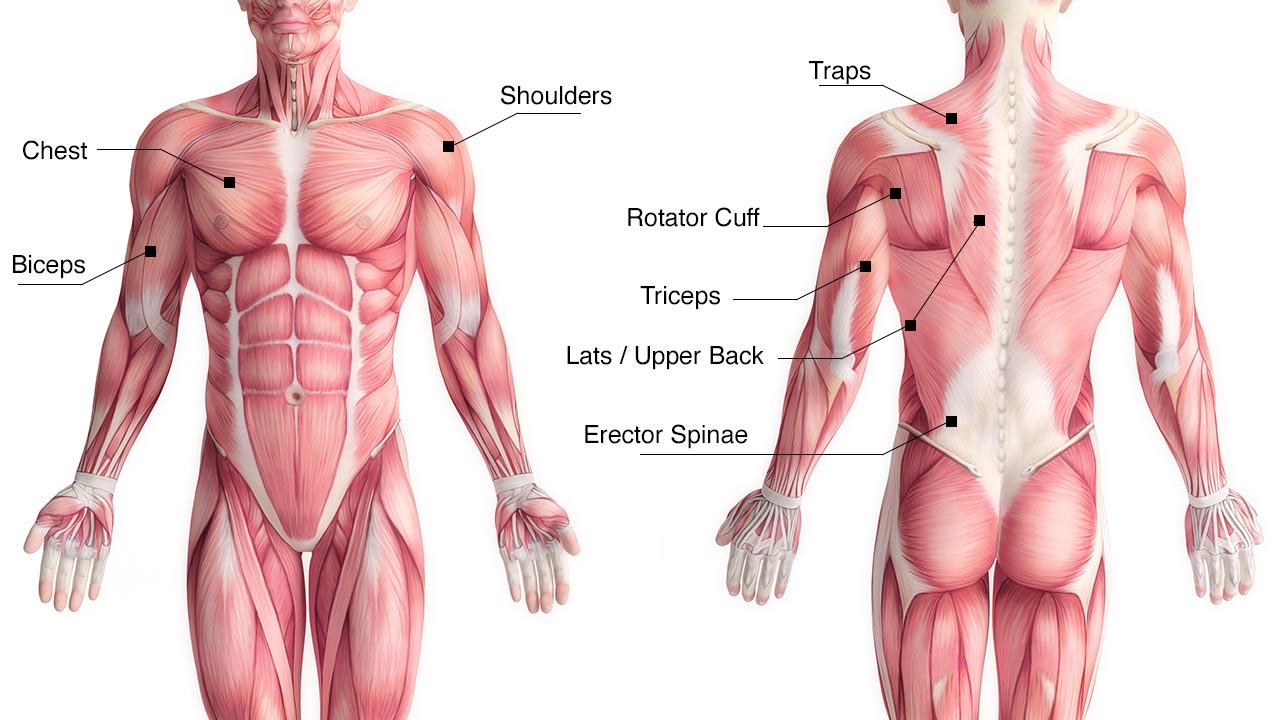
1. UPPER BODY DUMBBELL WORKOUT: MUSCLES WORKED
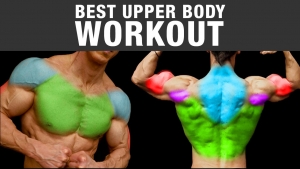
This upper body dumbbell workout focuses on the major muscle groups responsible for real strength and visible development.
Because dumbbells move through a free path instead of a fixed bar track, you’re able to train through a fuller range of motion and build a stronger mind-to-muscle connection with every rep.
The result is better muscle activation, fewer strength imbalances, and more productive work for each side of the body.
BACK MUSCLES
When most people think of the back, they imagine one big muscle.
In reality, the upper body relies on five major players here: the lats, upper and lower traps, erector spinae, rotator cuff, and teres major.
Each back muscle has a different role in pulling strength, posture, and shoulder control, so they all need focused attention in your training.
LATISSIMUS DORSI
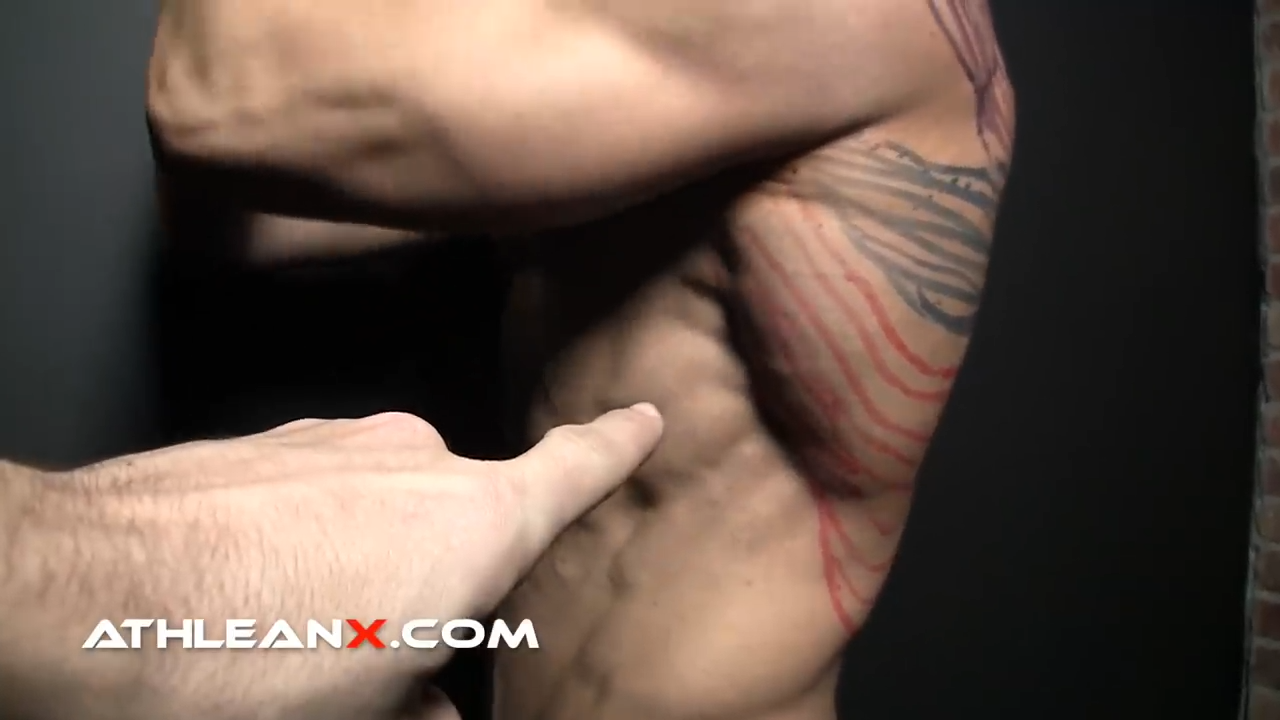
The latissimus dorsi sits along the outer sides of your upper back and attaches near the upper arm.
Its main job is shoulder extension, adduction, and pulling the arm behind the body.
In upper body workouts, this muscle drives every major pulling pattern, especially during exercises like the Bent-Over Row and Renegade Row.
Strong lats improve upper-body strength and help stabilize the shoulder during pressing movements like the Bench Press and Overhead Press.
UPPER AND LOWER TRAPEZIUS MUSCLES
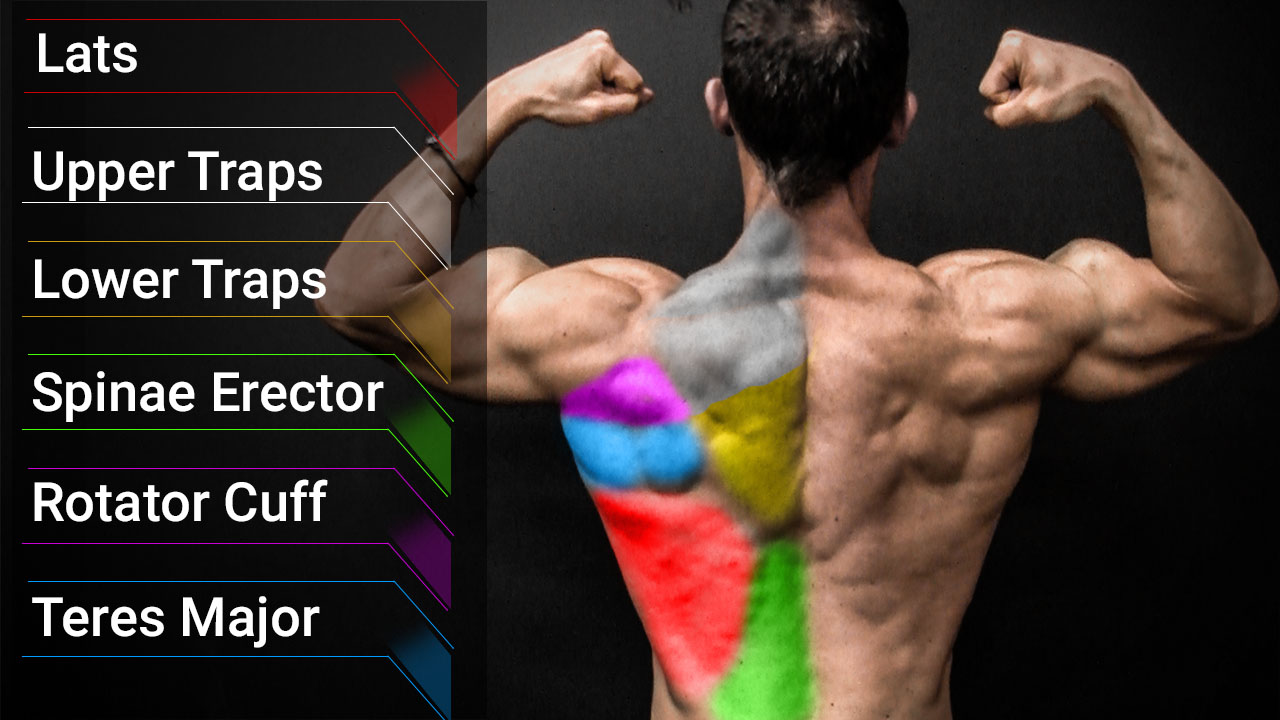
The upper trapezius runs along the top of the shoulders and neck, helping elevate and rotate the shoulder blade.
The lower traps sit between the shoulder blades and spine and are responsible for depressing and stabilizing the scapula.
During a dumbbell workout, these trap muscles keep the shoulder blades in the right position for cleaner pulling mechanics and healthier shoulder joints, especially when fatigue rises during heavy free weights or compound moves.
LOW BACK / ERECTOR SPINAE
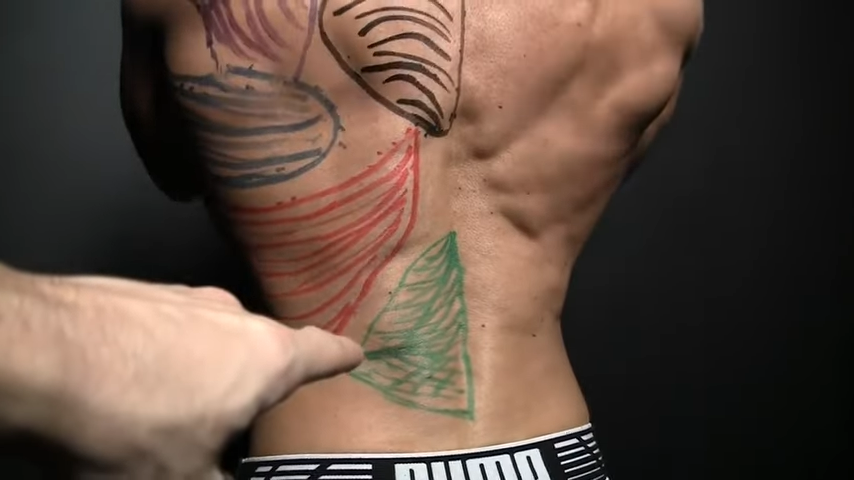
These long muscles run vertically along the spine and form part of the posterior chain.
They maintain posture during standing exercises and prevent the torso from collapsing during heavier rows or hinge-based movements.
Building the erectors with controlled tempo improves spinal stability, transfers force better through the upper body and reduces injury risk during higher training volume phases.
ROTATOR CUFF
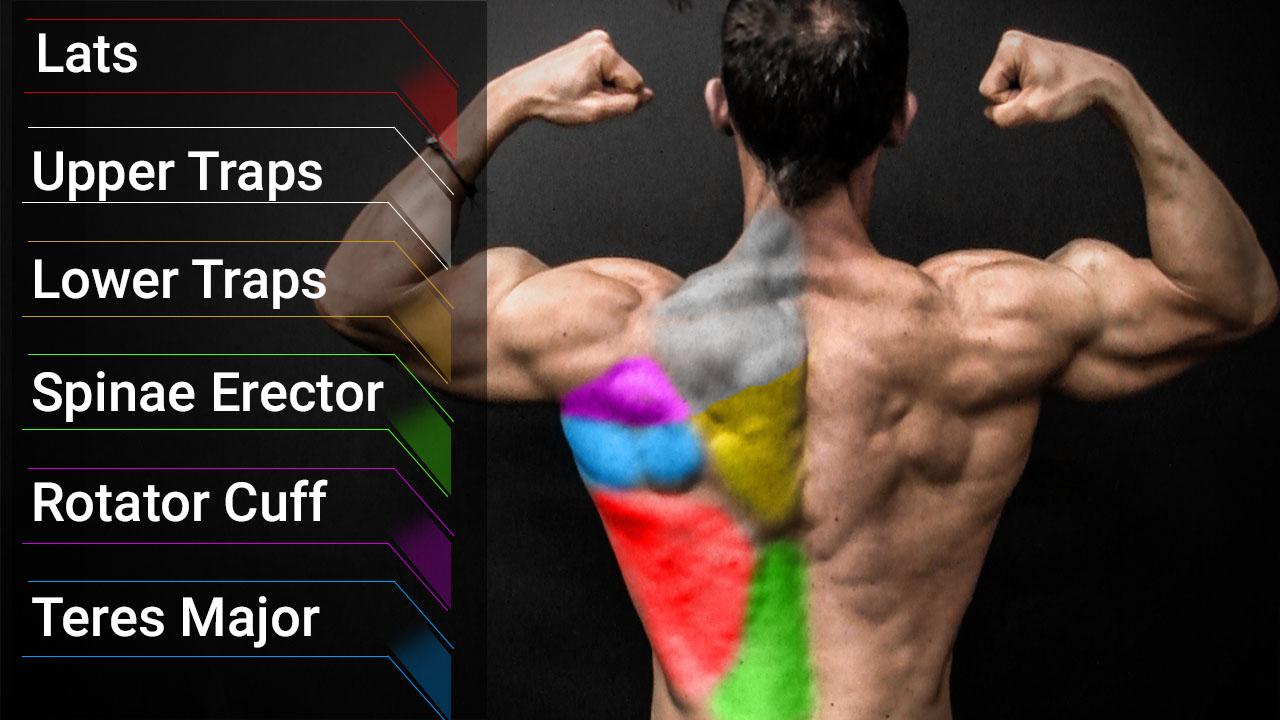
The rotator cuff consists of four small stabilizer muscles deep in the shoulder joint (supraspinatus, infraspinatus, teres minor, subscapularis).
Their primary role is to keep the arm centered in the socket and control rotation during pulling and pressing.
Since dumbbells aren’t locked into a fixed path, they force better stabilizer recruitment and highlight strength imbalances.
TERES MAJOR
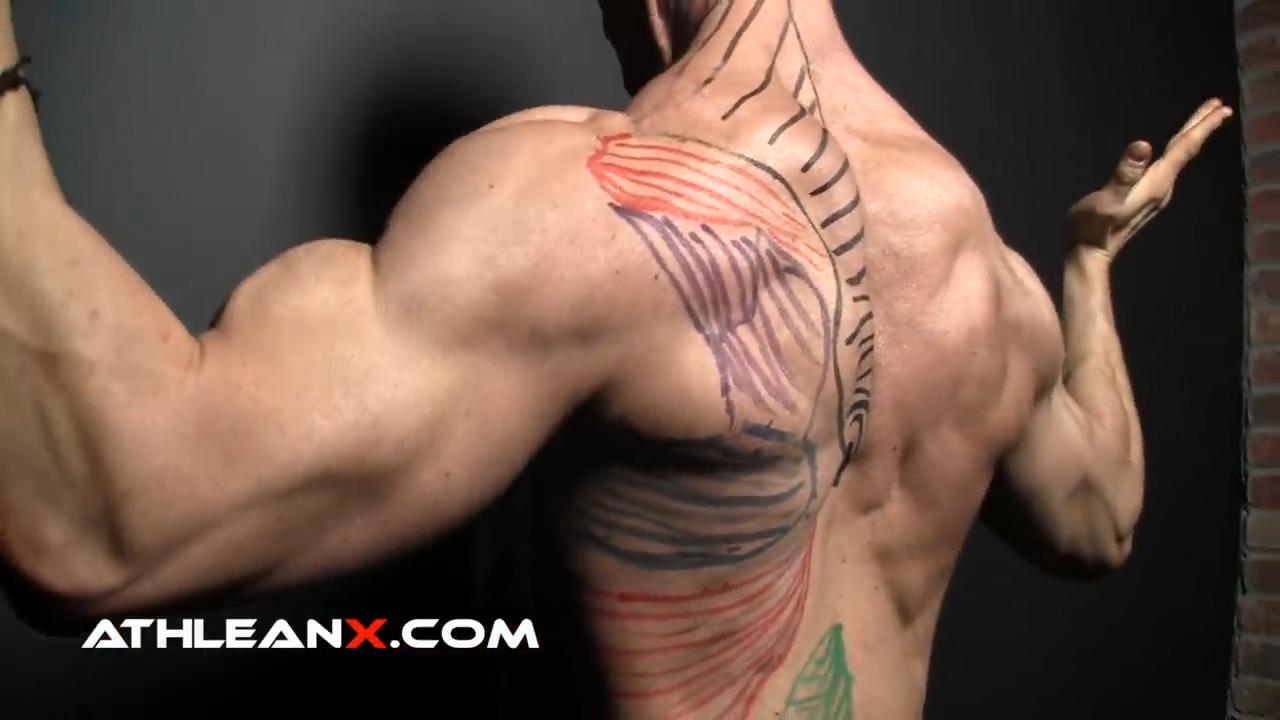
Located just below the shoulder and alongside the back of the scapula, the teres major assists the lats in extending and internally rotating the arm.
This muscle contributes to width and thickness through the back and plays a significant role during Dumbbell Rows and pulling isolation exercises.
Training the teres major with free-moving loads improves shoulder stability and increases total pulling strength without overloading the shoulder itself.
CHEST MUSCLES
The pecs aren’t just one flat slab of muscle. The pectoralis major is made up of three separate sections, each with its own fiber direction and its own job.
They attach at different points along the clavicle and sternum, which is why changing your pressing angle completely changes which area of the chest does the work.
UPPER CHEST FIBERS (CLAVICULAR HEAD)
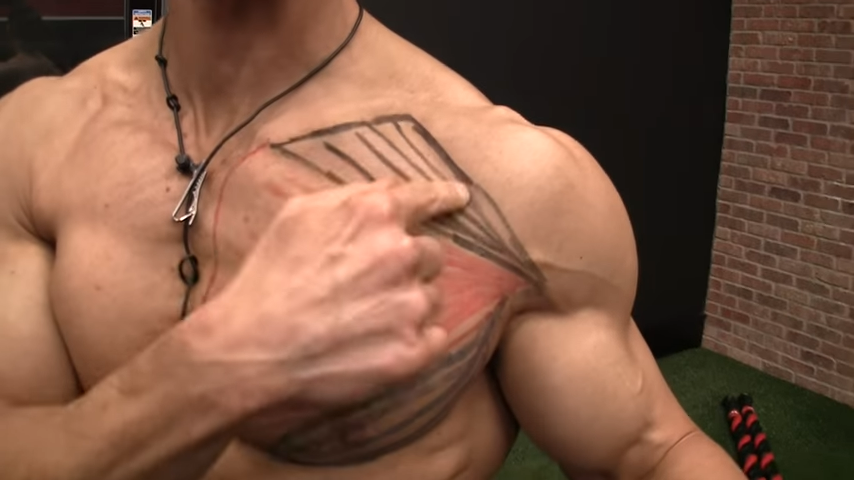
The clavicular head of the chest sits high on the upper pec just under the collarbone.
Its primary role is shoulder flexion and raising the arm upward at an angle, which is why incline pressing positions target it so well.
Strengthening the upper chest improves shoulder health and helps create a fuller, more balanced upper-body appearance, especially during movements like the Incline Chest Press or angled fly patterns.
MID CHEST FIBERS (STERNAL HEAD)

The sternal head forms the central portion of the chest and attaches along the sternum.
This is the largest section of the pec and handles most horizontal pressing strength.
Functionally, these muscle fibers move the arm across the body and help generate pressing power in everything from Pushups to Bench Press mechanics.
LOWER CHEST FIBERS (ABDOMINAL HEAD)
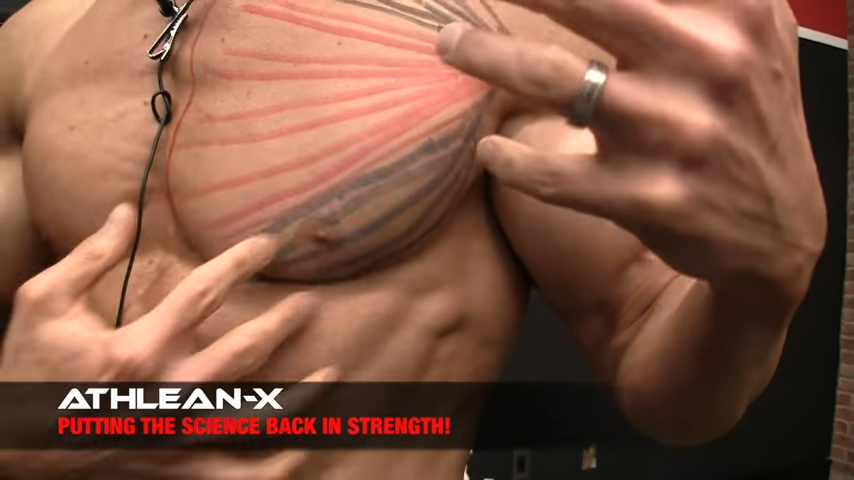
The abdominal head of the pec sits along the lower chest near the bottom of the rib cage and assists in shoulder extension and bringing the arm downward.
Decline or slightly downward pressing angles emphasize these fibers.
Developing the lower pec helps complete the shape of the chest while improving control at the bottom of pressing patterns and contributing to stronger lockout positions.
SHOULDER MUSCLES
The shoulder muscle complex is a three-part system made up of the anterior, medial, and posterior delts.
Each head has a different job and a different line of pull, which is why your overhead pressing alone will never fully develop the shoulder.
To build strength and protect the joint, each section needs to be targeted in your strength training.
ANTERIOR DELTOID
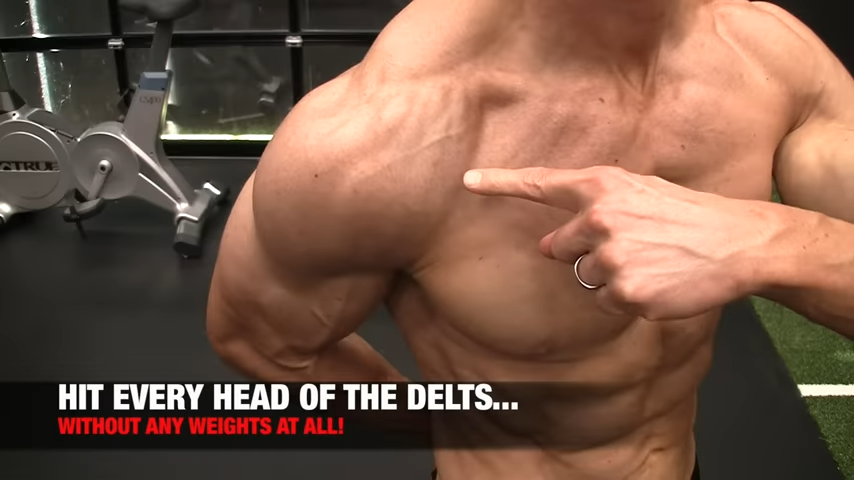
The anterior delt sits on the front of the shoulder and helps raise the arm forward.
It already gets a lot of work from most pressing exercises, so it usually doesn’t need a ton of extra volume.
Still, controlled overhead pressing will strengthen this area and support shoulder flexion without overloading the joint.
MEDIAL (LATERAL) DELTOID
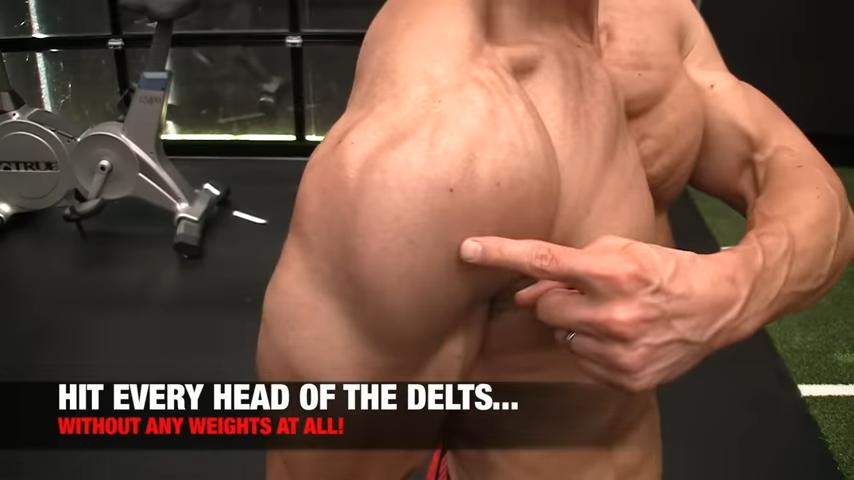
The medial delt runs along the outer side of the shoulder and is responsible for lifting the arm out to the side.
This is the muscle belly that gives the shoulder width, but it’s also the one most lifters unintentionally neglect.
Prioritizing lateral-raising patterns helps balance the shoulder and prevents the front delts from doing all the work during upper-body workouts.
POSTERIOR DELTOID
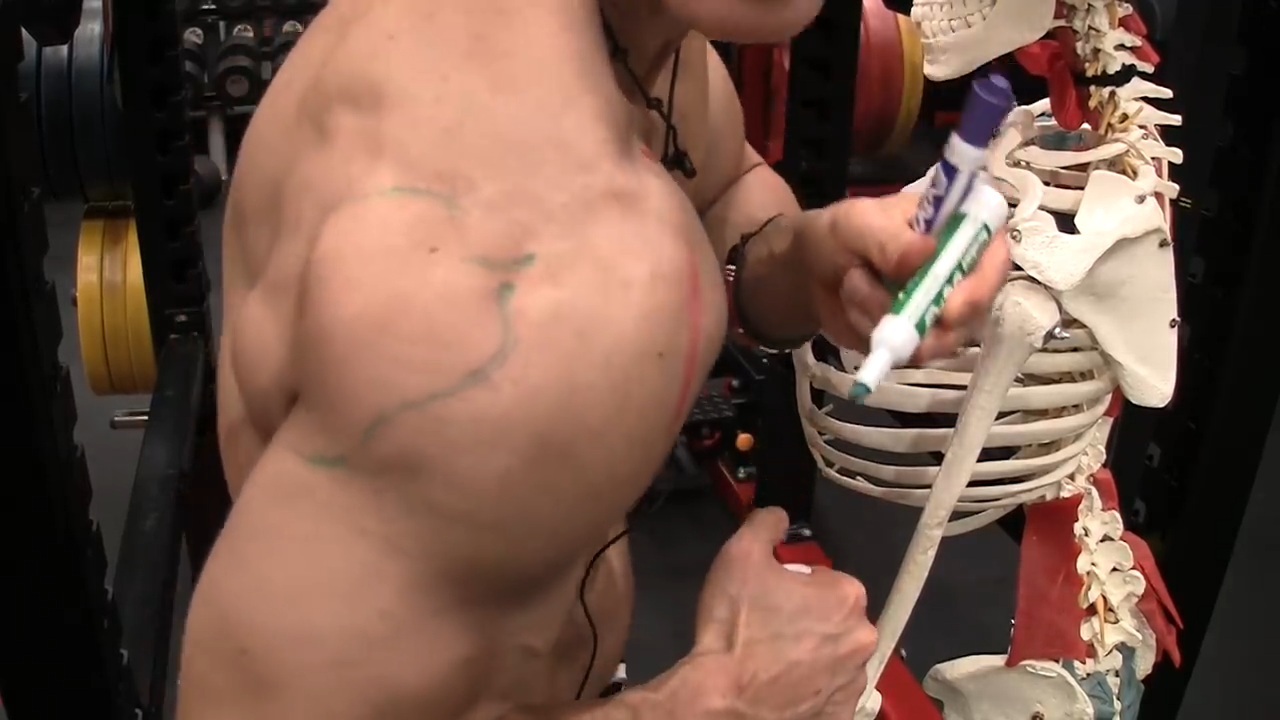
The rear delt sits on the back of the shoulder and plays a major role in pulling and external rotation.
Strengthening this area helps counter dominant pressing work, improves posture, and keeps the shoulder centered in the socket.
Movements like the Reverse Fly or Bent Over Raises also challenge the rotator cuff and deep stabilizers that keep overhead work safer long-term.
TRICEPS MUSCLES
The triceps brachii muscle is the primary extensor on the back of the upper arm, and it’s built from three separate heads: the long head, lateral head, and medial head.
Each head contributes differently to elbow extension and lockout strength, which is why the best triceps training has to hit all three sections with fixed and adjustable dumbbells.
This ensures balanced muscle growth and keeps the triceps contributing properly across all workout routines, not just isolation exercises.
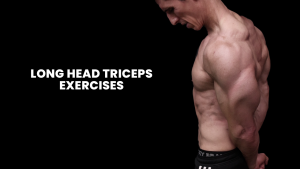
LONG HEAD
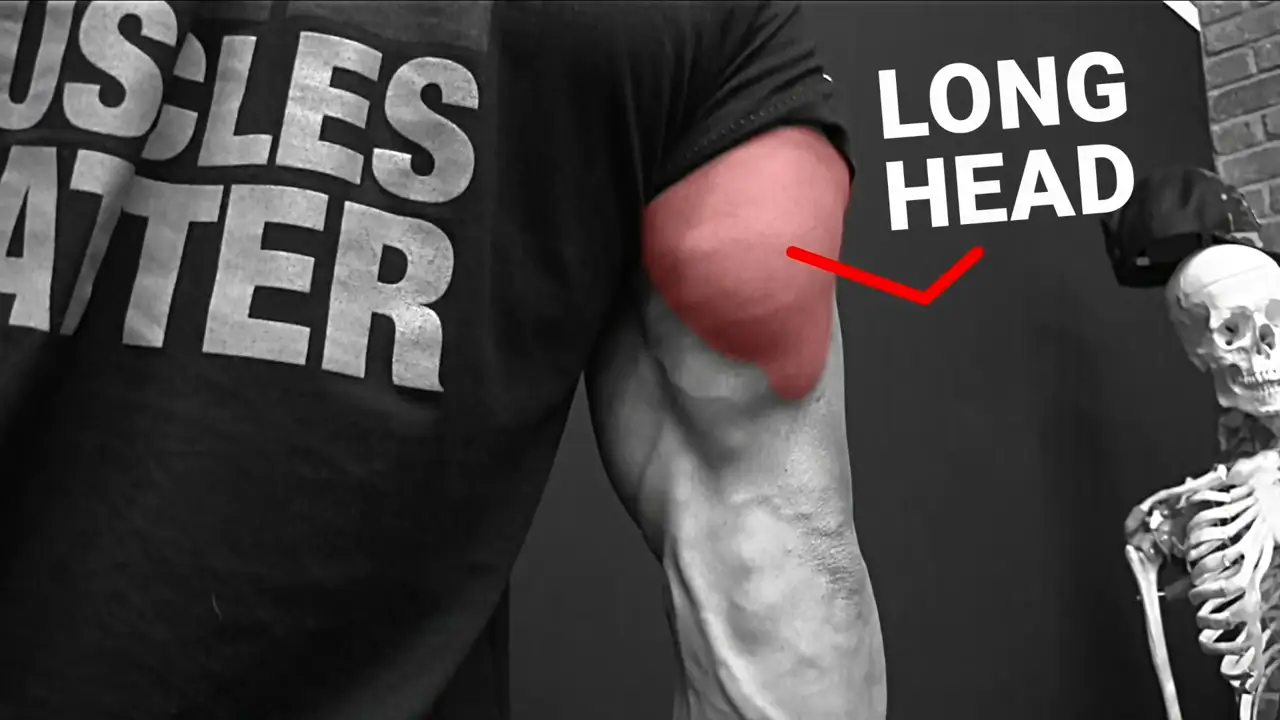
The lateral head sits on the outer side of the upper arm and contributes to the hard “horseshoe” shape associated with strong triceps and visible muscle definition.
It plays a major role in straightening the elbow and generating force during fast or powerful extensions.
Compound patterns and dumbbell arm exercises with a neutral or semi-pronated grip recruit this section well, especially with controlled lifting tempo and steady progressive overload.
Strengthening the lateral head is essential for building real pressing power and visible muscle mass over time.
MEDIAL HEAD
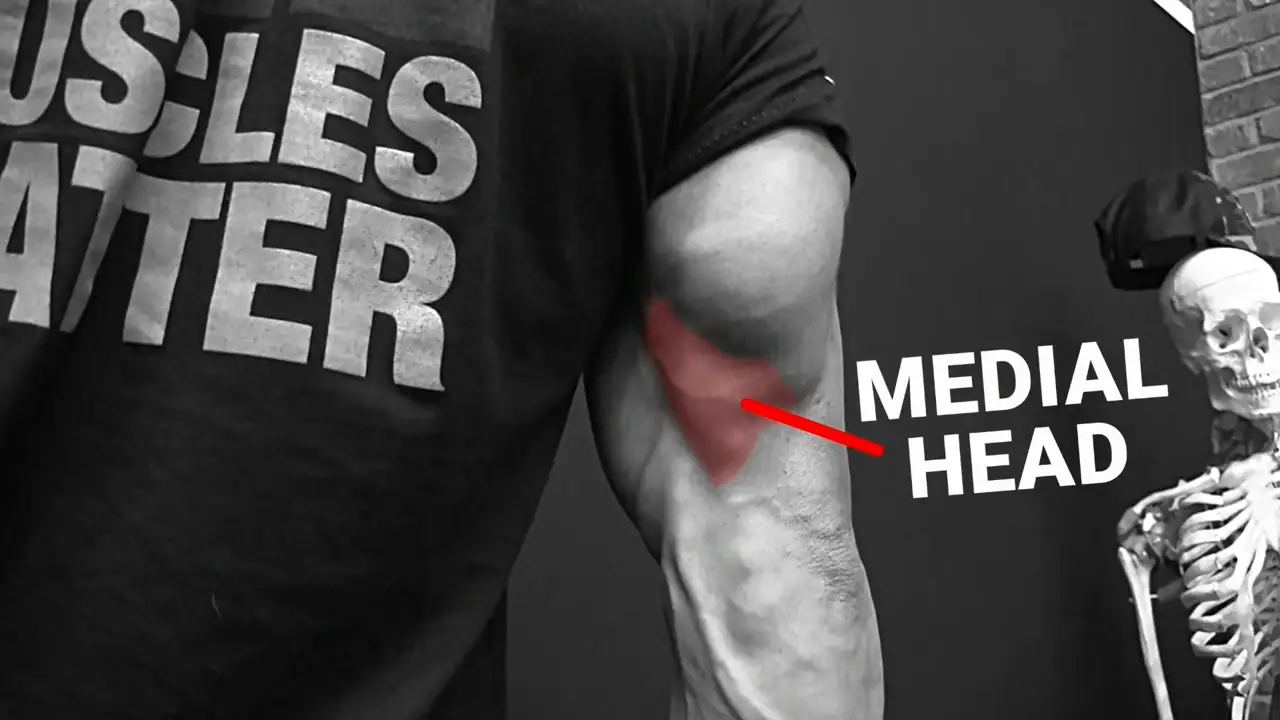
Located deep underneath the lateral and long heads, the medial head assists in elbow extension throughout the entire range of motion.
It’s working on every rep, especially at the bottom half of the movement, whether you’re performing Dumbbell Curls, Fly to Close Grip Presses, or even kettlebell arm exercises.
Because this head is active during all forms of elbow extension, consistency, and controlled form matter more than chasing more weight.
BICEPS MUSCLES
The biceps brachii has two distinct heads (the long head and the short head) and each contributes differently to overall arm strength and appearance.
Just underneath the biceps sits the brachialis. It’s technically a separate muscle, but it plays a major role in pushing the upper arm outward and giving the biceps more width.
If your goal is fuller, rounder arms, you’ll want to train all three areas, not just curl in one direction.
SHORT HEAD (INNER BICEPS)
The short head sits on the inner side of the upper arm and contributes most to elbow flexion when your arm is positioned outward or slightly supinated during Bicep Curls.
Because it attaches closer to the front of the shoulder, the short head plays a supportive role in shoulder flexion as well.
Proper supination and controlled tempo help maximize activation here, especially during variations like Prone Incline Curls or angled curling patterns.
LONG HEAD (OUTER BICEPS)
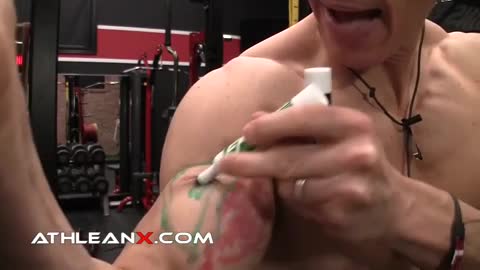
The long head runs along the outer portion of the upper arm and is responsible for the “peak” of the biceps during contraction.
It also helps stabilize the shoulder joint, particularly when the arm is positioned behind the torso or during faster pulling patterns in total-body workouts.
Training the long head with slightly extended shoulder positions creates more tension and contributes to long-term muscle building and arm width from the side.
BRACHIALIS
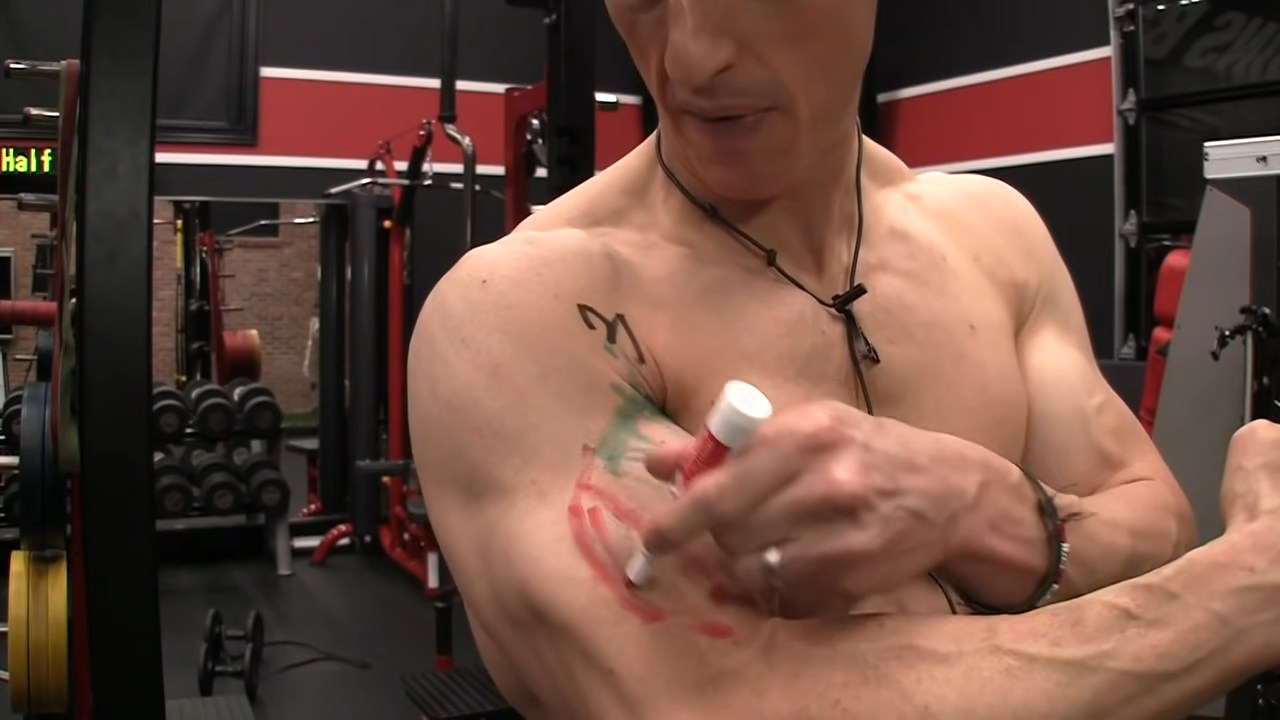
The brachialis sits underneath the biceps brachii and attaches to the ulna instead of the radius.
Its main function is elbow flexion, but because it lies beneath the biceps, developing this muscle pushes the whole upper arm outward, making the biceps look noticeably larger from the front.
Curl variations that reduce shoulder involvement and emphasize pure elbow flexion like hammer-style patterns or controlled standing curl variations tend to shift more load onto the brachialis.
FOREARM MUSCLES
The forearms aren’t just “grip.” They’re a group of muscles responsible for key movements like ulnar and radial deviation, wrist flexion, finger flexion, and pronation.
Understanding these functions helps you see why forearm training goes way beyond simply holding a weight and why stronger forearms carry over into almost every upper-body movement you do.
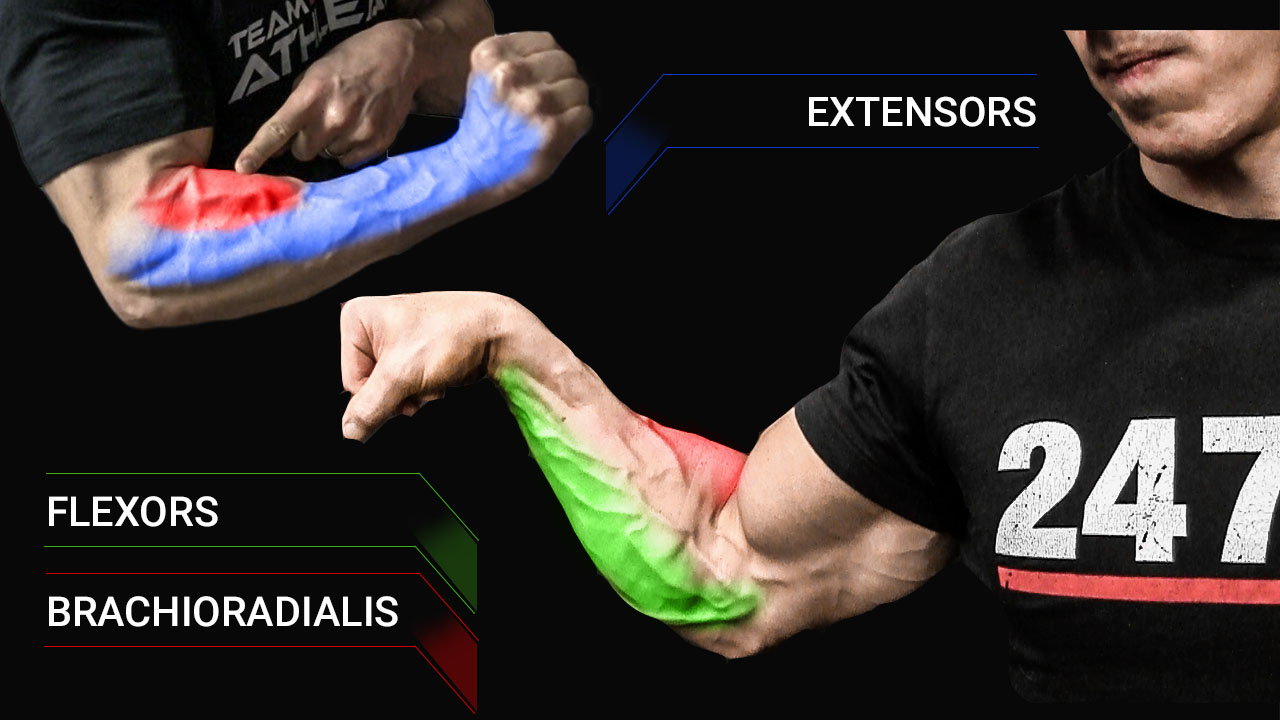
FLEXORS
The flexors run along the palm side of the forearm and are responsible for closing the hand, flexing the wrist, and gripping objects.
Any movement that forces you to hold onto dumbbells, especially under fatigue, will train these muscles.
Strong flexors support elbow stability and make your pulling and curling strength show up where it matters.
EXTENSORS
Located along the back of the forearm, the extensors straighten the fingers and extend the wrist.
They’re often the limiting factor in grip-heavy training because they have to counter the stronger flexor group on the opposite side.
Strengthening the extensors improves overall forearm balance and keeps the wrist from collapsing on heavy curls or rows.
BRACHIORADIALIS
The brachioradialis sits along the top of the forearm near the thumb side and acts as both an elbow flexor and a stabilizer.
It’s heavily involved in neutral-grip and hammer-style movements, and it’s one of the reasons those exercises add so much thickness to the upper forearm.
Strengthening the brachioradialis also reduces the strain that often shows up in the biceps tendon during heavy curling work.
CORE MUSCLES
The core is a group of muscles that wrap around the front, sides, and deep layers of the torso.
Each plays a different role in stabilizing the spine, controlling movement, and transferring force between the upper and lower body.
To train the core the right way, we need to understand what each of these muscles actually does, not just perform endless Sit-Ups.
RECTUS ABDOMINIS
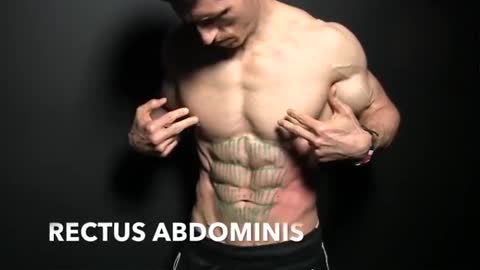
The rectus abdominis runs vertically along the front of the abdomen and attaches from the ribs down to the pelvis.
Its main job is spinal flexion, meaning it helps bring the rib cage toward the pelvis, but more importantly, it controls anti-extension during heavy upper-body movements.
When trained correctly, it creates strong core engagement that stabilizes the torso during pressing and rowing patterns where the spine wants to extend under load.
EXTERNAL OBLIQUES
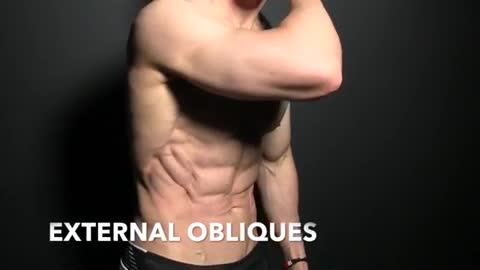
Located on the outer sides of the torso, the external obliques assist in trunk rotation and lateral flexion.
They also play a major role in resisting unwanted rotation, which is key during unilateral movements like carries, split stances, or rotational pressing.
Trained properly, they protect the lower back and create a stronger foundation for high-speed, athletic movements that demand better ultimate performance.
INTERNAL OBLIQUES
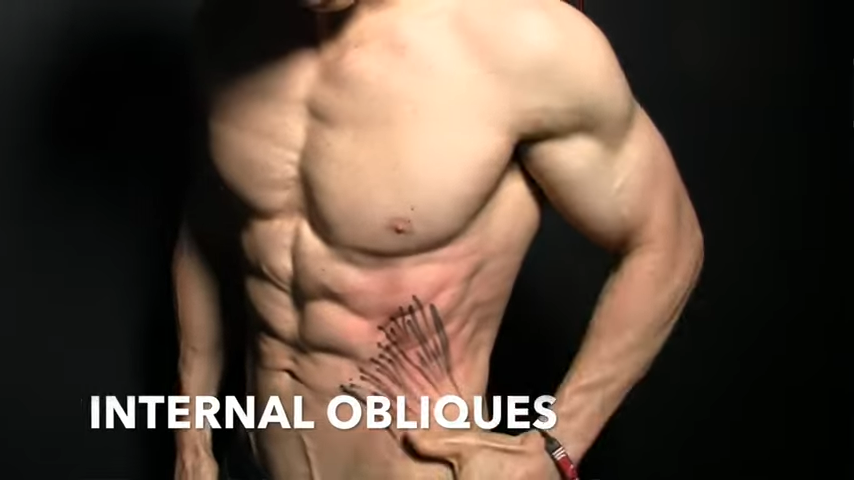
The internal obliques sit underneath the external obliques and run in the opposite fiber direction. Their primary functions include trunk rotation and spinal stabilization.
They’re especially active when resisting twisting forces, which is why any good personal trainer emphasizes anti-rotation work rather than endless crunching.
Strong internal obliques support better posture and help transfer force through the core during standing upper-body lifts.
TRANSVERSE ABDOMINIS
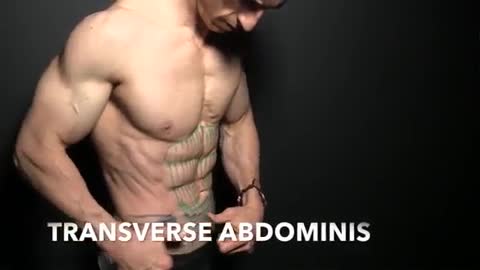
The transverse abdominis is the deepest abdominal layer and wraps around the midsection like an internal weight belt.
Its function is compressing the abdominal contents and maintaining intra-abdominal pressure.
That means it’s constantly working in any dumbbell circuit, loaded carry, or overhead pattern where the body has to resist extension.
Developing the TA is one of the most important trainer tips for long-term spine health and stronger upper-body mechanics.
SERRATUS
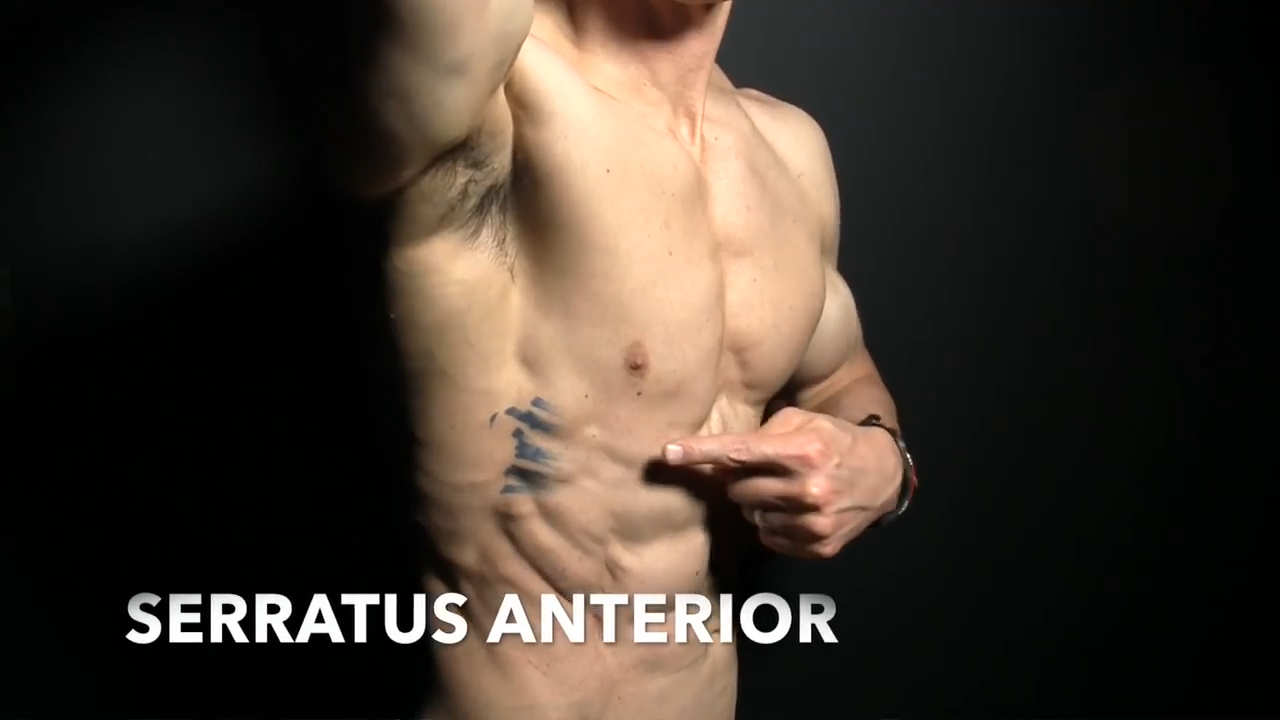
The serratus sits along the ribs under the shoulder and connects directly to the scapula.
Its primary role is scapular protraction and upward rotation, which makes it crucial for safe and efficient shoulder mechanics.
When the serratus is weak, the shoulder blades can’t move properly during overhead patterns, whether it’s pressing, reaching, or stabilizing on the floor.
Training the serratus improves shoulder stability and directly influences the quality of all core muscles and upper-body scapular movement patterns.
2. DUMBBELL BACK EXERCISES
Back training with dumbbells takes away the fixed path you get from exercise machines and forces each side to pull its own weight.
Whether you’re using adjustable dumbbells or a basic pair at home, these pulling patterns create fuller activation through the lats and upper back while exposing any weak links you might be hiding.
The goal here is not just building muscle but building strength that carries over to real movement and athletic speed and power.
Try using one or a few of these dumbbell back exercises:
CHEST SUPPORTED TOUCH ROW

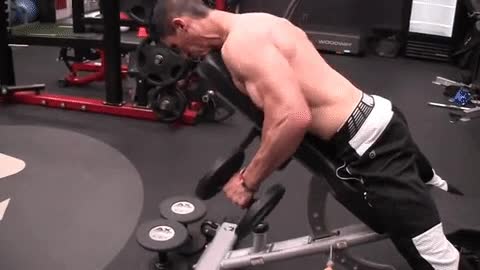
HOW TO DO THE CHEST SUPPORTED TOUCH ROW:
- Lie face down on an incline bench and grab a heavier pair of dumbbells. Keep a lighter pair standing upright on the floor just below your chest.
- Row the heavier bells up toward your hips, then let your arms stretch fully at the bottom and briefly “touch” the lighter dumbbells before initiating the next rep.
- Once the heavy load starts to fail, immediately switch to the lighter pair and continue rowing to keep tension on the lats.
WHAT MAKES IT EFFECTIVE: Supporting your chest takes strain off the lower back so you can focus on pure pulling strength without compensating. Touching the lighter bells at the bottom forces a controlled stretch, and finishing with the lighter load gives you an automatic drop set for more total fatigue without losing form. This is a smart way to drive intensity and metabolic fatigue inside back-focused workout routines.
DUMBBELL DEAD ROW
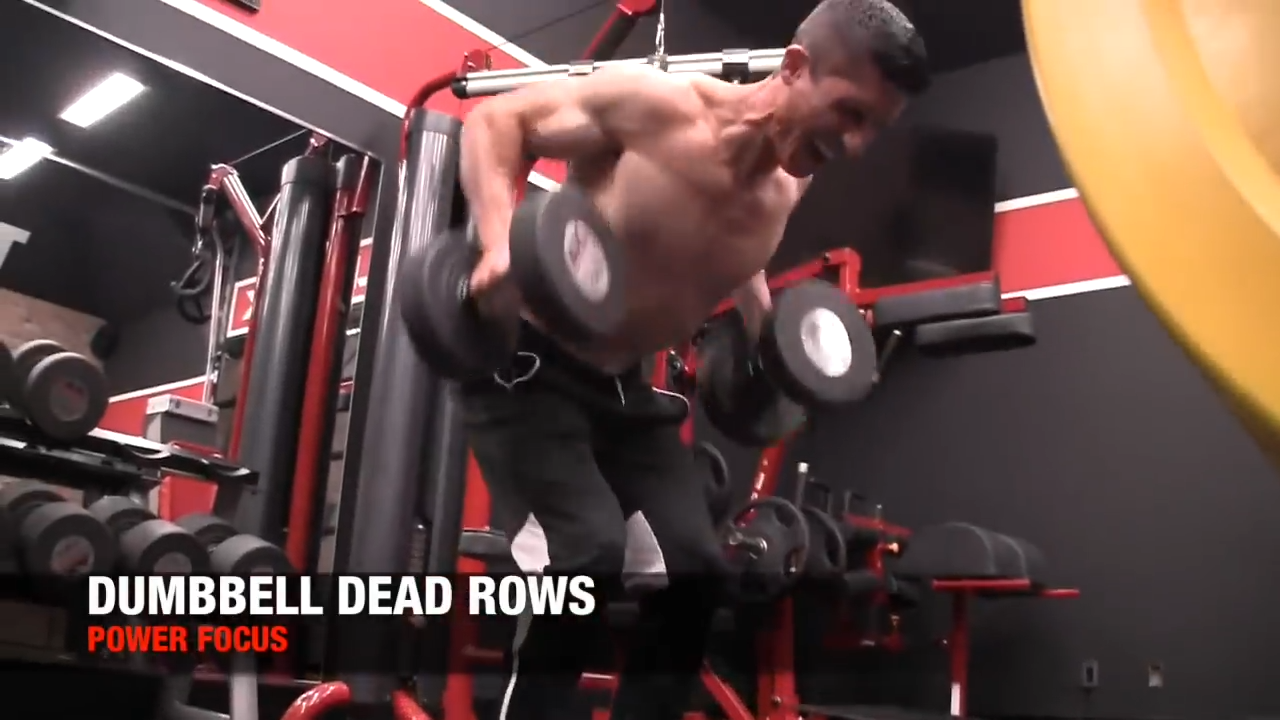
HOW TO DO THE DUMBBELL DEAD ROW:
- Stand with your feet hip-width apart and hinge forward at the hips with a slight bend in the knees.
- Place two dumbbells on the floor just outside your feet.
- Grab the weights and push hard into the ground as if you were starting a dumbbell deadlift.
- As the dumbbells reach knee level, drive your elbows back behind your body into a strong rowing motion.
- Lower under control and reset the hinge at the bottom.
- Keep your core braced and avoid turning this into a lower-back movement. The legs start the lift, but the lats finish it.
WHAT MAKES IT EFFECTIVE: This combines hip-driven power with upper-back strength, so you get the best of both a deadlift and a row in one movement. The hinge generates force from the ground up, while the row portion overloads the lats through a large range of motion. It’s a simple way to build strength and power without needing heavy barbells or machines.
WEIGHTED PULL-UP
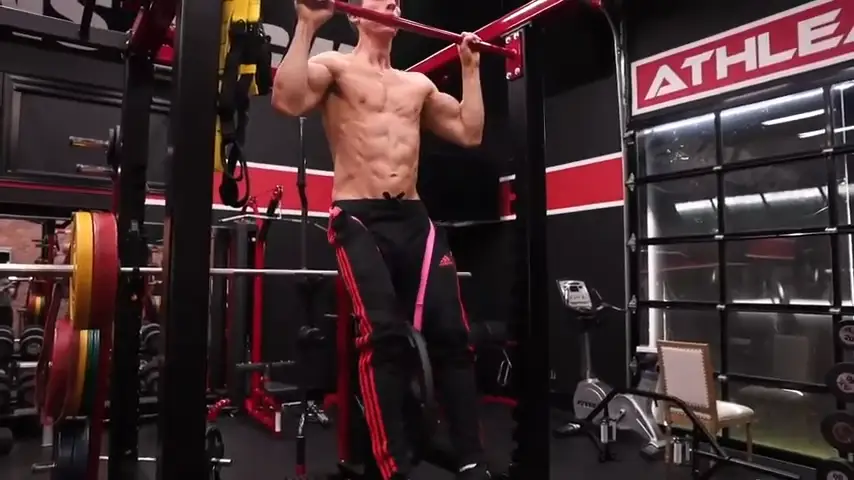
HOW TO DO THE WEIGHTED PULLUP:
- Attach a dumbbell using a dip belt or secure it between your feet if you don’t have one.
- Grab the pullup bar with an overhand grip, palms facing away.
- Hang fully extended, brace your core, and pull your chest toward the bar in a straight line until your chin clears the top.
- Lower under control and repeat without letting your body swing.
- If you don’t have a belt, stand on the dumbbell to reach the bar, then pinch it between your feet before starting the set.
- Keep the ribs down and avoid kicking or arching to finish reps.
WHAT MAKES IT EFFECTIVE: Weighted Pullups are one of the fastest ways to build pulling power. Adding load forces the lats, upper back, and arms to work harder through the full range of motion, instead of relying on momentum. It also increases time under tension and makes every rep count toward real strength.
‘W’ RAISE
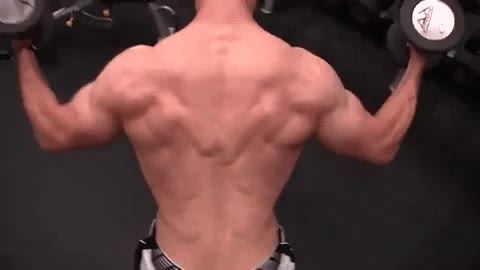
HOW TO DO THE DUMBBELL W RAISE:
- Kneel on the ground and lean forward slightly with a light pair of dumbbells.
- Lift the weights out and slightly back so your arms form a loose “W” shape, focusing on external rotation of the shoulder as you pull behind the elbows.
- Lower under control and repeat while keeping your abs and hips stable.
WHAT MAKES IT EFFECTIVE: The “W” Raise directly targets the rotator cuff and the often-neglected lower trap fibers responsible for shoulder stability. By externally rotating the shoulder instead of just lifting upward, you build control in the exact range that protects the joint during pressing and overhead work.
3. DUMBBELL CHEST EXERCISES
Dumbbells allow each arm to move through its own natural path, which means better tension on the chest fibers and less stress on the shoulders than what you often get from machines or straight bar pressing.
These dumbbell-only workout variations also let you adjust angles and wrist positions to match your structure, whether you’re chasing strength or more focused on a muscle-building workout.
DUMBBELL BENCH PRESS
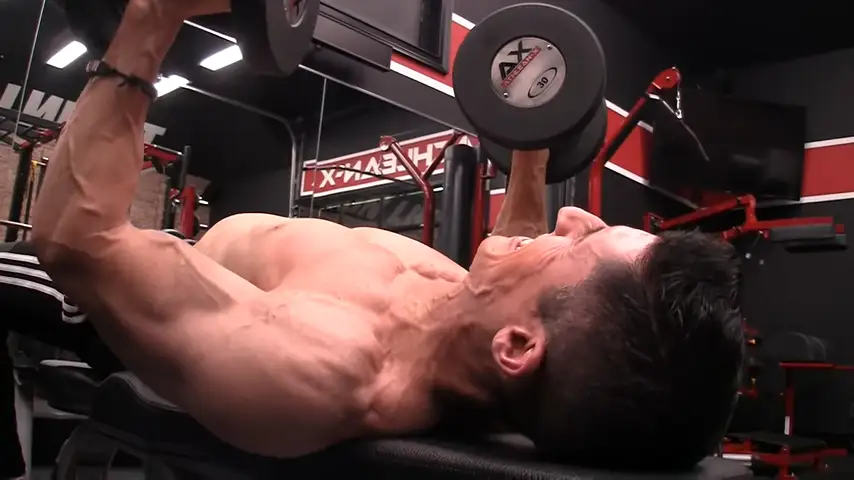
HOW TO DO THE DUMBBELL BENCH PRESS:
- Lie back on a flat bench with a dumbbell in each hand and press them up so they’re directly over your chest, not your shoulders.
- Lower the weights along a natural arc, keeping your elbows slightly tucked and your shoulder blades pinned to the bench.
- Press back up by driving through the chest, not letting the front delts take over.
- Control the descent. Don’t drop the weights into the bottom.
WHAT MAKES IT EFFECTIVE: Using dumbbells instead of a bar lets your wrists and shoulders find a more natural path, which reduces joint strain and increases chest activation. Each side also has to work independently, exposing strength imbalances that a barbell can hide. This makes the dumbbell bench a smarter choice for building real pressing strength and protecting the shoulders long-term.
DUMBBELL WEIGHTED DIP
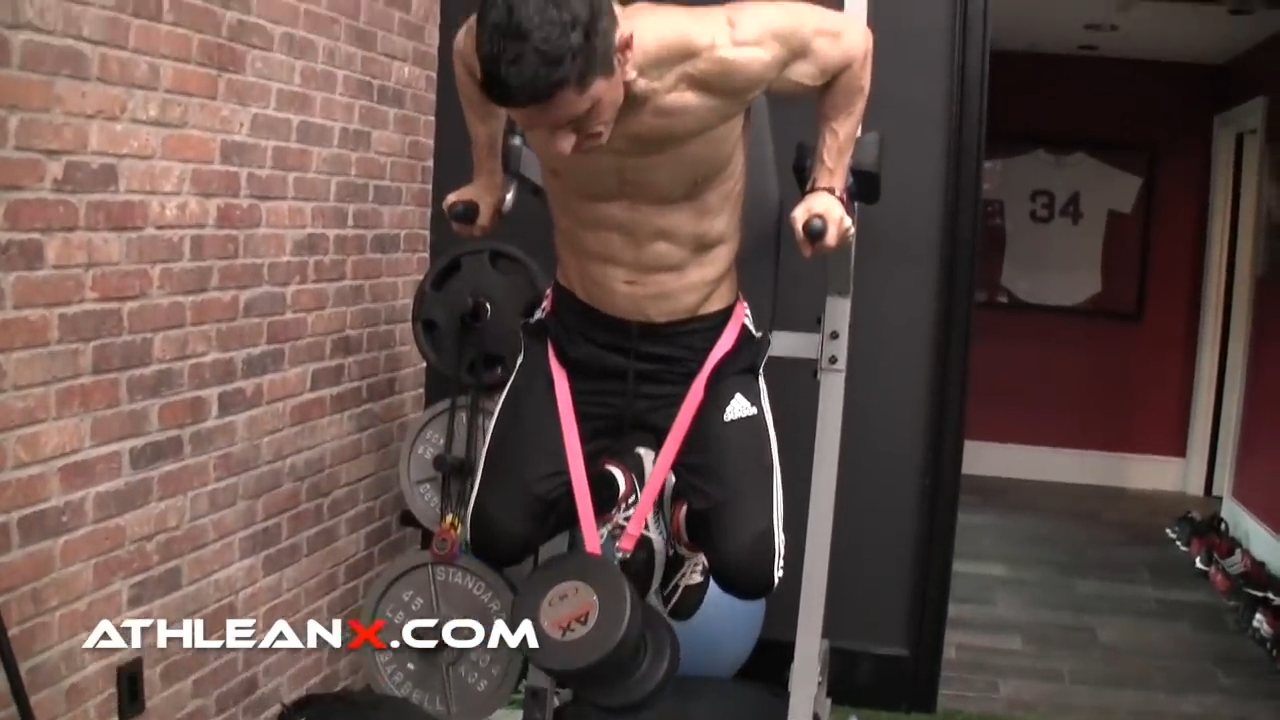
HOW TO DO THE DUMBBELL WEIGHTED DIP:
- Secure a dumbbell using a dip belt (or pinch it between your legs) and step up on the dip bars.
- Lower your body by bending the elbows until they’re roughly 90 degrees, keeping the chest slightly forward and the shoulders set down and away from your ears.
- Drive back up by pressing through the palms and squeezing the chest and triceps at the top.
- Keep your ribs down and your core braced. Don’t let your lower back arch just to get extra depth.
WHAT MAKES IT EFFECTIVE: Adding load forces the chest and triceps to work harder without compromising shoulder position. Unlike some heavy pressing variations, you’re able to push progressive overload while keeping the shoulders in a safer, more natural range.
ECCENTRIC FLOOR FLY
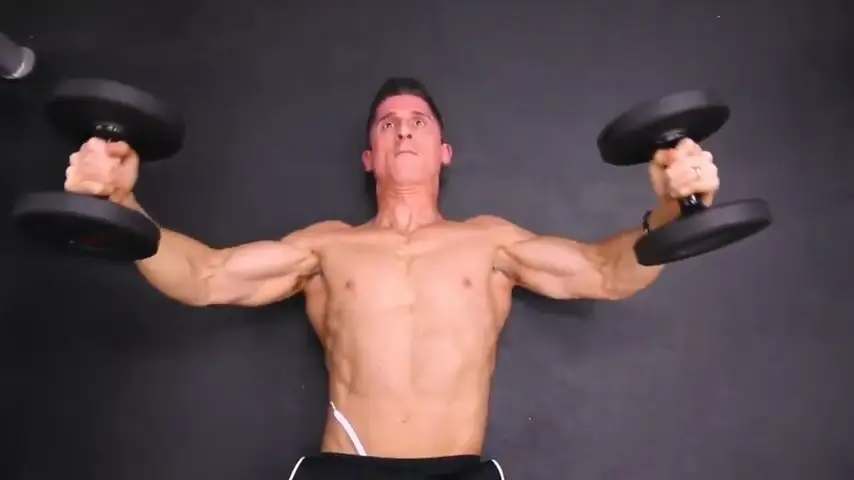
HOW TO DO THE ECCENTRIC FLOOR FLY:
- Lie on the floor with a dumbbell in each hand and press them up like the top of a Dumbbell Bench Press.
- From here, lower the weights out to the sides with a slight bend in the elbows, letting the arms open slowly like a controlled fly.
- Stop when your upper arms touch the floor, then press straight back up to the starting position.
- The goal isn’t how far you can stretch. It’s how controlled you can make the eccentric on every rep.
WHAT MAKES IT EFFECTIVE: By limiting the bottom position to the floor, you protect the shoulder while still getting a long, slow eccentric that loads the pecs. That combination of controlled stretch and safe depth drives more muscle fiber damage where it counts, without letting the shoulders take over the movement.
PLYO TAP
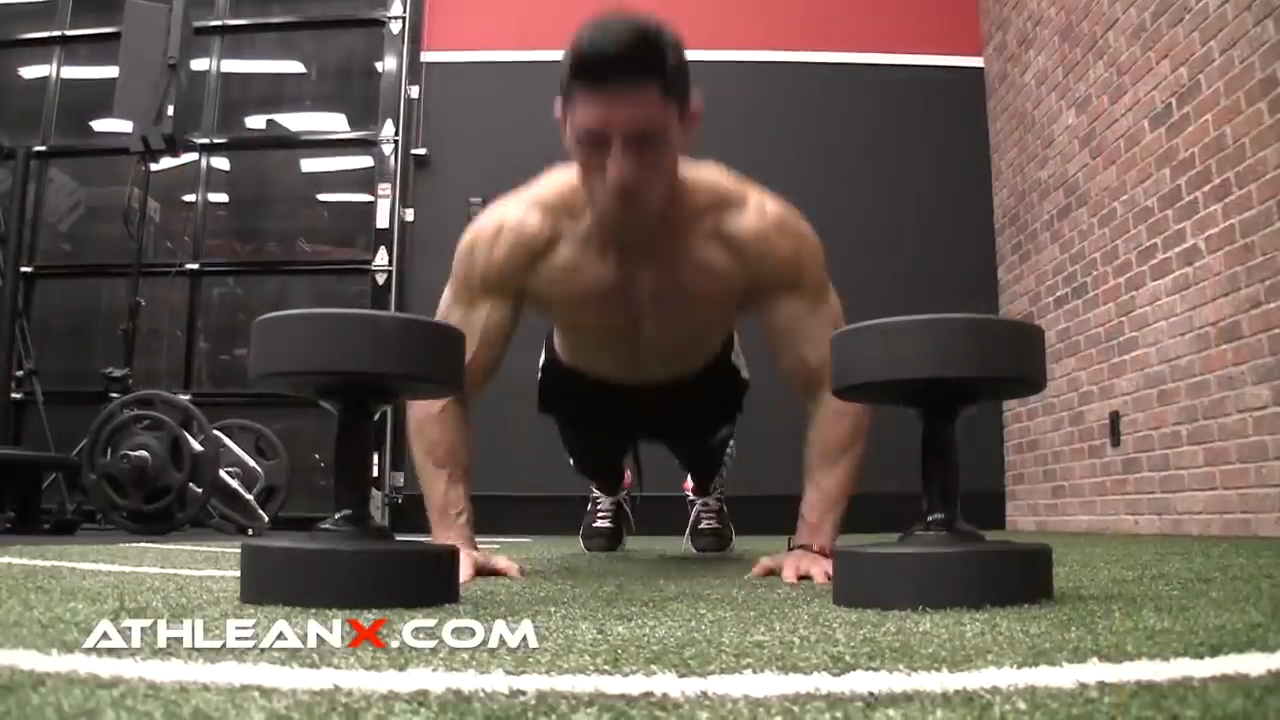
HOW TO DO THE PLYO TAP:
- Start in a high plank with a pair of dumbbells standing upright just in front of your hands.
- Perform an explosive push-up, pushing off the ground and tapping the top of the dumbbells before landing back in your plank.
- Immediately go into the next rep. There are no pauses here and no resting in between reps.
- Increasing the size of the dumbbells increases the height you need to reach, forcing more power on every push-off.
- As always, keep the core locked the entire time.
WHAT MAKES IT EFFECTIVE: This version removes the mechanical limitations you get from Regular Push-Ups or Bench Presses and lets you generate pure upper-body power. Driving explosively through the ground trains fast-twitch fibers and challenges endurance at the same time.
4. DUMBBELL SHOULDER EXERCISES
Your shoulders are built from three distinct heads, and each one deserves attention if you want strength, size, and a shoulder joint that holds up over time.
Dumbbells allow you to target all angles while keeping the shoulder moving in the path that feels most natural, instead of being forced into one fixed direction like you get with a barbell.
Here are some of my favorite dumbbell shoulder exercises:
DUMBBELL PUSH PRESS
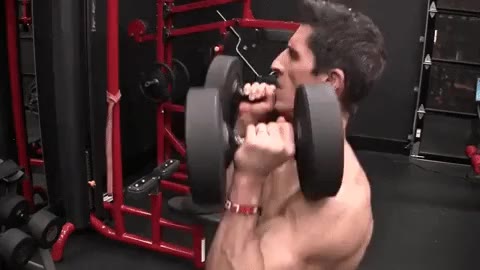
HOW TO DO THE DUMBBELL PUSH PRESS:
- Stand tall with a dumbbell in each hand at shoulder height, elbows slightly in front of the body.
- Dip your hips back (don’t just bend your knees) and drive through the floor to push the weights overhead in one explosive motion.
- Lock your ribs down and keep the core tight so you’re not arching your lower back.
- Lower under control and reset your stance before the next rep, keeping each rep smooth rather than grinding through fatigue.
WHAT MAKES IT EFFECTIVE: The Push Press lets you use the hips and legs to create power from the ground up, which means you can move heavier weight without beating up the shoulders. It trains speed, force production, and full-body coordination. Just remember that this is a power movement, not a burnout set, so keep the reps clean and explosive instead of pushing to failure and getting sloppy.
STANDING ARNOLD PRESS
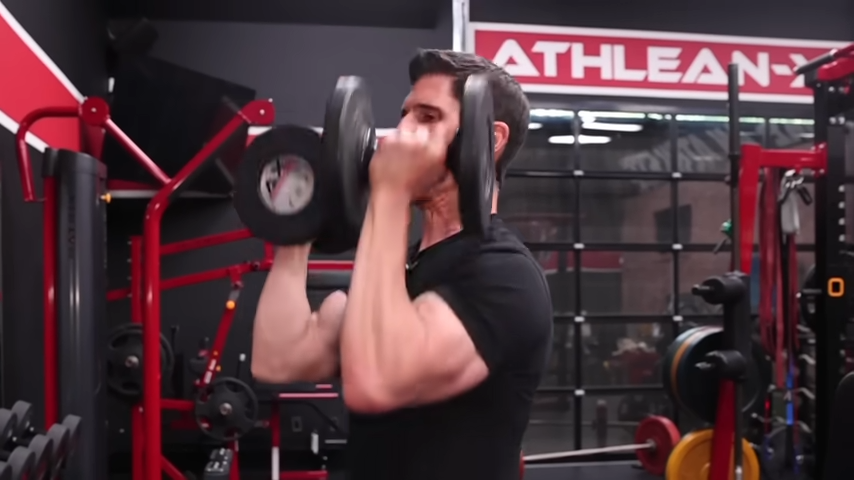
HOW TO DO THE STANDING ARNOLD PRESS:
- Stand tall with your feet shoulder-width apart and a dumbbell in each hand.
- Start with your elbows slightly in front of your body and your palms facing you, like the top of a curl.
- Brace your abs and squeeze your glutes.
- Press the dumbbells upward while rotating your palms outward so they face forward at the top. Stop just shy of lockout to keep tension on the delts.
- Lower under control while reversing the rotation and bringing the elbows back in front of your torso, not flaring them straight out to the side.
WHAT MAKES IT EFFECTIVE: During the famous Arnold Press, the rotation builds all three heads of the shoulder in one movement while training healthy shoulder mechanics. Standing forces your core and glutes to stabilize the press, which makes the lift more athletic but also easier to cheat if you’re not careful. Leaning back turns it into a push press, shifting tension away from the delts. Stay upright, brace the core, and keep the press strict for the most shoulder-focused benefit.
STRAIGHT DUMBBELL LATERAL RAISE
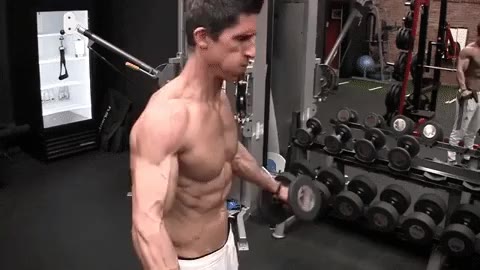
HOW TO DO THE STRAIGHT DUMBBELL LATERAL RAISE:
- Stand tall with a dumbbell in each hand and a slight bend in the elbows.
- Raise the arms straight out to the sides but favoring forward. Move the dumbbells up until they’re above shoulder height, preferably at the top of your head.
- Keep your thumb slightly higher than your pinky and don’t “pour the pitcher” at the top.
- Pause briefly at the top, then lower the weights under control.
- Avoid swinging or leaning to get the dumbbells up. This should be a strict lateral movement, not a momentum drill.
WHAT MAKES IT EFFECTIVE: Keeping the thumb higher than the pinky keeps the shoulder in a safer position and puts more emphasis on the middle delts instead of grinding the joint. The controlled raise and slow return load the muscle through the exact range responsible for shoulder width and stability.
STANDING REAR DELT ROW
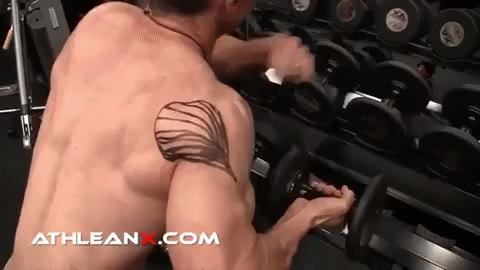
HOW TO DO THE STANDING REAR DELT ROW:
- Hold a single dumbbell with an underhand grip and stand in a staggered stance or lean slightly onto a bench or weight rack for support.
- Pull the weight up and back toward shoulder height while rotating your hand outward. Imagine pointing your thumb behind you as you row.
- Keep the elbow moving behind the torso, not straight out to the side, and control the lower portion of the rep.
WHAT MAKES IT EFFECTIVE: Driving the elbow behind the body and adding external rotation lines the resistance up directly with the rear delts. This is exactly where most rowing variations fall short. This combination hits the rear delt with precision instead of letting the upper back dominate, making it a smarter way to build rear delt strength.
5. DUMBBELL TRICEPS EXERCISES
Your triceps make up most of the size of the upper arm, and they’re responsible for every pressing lockout you do.
Dumbbells give you the freedom to put the elbow where it’s safest and load each head of the triceps without beating up the shoulder or wrist.
Here are my picks for the smartest triceps exercises you can do with dumbbells:
DUMBBELL CLOSE GRIP BENCH PRESS
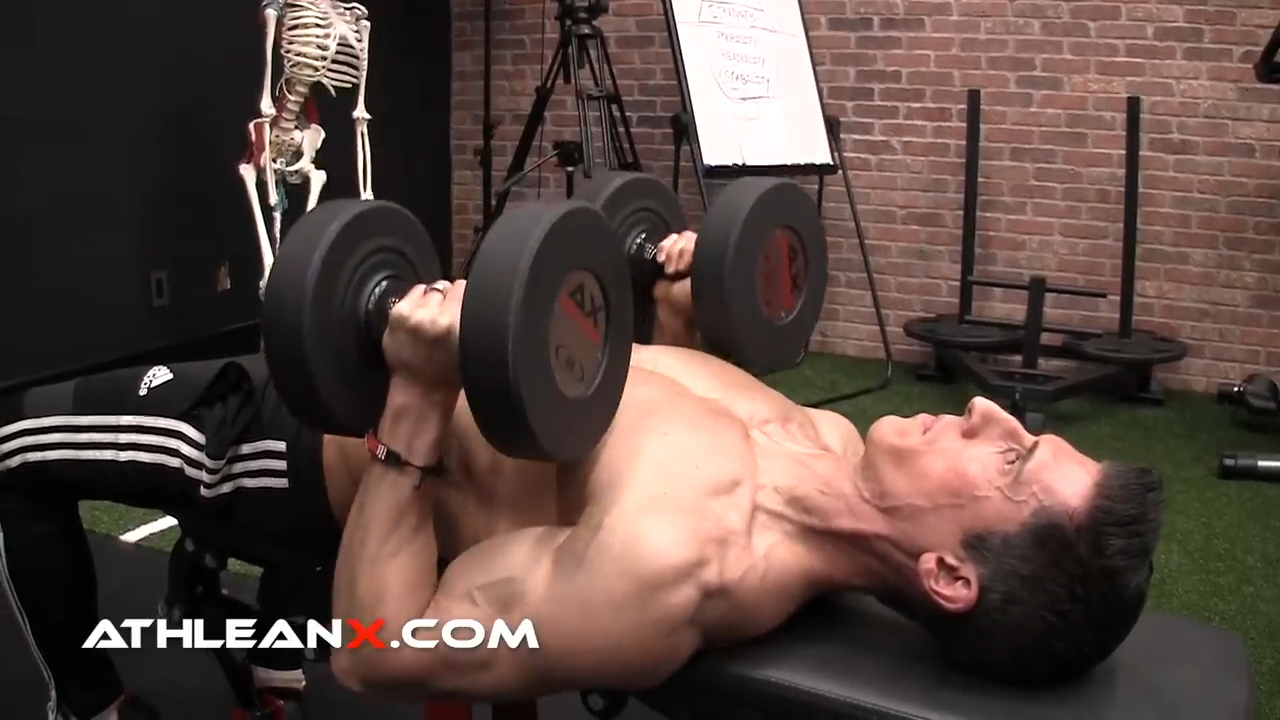
HOW TO DO THE DUMBBELL CLOSE GRIP BENCH PRESS:
- Lie flat on a bench with your feet planted and a dumbbell in each hand.
- Hold the weights just inside shoulder width with your palms facing each other. Keep your elbows close to your sides.
- Press the dumbbells straight up by driving through the triceps, then lower under control until your elbows come just past 90 degrees.
- Keep your ribs down and your shoulders pulled back into the bench the whole time.
WHAT MAKES IT EFFECTIVE: Turning a press into a close-grip movement shifts more work to the triceps and away from the front delts, which is something most regular pressing can’t do. Dumbbells also let your elbows follow a safer path than a straight bar, reducing stress on the wrists and shoulders while still loading the lockout portion of the lift.
LYING DUMBBELL TRICEP EXTENSION
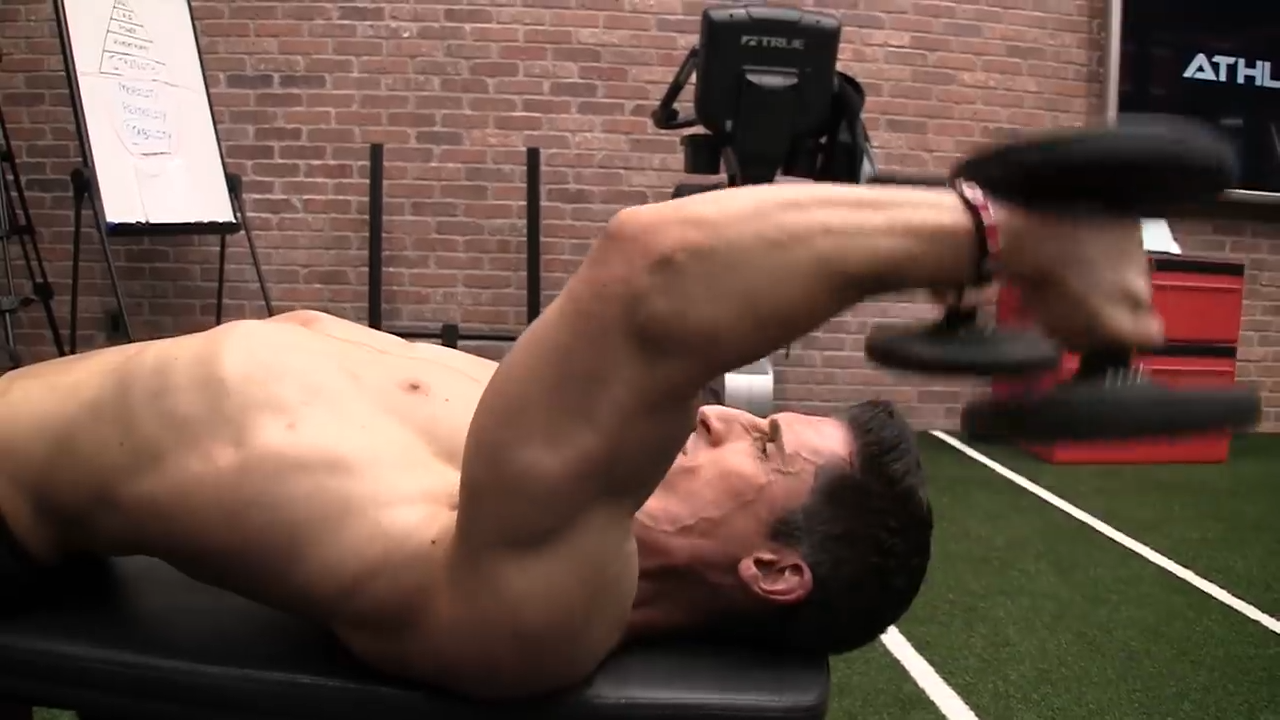
HOW TO DO THE LYING DUMBBELL TRICEP EXTENSION:
- Lie on a flat bench with a dumbbell in each hand and start with your upper arms slightly angled back rather than straight overhead.
- Bend your elbows and lower the weights behind the head, keeping the elbows pointed.
- When you’ve reached a comfortable stretch, squeeze through the triceps and extend the arms back to the starting position.
- Keep the ribs down and the core braced throughout so the low back doesn’t arch.
WHAT MAKES IT EFFECTIVE: Angling the upper arms back places the long head of the triceps under greater stretch and tension. This increases the loading on the most powerful section of the triceps while reducing unnecessary stress on the elbows and shoulders.
DUMBBELL JM PRESS
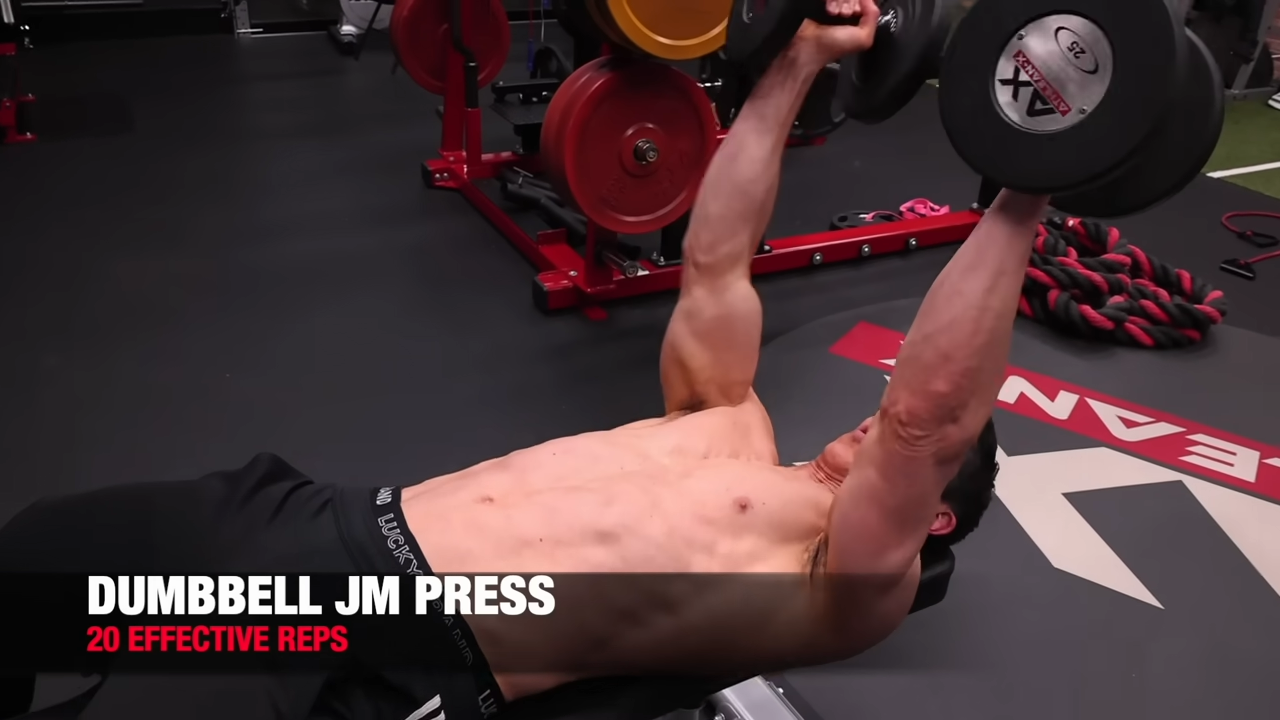
HOW TO DO THE DUMBBELL JM PRESS:
- Lie on a flat bench with a dumbbell in each hand, starting directly over your upper chest with the palms facing each other.
- Lower the weights by bending at the elbows and letting them track down toward your sides as the dumbbells move toward your ears, not straight toward your chest.
- Once you feel a strong stretch through the triceps, explosively extend the arms back to the starting position.
- Keep the elbows tucked and your shoulders packed down throughout the motion.
WHAT MAKES IT EFFECTIVE: The JM press blends a Skull Crusher with a Close-Grip Press, creating a powerful triceps movement without requiring barbells or heavy loading. By lowering toward the ears instead of directly toward the chest, you hit the long head and finish every rep with strong triceps extension instead of letting the shoulders take over.
DUMBBELL TRICEPS KICKBACK
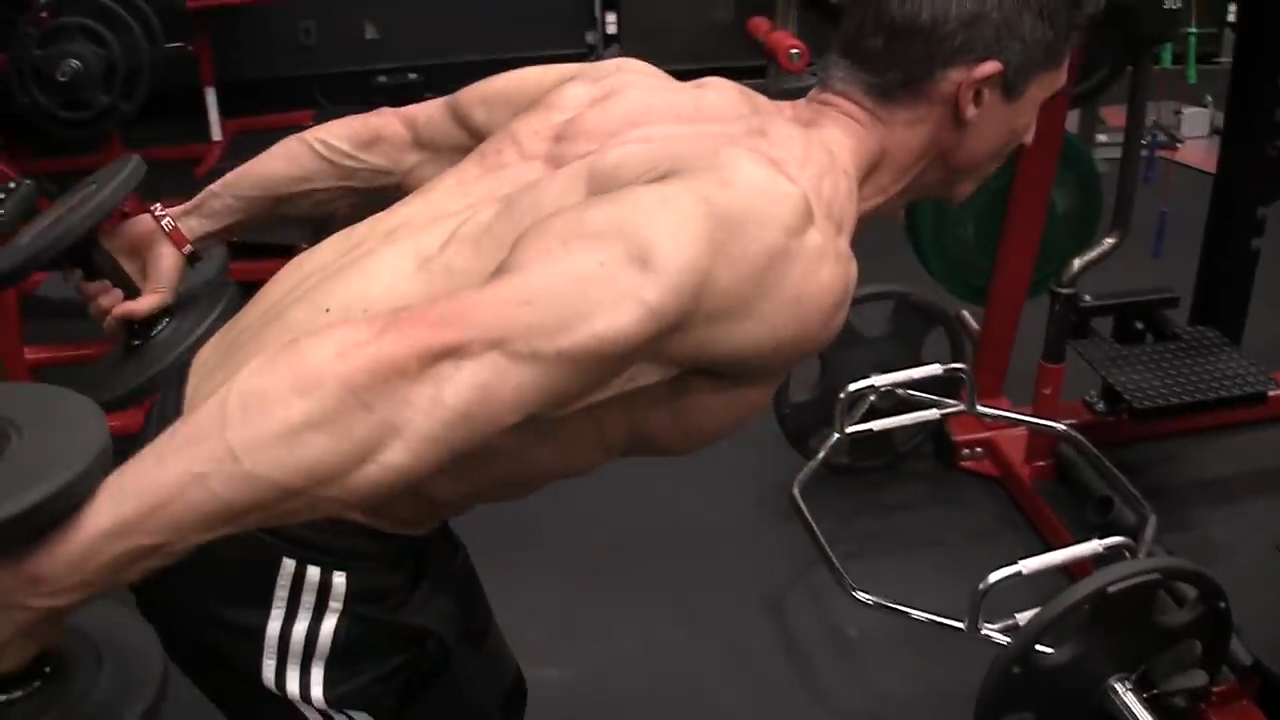
HOW TO DO THE DUMBBELL TRICEPS KICKBACK:
- Hinge forward with a dumbbell in each hand and tuck your elbows in tight to your sides.
- Start by pulling your upper arms slightly behind your torso.
- From there, extend the elbows to straighten your arms and squeeze hard at the top.
- Lower under control and maintain the elbow position on every rep.
- Don’t allow the arms to drift forward as fatigue sets in. If your arm position starts to drop, switch to lighter weights and finish the set.
WHAT MAKES IT EFFECTIVE: The entire benefit of the kickback comes from keeping the upper arm behind the body, placing the long head in a fully shortened position. If the elbow drops, the tension shifts away from the triceps, and the exercise becomes a simple extension instead of a full contraction drill. Using lighter weights often works better here, as long as you can keep that upper arm pinned back through every rep.
6. DUMBBELL BICEPS EXERCISES
Every biceps exercise might look like a curl, but each one hits the arm differently depending on grip, elbow position, and how much the shoulder gets involved.
Dumbbells let you control all of those variables and target the long head, short head, and brachialis exactly where they grow best.
Here are my go-to dumbbell bicep exercises:
ALTERNATING DUMBBELL BICEPS CURL
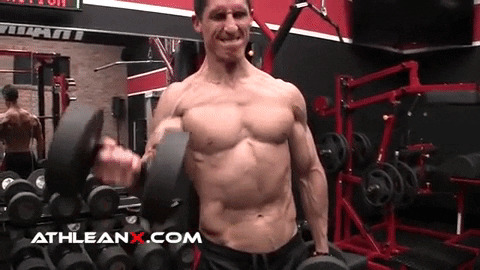
HOW TO DO THE ALTERNATING DUMBBELL BICEPS CURL:
- Stand tall with a dumbbell in each hand and your arms hanging at your sides.
- Curl one dumbbell up by rotating your palm toward you as it rises. Don’t just bend the elbow, actively supinate the wrist to shorten the biceps.
- Pause at the top and squeeze before lowering under control. Then switch sides and repeat.
- Keep your elbow close to your torso and avoid swinging your body or letting the weight drift forward.
WHAT MAKES IT EFFECTIVE: By alternating arms, you cut the stabilization demand in half, which means you can typically handle more weight with better control. This lets you overload the biceps more effectively without turning the movement into a full-body sway. You also get a moment to refocus and reset each rep, improving the contraction and reducing the urge to cheat the weight up when fatigue kicks in.
INCLINE DUMBBELL CURL
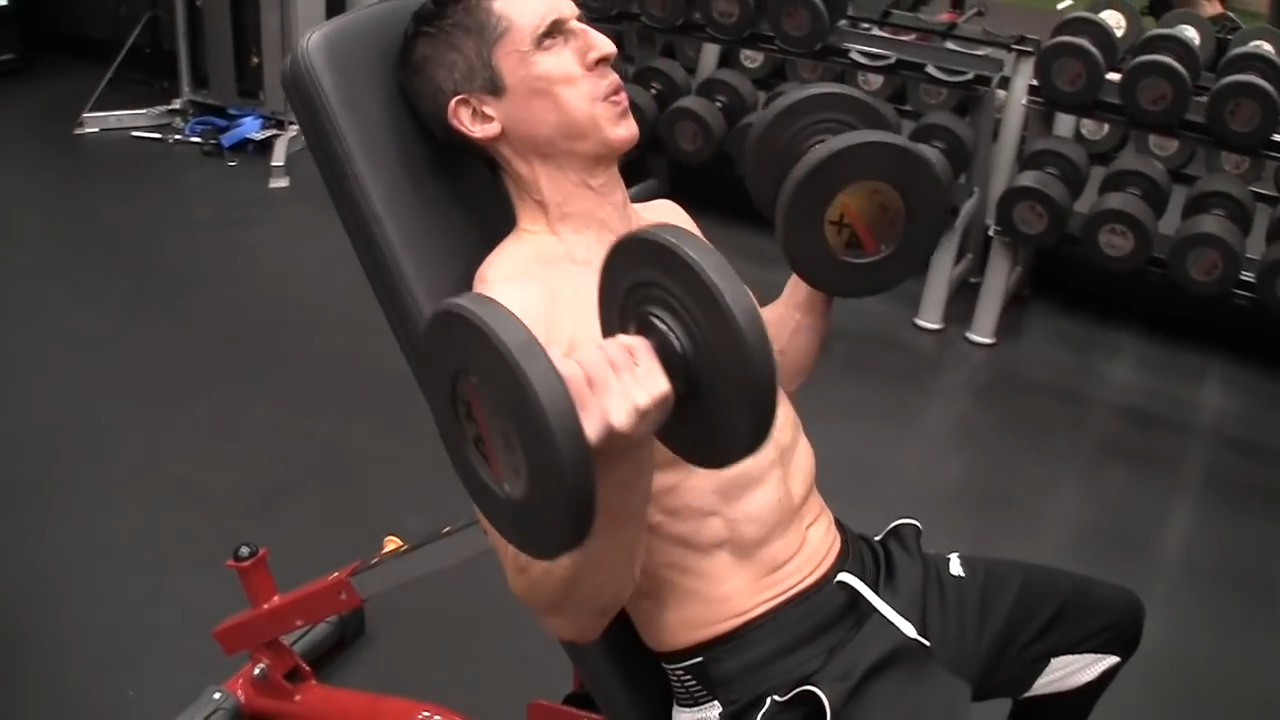
HOW TO DO THE INCLINE DUMBBELL CURL:
- Set an adjustable bench to a low incline and sit back with your arms hanging slightly behind your torso.
- Hold a dumbbell in each hand with your palms facing forward.
- Curl the weights by keeping the elbows fixed and letting the biceps do the lifting, not the shoulders.
- Pause and squeeze at the top, then lower slowly, making sure your elbows don’t drift forward as you fatigue.
WHAT MAKES IT EFFECTIVE: Starting with the arms behind the body puts the long head of the biceps into a stretched position. That extra stretch creates more tension through the full range of motion and forces the biceps to work harder with less help from the shoulders.
DRAG CURL
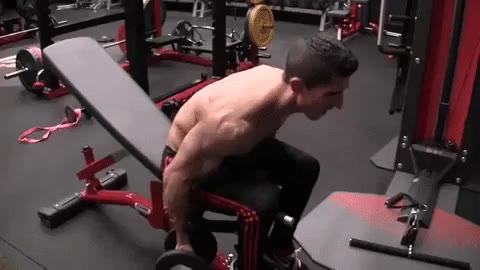
HOW TO DO THE DRAG CURL:
- Sit tall on a bench with a dumbbell in each hand and keep your elbows close to your sides.
- Instead of curling the weights outward in front of you, pull your elbows slightly back as you curl so the dumbbells travel close to your torso. It’s like you’re “dragging” along your rib cage.
- Squeeze at the top, then lower slowly while keeping the elbows behind the body rather than letting them drift forward.
WHAT MAKES IT EFFECTIVE: Dragging the dumbbells closer to your body shortens the moment arm, which keeps tension centered on the biceps without relying on the front delts. It also encourages a stronger squeeze at the top and reduces cheating through momentum.
PRONATED FOREARM CROSSBODY HAMMER CURL
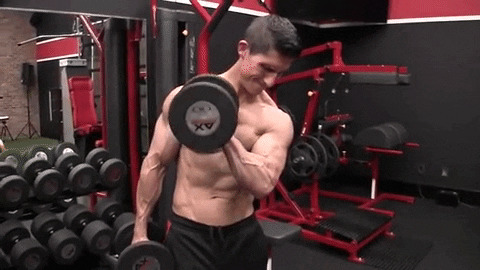
HOW TO DO THE PRONATED FOREARM CROSSBODY HAMMER CURL:
- Stand with your feet shoulder-width apart and hold a dumbbell in each hand using an overhand (pronated) grip.
- Keeping the elbows close to your sides, curl one dumbbell up and across your body toward the opposite shoulder.
- Lower under control, then repeat with the other arm.
- Keep the wrist neutral throughout. Don’t twist into a traditional curl. Avoid swinging the torso for momentum.
WHAT MAKES IT EFFECTIVE: Curling across the body with a pronated grip shifts a significant portion of the load to the brachialis and brachioradialis, which are two muscles that add width and thickness to the upper arm. Because these muscles sit underneath the biceps, developing them makes your arms look visibly bigger from every angle, even with moderate weight.
7. DUMBBELL FOREARM EXERCISES
Most people focus on grip strength without realizing the forearms are doing far more than just holding a weight.
Targeting the flexors, extensors, and brachioradialis directly helps balance the wrist, protect the elbow, and transfer force into every pull, curl, and row you do.
Dumbbells make it easy to train each area with control instead of just squeezing harder.
Give these dumbbell forearm exercises a try during your next Arm Day workout:
FARMER’S CARRY
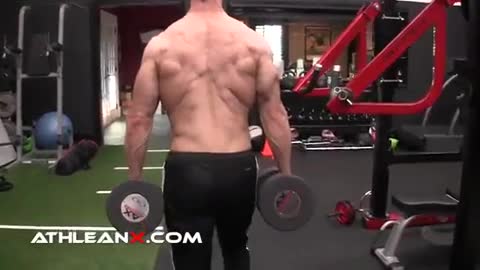
HOW TO DO THE FARMER’S CARRY:
- Pick up a heavy pair of dumbbells and stand tall with your shoulders set down and back.
- Grip the handles tightly and walk in a straight line, keeping your abs braced and your posture stacked.
- If you don’t have room to walk across the gym, take 12 to 15 controlled steps in one direction, then slowly turn and repeat.
- Keep your eyes forward and avoid letting the dumbbells drift away from your sides.
WHAT MAKES IT EFFECTIVE: The Farmer’s Carry hits grip strength, wrist stability, and endurance all while forcing your core to control the load. As you build grip capacity, you’re able to handle more weight and carry it farther, turning a simple exercise into a progression of serious forearm and upper-body strength.
OFFSET DUMBBELL REVERSE CURL
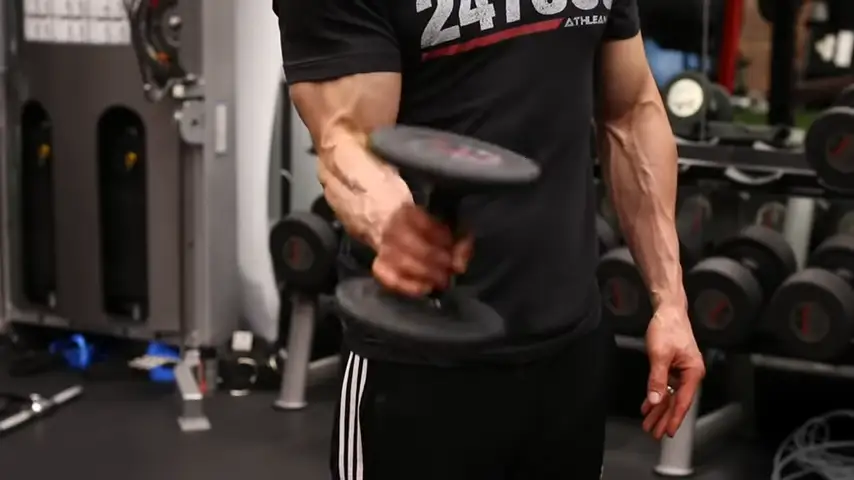
HOW TO DO THE OFFSET REVERSE DUMBBELL CURL:
- Hold a dumbbell in a normal curling position but shift your hand toward the bottom end of the handle so more of the weight sits above your thumb.
- Start with a supinated grip, curl the weight upward, and rotate into a pronated position at the top with palms facing down.
- Keep the elbows pinned to your sides and lower slowly, returning to the original grip each rep.
WHAT MAKES IT EFFECTIVE: By offsetting your hand toward one end of the dumbbell, the forearm has to work harder to control pronation against gravity. That added rotational load is what targets the weaker extensors, helping balance forearm strength and build size in a part of the arm most lifters ignore.
REVERSE CURL
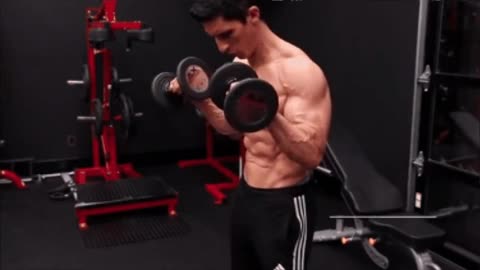
HOW TO DO THE REVERSE CURL:
- Stand tall with a dumbbell in each hand and hold them with your palms facing down.
- Curl the weights toward your shoulders by bending only at the elbow.
- Keep the elbows locked at your sides and squeeze at the top before lowering under control to the starting position.
WHAT MAKES IT EFFECTIVE: Keeping the palms down forces the forearm extensors to do more of the work instead of letting the biceps dominate every rep. That added demand helps strengthen the back of the forearm and builds a more balanced arm overall.
8. DUMBBELL CORE EXERCISES
It’s easy to forget that one of the main functions of the core is more than just flexing the spine.
It’s also resisting movement so your body can transfer force safely from the ground up.
Dumbbells challenge the core in ways bodyweight alone can’t, especially when you’re fighting rotation, extension, or loaded carries.
Below are the core movements I rely on most to build real, functional strength.
ONE-ARM OTIS-UP
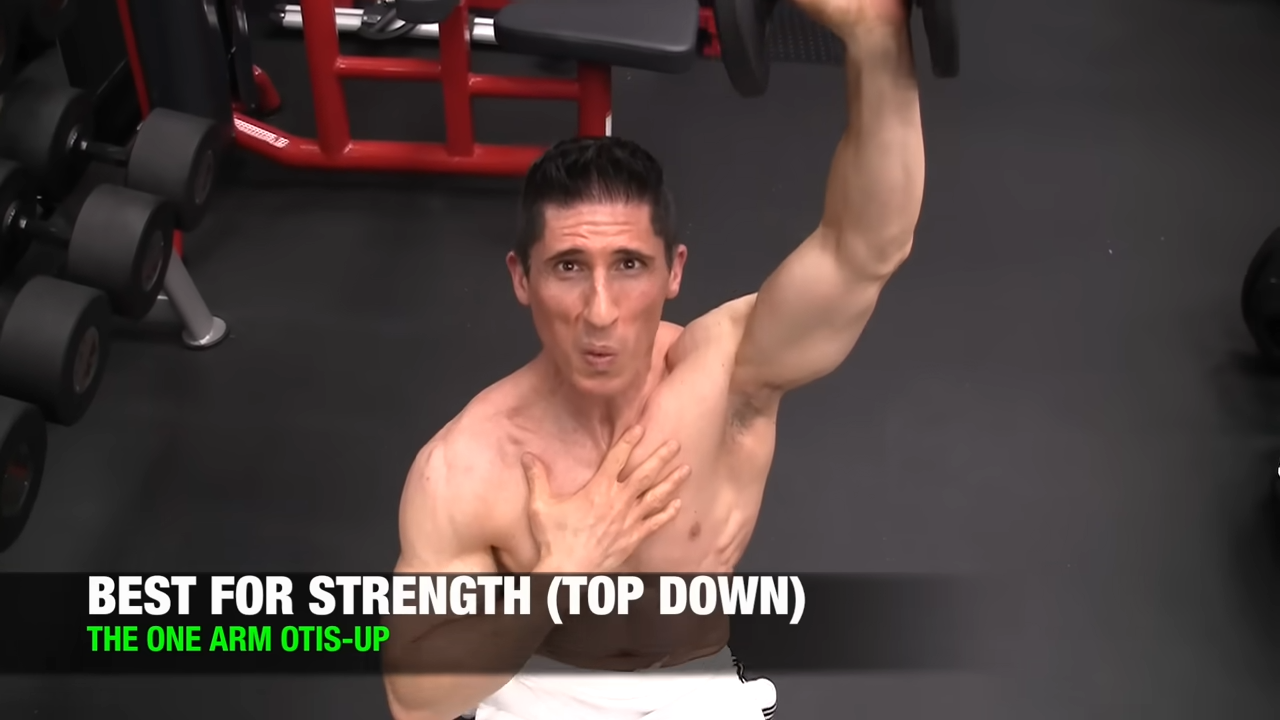
HOW TO DO THE ONE-ARM OTIS UP:
- Lie flat on the floor with your knees lightly bent and hold a single dumbbell straight above your chest.
- Without driving your feet into the ground, sit up by pulling your rib cage toward the dumbbell, keeping your arm straight the entire time.
- Reach a tall, upright position at the top, then lower yourself slowly back down under control.
- Keep the motion smooth without rocking or using momentum to swing yourself up.
WHAT MAKES IT EFFECTIVE: Since your legs can’t assist, the Otis-Up forces your abs and hip flexors to do all the work getting your torso off the floor. Holding the dumbbell overhead creates a longer lever and keeps your core under tension throughout the entire rep.
TWISTING TOE TAPS
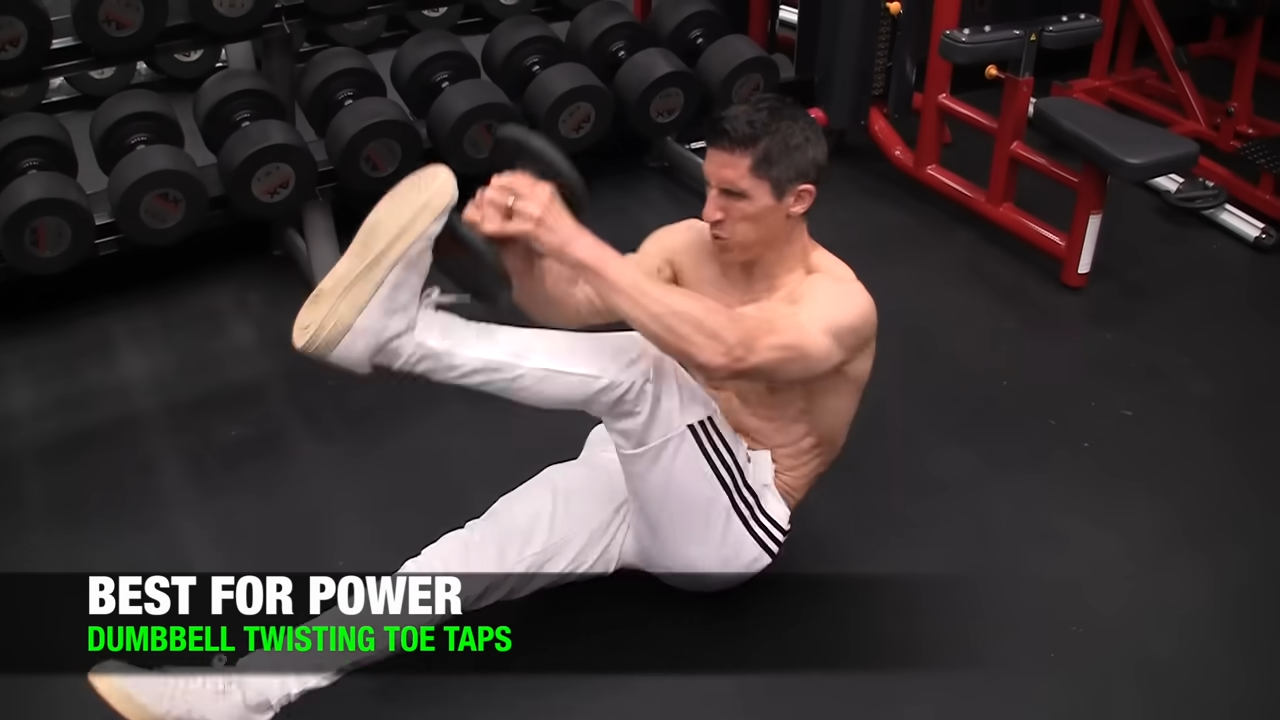
HOW TO DO TWISTING TOE TAPS:
- Sit on the floor in a leaning-back position with a dumbbell held in both hands.
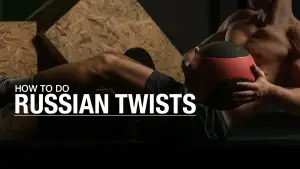
- Rotate your torso like a Russian twist while simultaneously extending the opposite leg, reaching the dumbbell toward the outside of that foot as it lifts.
- Return to center and repeat on the other side, alternating sides just like a scissors motion.
- Keep the heels just off the floor and stay tall through the chest without collapsing the lower back.
WHAT MAKES IT EFFECTIVE: Combining a rotational twist with alternating leg extension forces the upper and lower core to work together instead of in isolation. The cross-body action preloads the obliques and then challenges them to control rotation under speed, giving you a powerful, athletic core exercise.
WEIGHTED LEVITATION CRUNCH
HOW TO DO WEIGHTED LEVITATION CRUNCHES:
- Sit back over a Swiss ball with a dumbbell held over your head with straight arms and a slight bend in the elbow.
- Let your upper back extend slightly over the ball so your ribs open and the abs stretch.
- From there, slowly curl your torso forward by pulling your rib cage toward your pelvis.
- Pause at the top, then lower with control back over the ball to place another stretch on the abs.
- Keep your lower back supported by the curve of the ball and avoid yanking with the neck.
WHAT MAKES IT EFFECTIVE: Keeping the dumbbell overhead shifts the center of mass farther from the core, increasing the lever arm and the stretch on every rep. Because the physioball lets you go past neutral, you’re able to overload the eccentric portion of the movement in a way the floor can’t match.
ONE-ARM ROLL-OUTS
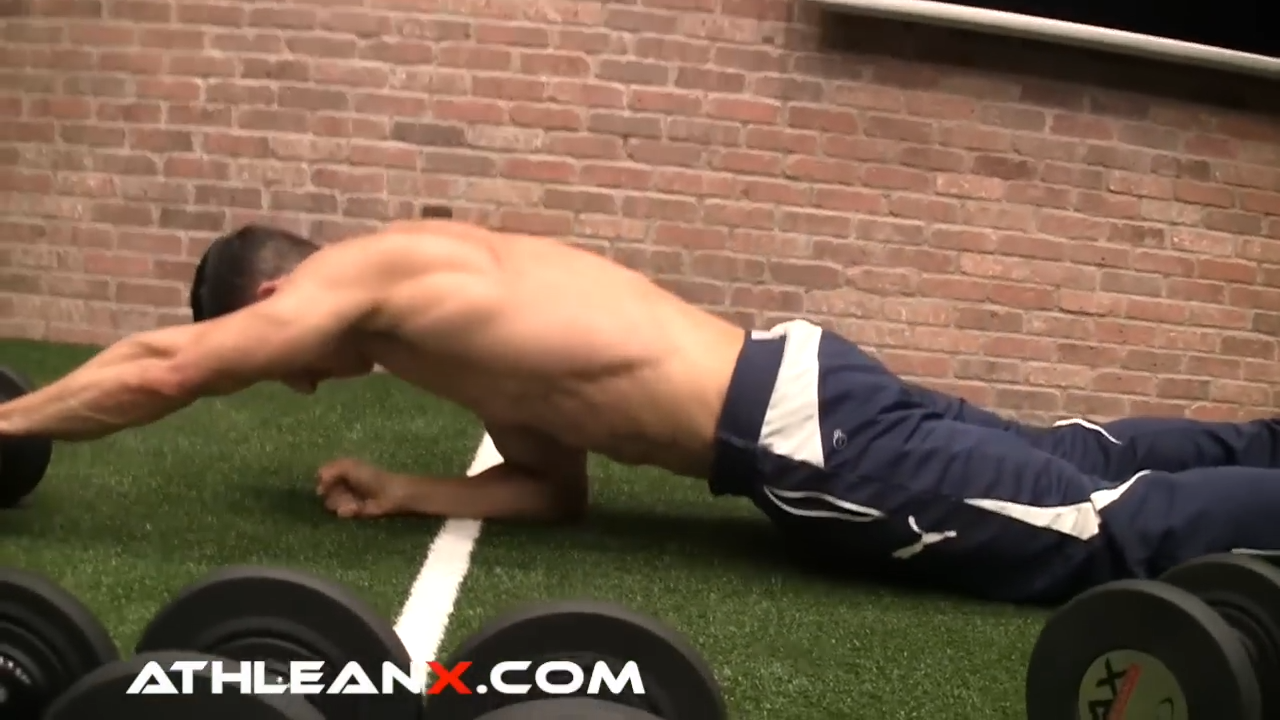
HOW TO DO ONE-ARM ROLL-OUTS:
- Start in a plank position with a single dumbbell next to you.
- Grab the dumbbell with one hand and slowly roll it forward while keeping your arm straight and your torso rigid.
- Let your hips and chest move in one line as you extend, without letting your low back sag.
- Pause at your furthest controllable reach, then pull yourself back to the starting position using your core. Don’t just drag the dumbbell in with your arm.
- Switch sides after each set.
WHAT MAKES IT EFFECTIVE: Using one arm forces the core to resist rotation while maintaining a straight line from shoulders to knees. That extra anti-rotation demand trains the deep stabilizers of the core, especially the obliques and transverse abdominis, far more than traditional Roll-Outs.
9. PROGRAMMING GUIDELINES
Training hard is great, but training smart is what builds size and strength long-term.
If you want this upper-body dumbbell workout to deliver real results, your programming decisions matter just as much as the exercises themselves.
This is where rep ranges, rest, frequency, and progressive overload come together. Use these rules to build your blueprint.
SET YOUR GOAL
Before worrying about rep ranges or weight selection, decide what your primary goal is right now.
Are you training to build muscle, improve strength, or simply develop your upper body overall?
Each goal dictates how many reps you perform per set and how long you rest between sets.
- Muscle Growth: moderate reps, moderate rest
- Strength: lower reps, longer rest
- Body Recomposition: a mix of both
Having clarity up front makes every training decision, from exercise selection to intensity, more intentional and effective.
HYPERTROPHY
For most upper-body dumbbell exercises, the sweet spot for muscle growth lives in the 6 to 12 rep range.
This range provides enough mechanical tension to stimulate hypertrophy while keeping fatigue and sloppy form under control.
To keep every rep productive, focus on the following:
- Sets: 3 to 4, Reps: 6 to 12
- Stop 1 to 2 reps short of failure
- Rest 60 to 90 seconds
- Prioritize slow eccentrics and controlled tempo
STRENGTH
You don’t need a barbell to get strong.
Heavy dumbbell work can build serious upper-body strength if you attack compound lifts in the 3 to 6 rep range with longer rest periods.
Think Dumbbell Bench Press, Weighted Pull-Ups, Push Press, and any heavy rowing variation.
Strength demands quality reps, not burnout volume, so focus on this:
- Sets: 4 to 6, Reps: 3 to 6
- Use the low-rep range on compounds only
- Keep volume lower than hypertrophy work
- Rest 2 to 3 minutes to keep power high
WEEKLY FREQUENCY
For real progress, frequency matters more than annihilating your muscles in one workout.
Most lifters grow best training upper body 2 to 3 times per week so that each muscle gets hit often enough to recover and grow again.
Typical weekly splits might look like:
- Upper / Lower / Off / Upper / Lower / Off / Off
- Upper / Lower / Upper / Off / Upper / Lower / Off
As long as each major muscle group is stimulated at least twice per week, you’re in the ideal zone for steady strength and size.
WEEKLY VOLUME
Volume drives hypertrophy more than any other training variable, and the research is pretty clear that 10 to 20 hard sets per muscle group per week is the zone where most lifters grow.
A simple weekly chest example might be:
- 3–4 exercises per muscle across the week
- 3–4 hard sets per exercise
That puts you right in the proven growth range without overdoing it.
HOW TO PROGRESS
Muscle doesn’t grow without progression so always apply a simple progression order.
First, add reps. Then increase load. Only after that should you think about adding more volume.
- Add reps until you reach the top of the rep range
- Increase weight and drop back to the bottom of the rep range
- If progress slows, add one additional set
EFFORT LEVEL (INTENSITY)
Most working sets should land around RPE 7 to 9, meaning you leave 1 to 3 reps in the tank.
Failure has its place, but going to max effort every set destroys recovery and reduces training frequency.
- RPE 7–8 = 2–3 reps in reserve
- RPE 9 = 1 rep in reserve
Save true failure for the final set of a safe isolation movement, not your heavy compounds.
When you train the entire upper body with dumbbells, you immediately remove the shortcuts that machines and fixed bars give you.
Every rep has to be earned, every muscle has to stabilize, and your weak links can’t hide anymore.
Stick to the plan, track your progress, and the upper body you’ve been trying to build finally becomes the one you can train toward with confidence.
Check out our complete line of ATHLEAN-RX Supplements and find the best training program for you based on your fitness level and goals.

- Dumbbells force each side of the upper body to work independently, eliminate hidden imbalances, and train stabilizers your barbell and machines ignore.
- Back Training: Lats, traps, erectors, rotator cuff, and teres major can be targeted with Chest-Supported Touch Rows, Dead Rows, Weighted Pull-Ups, and the “W” Raise for stronger pulling and shoulder control.
- Chest Training: Upper, mid, and lower pec fiber angles are built with Dumbbell Bench Presses, Weighted Dips, Eccentric Floor Flys, and Plyo Taps for strength, stretch, and power.
- Shoulders Training: Target all three heads with Dumbbell Push Presses, Standing Arnold Presses, Straight Lateral Raises, and Rear Delt Rows for full-round delt development.
- Triceps Training: Long, lateral, and medial heads can be worked out with Close-Grip Dumbbell Bench Presses, Lying Extensions, JM Presses, and Kickbacks for complete elbow-extension strength.
- Biceps Training: Short head, long head, and brachialis are developed with Alternating Curls, Incline Curls, Drag Curls, and Pronated Crossbody Hammer Curls for bigger, fuller arms.
- Forearms Training: Flexors, extensors and brachioradialis can be challenged with Farmer’s Carries, Offset Reverse Curls, and Reverse Curls for grip and wrist strength.
- Core: Abs and deep stabilizers should be targeted with Otis-Ups, Twisting Toe Taps, Weighted Levitations, and One-Arm Roll-Outs for rotational control and anti-extension strength.
- Programming: Use 6 to 12 reps for hypertrophy and 3 to 6 reps for strength. Train your upper body 2 to 3x per week and aim for 10 to 20 weekly sets per muscle group.
UPPER BODY DUMBBELL WORKOUT FAQ
If you’re just getting started, stick with movements that control your body position and teach clean mechanics.
For back strength, Chest-Supported Touch Rows remove the lower back from the equation and teach you to pull with your lats.
For chest and shoulders, a simple Dumbbell Bench Press plus the Standing Arnold Press gives you a full pressing foundation without forcing your joints into one fixed path like a barbell.
For arms, you can’t go wrong with Alternating Dumbbell Curls and Lying Dumbbell Tricep Extensions since both are gentle on the elbows and let you feel the muscle without complicated setup.
As you get more comfortable, you can mix in Push Presses, Weighted Pull-Ups, and floor-based fly variations to build real strength without sacrificing form along the way.
A properly built dumbbell routine trains every major upper-body muscle without leaving holes in your development.
You’ll train the lats, traps, and rotator cuff with Dead Rows, Weighted Pull-Ups, and Rear-Delt Rows.
You’ll hit all three regions of the chest (upper, mid, and lower pec fibers) with the Dumbbell Bench Press, Eccentric Floor Fly, and Weighted Dips.
And the shoulders get complete coverage with the Push Press, Arnold Press, Straight Lateral Raise, and Rear-Delt Row, which cover every deltoid head and protect the joint long-term.
Movements like the Close-Grip Dumbbell Bench Press, Lying Tricep Extension, JM Press, and Triceps Kickback train all three heads of the triceps and build the lockout strength you need for every pressing pattern.
Alternating Dumbbell Curls, Incline Curls, Drag Curls, and the Pronated Crossbody Hammer Curl targets both heads of the biceps and the brachialis, building wider, fuller upper arms.
Forearm-focused movements like Farmer’s Carries and Reverse Curls train grip, wrist control, and elbow integrity.
And core-dominant drills like Otis-Ups and One-Arm Roll-Outs build the deep trunk stability that carries over into most of the exercises in your workout since all movement starts with the core.
REFERENCES
Jeff Cavaliere M.S.P.T, CSCS
Jeff Cavaliere is a Physical Therapist, Strength Coach and creator of the ATHLEAN-X Training Programs and ATHLEAN-Rx Supplements. He has a Masters in Physical Therapy (MSPT) and has worked as Head Physical Therapist for the New York Mets, as well as training many elite professional athletes in Major League Baseball, NFL, MMA and professional wrestling. His programs produce “next level” achievements in muscle size, strength and performance for professional athletes and anyone looking to build a muscular athletic physique.