






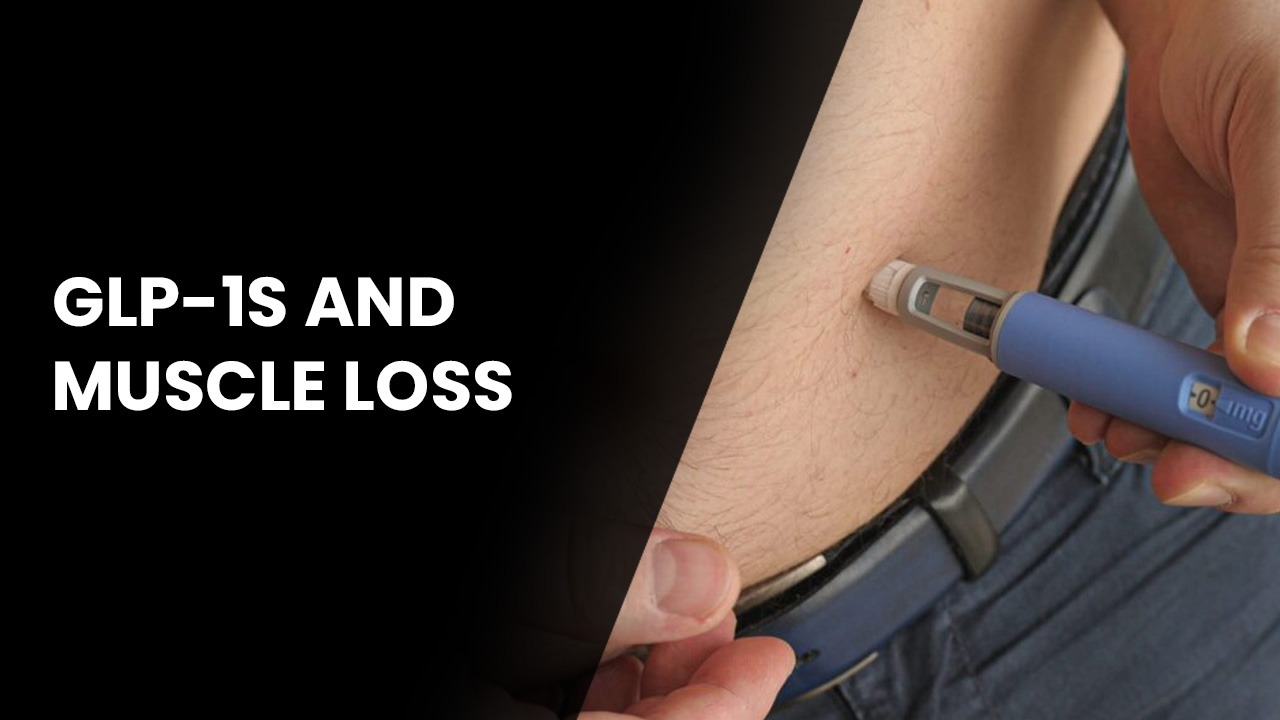
DOES OZEMPIC CAUSE MUSCLE LOSS?
Your neighbor is on it. Your coworker dropped 40 pounds on it in six months. And if you’ve spent any time online lately, you already know the question that follows all of it:
Does Ozempic cause muscle loss?
The critics are loud. They’ll tell you these weight-loss drugs will destroy your muscle mass, wreck your body composition, and leave you skinny-fat and weaker than when you started.
And they’re not completely wrong to be concerned…
Clinical studies do show that people on GLP-1 medications lose some lean muscle mass alongside body fat. That’s documented. Not in dispute.
But this isn’t the full story.
By the end of this article, you’ll know exactly what’s happening to your skeletal muscle on these drugs, what the science shows, and the specific steps to protect your lean body mass while on a GLP-1.

WHAT IS OZEMPIC AND HOW DOES IT WORK?
Before we get into the muscle loss question, you need to understand what these drugs do in your body because most people don’t.
GLP-1 stands for glucagon-like peptide-1.
It’s a hormone your gut naturally releases after you eat. Its job is to tell your brain that you’re full and your pancreas to manage blood sugar control.
Your body makes it every day. These drugs mimic it.
When you inject semaglutide, which is the active ingredient in Ozempic and Wegovy, you’re essentially flooding your system with a supercharged version of that fullness signal.
Your brain thinks you’ve eaten. Your appetite drops. You eat less. You lose weight.
That’s the whole mechanism. There’s no magic. It’s appetite suppression through hormonal mimicry.
But not all GLP-1 drugs are the same.
A few drugs fall into this category, and you’ll hear all of them lumped together in the muscle loss conversation.
They’re related, but they’re not identical and the differences are worth understanding.
OZEMPIC / WEGOVY (SEMAGLUTIDE)
Same drug, different doses, different purposes.
Ozempic tops out at 2mg weekly and is FDA-approved for blood sugar control in type 2 diabetes.
Wegovy uses the same molecule but recently received FDA approval for doses up to 7.2mg weekly, specifically for weight management.
In clinical trials, people on Wegovy lost an average of 15% of their body weight.
The higher dose ceiling is why Wegovy usually outperforms Ozempic on weight loss.
Naturally, more semaglutide results in stronger appetite suppression and a deeper calorie deficit.
MOUNJARO / ZEPBOUND (TIRZEPATIDE)
This one is a step up in terms of mechanism. Tirzepatide is a GIP/GLP-1 receptor agonist.
It targets two hormones instead of one, which produces stronger appetite suppression and, in most studies, greater total weight loss than semaglutide.
That also means the calorie deficit tends to be more aggressive, which makes the muscle preservation conversation even more important on this drug.
Does Mounjaro cause muscle loss like Ozempic?
The short answer is yes, for the same reasons, and potentially to a greater degree if the deficit isn’t managed carefully.
VICTOZA / SAXENDA (LIRAGLUTIDE)
This is the older generation of GLPs.
Liraglutide works through the same GLP-1 mechanism but requires a daily injection instead of weekly and produces less weight loss on average than the newer options.
It’s still prescribed, but largely being replaced by semaglutide and tirzepatide.
Have you noticed a pattern yet? The muscle loss risk across all three comes down to the same root cause: calorie restriction.
The stronger the appetite suppression, the larger the potential deficit and the more important it becomes to have a plan for protecting your lean muscle mass.
But does Ozempic cause muscle loss?
OZEMPIC AND MUSCLE LOSS
The research on Ozempic muscle mass loss points in a consistent direction: most of what you lose on these drugs is fat, not muscle.
But some lean tissue loss is real, and the range is wider than most headlines suggest.
Across recent clinical trials, lean soft tissue loss made up 26 to 40% of total weight lost for most GLP-1 users. In some cases, it goes higher.
A recent Regeneron COURAGE trial found that people on semaglutide alone lost approximately 34.5% of their total weight as lean mass, a number that gets more concerning the longer you look at it without context. [1]
And context is everything here.
LEAN BODY MASS VS. MUSCLE MASS
Lean mass and muscle are not interchangeable terms. Your lean mass is everything in your body that isn’t fat.
Skeletal muscles, yes, but also connective tissue, water, organ tissue, and glycogen stores. Every single one of those things registers as “lean mass” in study data.
When you drop a significant amount of body fat, the connective tissue and water that surrounded and supported that fat disappears with it.
That reduction shows up in the data as “lean mass lost.”
But your biceps, your quads, and your back muscles are not going anywhere unless the conditions are specifically pushing them there.
DEXA scans and BIA tests can get more granular and separate actual skeletal muscle changes from total lean mass changes.
The SEMALEAN study, published in 2025, tracked 115 semaglutide patients over 12 months using DEXA scans and found that while total lean mass initially declined, it stabilized by month 12 while fat mass continued dropping throughout. [2]
There is another layer to this that most Ozempic muscle loss studies don’t discuss at all.
As people gain weight over time, fat infiltrates muscle tissue itself. This is called myosteatosis, and it directly reduces muscle strength, muscle force, and physical function even when total muscle mass looks normal on a scan.
When you lose significant weight, that intramuscular fat clears out.
The result is that your musculoskeletal health often improves and your skeletal muscles frequently work better after weight loss than they did before it, even if the total lean mass number on a DEXA scan went down.
This is why many people report feeling stronger and moving better after losing significant weight on GLP-1s, despite what the raw lean mass numbers suggest.
Ozempic muscle loss before and after comparisons that only look at lean mass on a scale are missing this piece of the picture entirely.
That is the story the alarming headlines are not telling you.
WHY DOES OZEMPIC CAUSE MUSCLE LOSS?
Ozempic muscle and bone loss come down to two pathways working against you at the same time.
First, GLP-1 agonists suppress your appetite so effectively that your calorie intake drops significantly.
When that happens, your body doesn’t burn fat exclusively. It burns a mix of fat mass and lean mass, including skeletal muscle mass, to fuel itself.
Second, when appetite suppression is aggressive enough, protein intake drops too.
And when protein is chronically low, muscle wasting accelerates well beyond what a normal calorie deficit would cause on its own.
Sure, this sounds bad initially, but this kind of muscle loss isn’t unique to GLP-1s.
In fact, researchers have a name for the fat-to-lean-mass loss ratio that shows up across virtually every serious weight loss method: the “quarter fat-free mass rule.”
It refers to the consistent finding that roughly 25% of weight lost during a significant calorie deficit comes from lean tissue, regardless of how that deficit was created.
Dieting produces it. Bariatric surgery produces it. GLP-1s produce it.
Mass General Brigham researchers reviewed the current data and confirmed that weight loss paradigms universally induce lean body mass loss. Not just GLP-1s. [3]
The Ozempic muscle loss risk is not categorically higher than what you would face on any other aggressive fat loss protocol.
What is different is that the appetite suppression makes it far easier to let protein intake slip without noticing. And when protein slips, muscle loss accelerates. The good news is that this is entirely fixable.

HOW TO PREVENT MUSCLE LOSS ON OZEMPIC
The calorie deficit burns lean mass. The appetite suppression tanks protein intake. Left unchecked, those two things working together will cost you muscle you worked hard to build.
But here’s what the critics who fear muscle loss on Ozempic get wrong.
The drug isn’t the variable that determines whether you lose muscle. Your habits are. And habits are something you can control.
There are three things that will determine your outcome on these drugs.
Get them right and you protect your muscle, preserve your strength, and come out the other side of this leaner than when you started.
To follow are some guidelines for what to do to avoid muscle loss on Ozempic and other GLP-1 medications.
STRENGTH TRAINING
Most people think of strength training as a way to build muscle. On Ozempic, it serves a more urgent purpose: keeping the muscle you already have.
When you are in a calorie deficit, your body does not automatically prioritize fat as its primary fuel source. It burns whatever is most available and most convenient.
Without a direct stimulus telling it to protect lean tissue, it will break down skeletal muscle just as readily as stored fat.
Resistance training is that stimulus. It tells your body at the cellular level that your muscle is being used, it is under load, and it is necessary. That signal is what separates people who lose mostly fat on these drugs from people who lose muscle along with it.
A lot of people on Ozempic default to cardio as their primary form of physical activity. That is a mistake.
Cardio burns calories. It does not give your body a reason to protect lean tissue.
Strength training does.
The two are not interchangeable and treating them as if they are is one of the most common reasons people end up with significant muscle loss from Ozempic despite being consistently active.
Outside of muscle mass, there is also a broader metabolic health argument for lifting.
Skeletal muscle tissue drives insulin sensitivity, supports cardiometabolic health, and plays a direct role in how efficiently your body manages blood sugar.
As a glucagon-like peptide-1 receptor agonist, Ozempic improves insulin sensitivity through appetite suppression and weight loss.
Resistance training compounds that benefit.
Research published in the Scandinavian Journal of Medicine and Science in Sports confirms that even relatively low volume resistance training has been shown to prevent lean mass loss during caloric restriction.
The goal while on Ozempic is not to maximize performance. It is to maintain the stimulus consistently enough that your body has no reason to sacrifice muscle for fuel. [4]
FOCUS ON COMPOUND LIFTS
Compound movements recruit multiple muscle groups simultaneously, generate the strongest anabolic signal per set, and give you the highest return on time spent in the gym.
A squat challenges your quads, hamstrings, glutes, and core in a single movement. A row hits your back, biceps, and rear deltoids at the same time. That overlap is exactly why compound lifts preserve more muscle per session than an equivalent amount of isolation work.
There is also a hormonal argument.
Heavy compound movements like Deadlifts, Squats, and Presses produce a significantly greater acute hormonal response than isolation exercises, including testosterone and growth hormone.
Both support muscle retention during a calorie deficit.
On Ozempic, where the deficit runs deeper and longer than most people would sustain through willpower alone, that hormonal response is one of the key reasons lifting heavy should be the centerpiece of your training.
Heavy weight-bearing exercises also support bone density, which is something to consider during rapid weight loss. This is particularly important for older adults where sarcopenia and Ozempic muscle loss is a genuine clinical concern.
In a typical training session, organize your compound movements around the following movement patterns. These patterns ensure you are training the entire body efficiently.
SQUAT
- Goblet Squat
- Front Squat
- Back Squat
- Box Squat
- Zercher Squat
LUNGE
- Reverse Lunge
- Walking Lunge
- Split Squat
- Bulgarian Split Squat
- Lateral Lunge
HINGE
- Romanian Deadlift
- Traditional Deadlift
- Hip Thrust
- Single-Leg Romanian Deadlift
- Trap Bar Deadlift
PUSH
- Push-Up
- Dumbbell Bench Press
- Overhead Press
- Incline Dumbbell Press
- Landmine Press
PULL
- Dumbbell Row
- Chest-Supported Row
- Pull-Up
- Lat Pulldown
- Seated Cable Row
- Face Pull
CARRY
- Farmer’s Carry
- Suitcase Carry
- Front Rack Carry
- Overhead Carry
- Trap Bar Carry
CORRECTIVE
- Band Pull-Aparts
- Face Pulls
- Glute Bridge
- Dead Bug
- Bird Dog
- Pallof Press
PICK YOUR WORKOUT SPLIT
To avoid muscle loss on Ozempic, your program needs to hit each muscle group at least twice per week.
Here are three ways to get there depending on how many days you can train.
Total Body Split: A total body split trains every major muscle group in a single session, built around compound movements for the larger muscles first, with secondary work for smaller groups like biceps and triceps afterward. Train three non-consecutive days per week (e.g., Monday, Wednesday, and Friday).
Upper/Lower Split: An upper/lower split divides training into two categories and allows more volume per muscle group than full body training. Upper body days cover chest, back, shoulders, arms, and core. Lower body days cover quads, hamstrings, glutes, calves, and core. Four sessions per week, each shorter than a full body session, with every muscle group trained twice.
- Monday: Upper Body
- Tuesday: Lower Body
- Wednesday: Active Recovery
- Thursday: Upper Body
- Friday: Lower Body
Push/Pull/Legs: The PPL split that I recommend groups muscles by function rather than location. I’m also a fan of going Push then Legs then Pull. Pairing muscles that share the same function reduces overlap between sessions and allows for greater muscle stimulation per workout. Run the full sequence twice per week and every muscle group gets hit twice with more total weekly volume than either of the previous options.
- Monday: Push
- Tuesday: Legs
- Wednesday: Pull
- Thursday: Rest
- Friday: Push
- Saturday: Legs
- Sunday: Pull
ACUTE VARIABLES
How you train determines whether your sessions produce a strong enough stimulus to protect muscle during the calorie deficit Ozempic creates.
These are the variables that control that stimulus.
Sets: Do 3 to 5 working sets per exercise. A working set is a set taken close to failure, not a warm-up. Three sets are enough to drive hypertrophy when effort is high. Doing five sets increases total volume for muscle groups that need more stimulus or are lagging behind.
Reps: The primary hypertrophy range is 6 to 12 reps per set. Going higher, up to 15 to 20 reps with a lighter load, also produces hypertrophy provided the set is taken close to failure.
Intensity: Working sets should be taken to within 1 to 3 reps of failure. For most people, this corresponds to working at roughly 70 to 85% of your one-rep maximum (1RM). It should be heavy enough to create a strong hypertrophy stimulus, but not so heavy that form breaks down and injury risk climbs.
Rest Periods: Rest 2 to 3 minutes between sets for compound movements. Rest 60 to 90 seconds between sets for isolation work.
Tempo: Tempo refers to the speed at which you move through each phase of a rep. For hypertrophy, follow a 2-0-3 tempo:
- 2 seconds concentric (lifting)
- 0 seconds isometric (no pause)
- 3 seconds eccentric (lowering)
The eccentric phase is where most of the muscle damage and growth stimulus occurs. Rushing through it undermines the training stimulus regardless of how much weight is on the bar.
Weekly Volume: Aim for 10 to 20 working sets per muscle group per week. Beginners should start at the lower end. Intermediate lifters can work toward the higher end as recovery allows. Here is what that looks like in practice:
- Chest: 10 to 14 sets per week
- Back: 12 to 16 sets per week
- Shoulders: 10 to 14 sets per week
- Quads: 10 to 14 sets per week
- Hamstrings and Glutes: 10 to 14 sets per week
- Biceps: 8 to 12 sets per week
- Triceps: 8 to 12 sets per week
- Core: 8 to 12 sets per week
Back gets a slightly higher set recommendation because it is the largest and most complex muscle group in the upper body and responds well to higher volume. Biceps and triceps sit at the lower end because they receive indirect stimulus from every compound push and pull movement you perform.
PROGRESSIVE OVERLOAD
Your body adapts to whatever you consistently ask it to do. Once it adapts, the stimulus stops producing a response.
Progressive overload is the solution.
By consistently increasing the demand placed on your muscles, you can continue to see results and protect your hard-earned lean muscle.
Increase the Weight: When you can complete all of your working sets at the top of your rep range with 2 to 3 reps left in reserve, add weight. For upper body exercises, increase by 2.5 to 5 pounds. For lower body exercises, increase by 5 to 10 pounds. Small, consistent increases over time produce the most sustainable long-term progression.
Add a Rep: If you completed 3 sets of 8 last session, aim for 3 sets of 9 this session. Once you hit the top of your rep range consistently, then add weight.
Add a Set: Increase from 3 working sets to 4 on a given exercise. This adds volume without changing the load or rep target.
Slow the Eccentric: If you are currently lowering the weight in 2 seconds, extend that to 3 seconds. More time under tension produces a stronger hypertrophy stimulus at the same load.
Improve Range of Motion: Squat deeper. Pull through a fuller range on rows. A greater range of motion increases the stretch placed on the muscle, which directly amplifies the growth stimulus.
EAT ENOUGH PROTEIN
Training creates the demand for muscle. Protein supplies the building blocks your body needs to meet it.
Without sufficient protein intake, lean mass breaks down faster than it can be maintained regardless of how much or how well you are lifting.
Most people on GLP-1s do not eat enough protein.
Not because they do not understand its importance, but because aggressive appetite suppression makes it easy to go hours without eating and not notice.
By the time hunger returns, the day is almost over, and the protein target is nowhere close to being met.
WHY IS PROTEIN SO IMPORTANT?
Protein does two things that no other macronutrient can replicate during a calorie deficit.
First, it provides the amino acids your body uses to repair and rebuild muscle tissue.
Skeletal muscle is in a constant state of breakdown and rebuilding, a process called muscle protein turnover that runs continuously whether you are training or not.
When protein intake is adequate, rebuilding outpaces breakdown and lean mass is preserved. Without enough protein coming in, muscle breakdown accelerates and lean mass decreases regardless of how consistently you are training.
Second, protein has a higher thermic effect than carbohydrates or fat.
Your body burns more calories digesting it than it does processing any other macronutrient. During a significant calorie deficit, this directly supports your metabolic rate at a time when the body would otherwise adapt by slowing it down.
Protecting the metabolic rate during rapid weight loss is a critical but frequently ignored part of Ozempic muscle loss prevention.
The GLP-1 specific problem compounds both of these issues.
These drugs suppress appetite so effectively that many people go entire days eating very little.
When total food intake drops that low, protein is almost always the first thing to go.
Muscle breakdown then accelerates alongside fat loss, which is the primary nutritional driver of Ozempic and muscle mass loss in people not tracking their intake.
Protein synthesis, the process by which your body repairs muscle tissue damaged during training, also requires a sustained supply of amino acids throughout the day.
When intake is sporadic or insufficient, recovery between sessions is compromised and each training session produces a weaker muscle preservation response than it otherwise would.
Making sure your protein intake is high combined with consistent resistance training is the most direct nutritional tool for preventing Ozempic loss of muscle mass.
HOW MUCH PROTEIN DO YOU NEED?
The target is 0.7 to 1 gram of protein per pound of bodyweight per day. Where you land within that range depends on how much you are training and how much weight you have to lose.
If you are significantly overweight, using your current bodyweight as the baseline will produce an unrealistically high number. Instead, use your goal bodyweight and multiply by 0.7 grams as a starting point.
Here is how that plays out across three different scenarios:
Minimally Active, Significant Weight to Lose
- Current weight: 280 pounds
- Goal weight: 200 pounds
- 200 x 0.7 = 140 grams of protein per day
Moderately Active, Some Weight to Lose
- Current weight: 200 pounds
- Goal weight: 170 pounds
- 170 x 0.8 = 136 grams of protein per day
Actively Strength Training, Significant Weight to Lose
- Current weight: 250 pounds
- Goal weight: 190 pounds
- 190 x 1.0 = 190 grams of protein per day
The more consistently you are strength training, the higher your protein target should be within that range.
Muscle tissue under consistent training load has a greater demand for amino acids than muscle that is not being regularly challenged.
For someone combining GLP-1s with a serious resistance training program, hitting the higher end of the range is the most effective approach to preventing Ozempic skeletal muscle loss.
BEST SOURCES OF PROTEIN
Not all protein sources are equal in terms of amino acid profile, digestibility, and practicality.
The foods below are the most effective options for hitting your daily protein target.
Each entry includes a standard serving size and the approximate protein content you can expect from it.
ANIMAL PROTEIN
These are the most complete protein sources available, meaning they contain all nine essential amino acids in sufficient quantities to support muscle protein synthesis.
| FOOD | SERVING SIZE | PROTEIN PER SERVING IN GRAMS |
| Chicken breast | 6 oz cooked | 50g |
| Turkey breast | 6 oz cooked | 48g |
| Lean ground beef (93%) | 6 oz cooked | 43g |
| Sirloin steak | 6 oz cooked | 42g |
| Canned tuna | 1 can (5 oz) | 40g |
| Salmon | 6 oz cooked | 34g |
| Tilapia | 6 oz cooked | 34g |
| Shrimp | 6 oz cooked | 28g |
| Whole eggs | 2 large | 12g |
| Egg whites | 4 large | 14g |
| Greek yogurt | 1 cup | 17g |
| Cottage cheese | 1 cup | 25g |
| Low fat milk | 1 cup | 8g |
PLANT-BASED PROTEINS
Plant-based sources generally provide less protein per serving and are lower in one or more essential amino acids.
They can absolutely contribute to your daily target, but combining multiple sources throughout the day produces a more complete amino acid profile.
| FOOD | SERVING SIZE | PROTEIN PER SERVING IN GRAMS |
| Edamame | 1 cup | 17g |
| Lentils | 1 cup cooked | 18g |
| Black beans | 1 cup cooked | 15g |
| Chickpeas | 1 cup cooked | 15g |
| Tofu (firm) | 6 oz | 15g |
| Tempeh | 6 oz | 24g |
| Quinoa | 1 cup cooked | 8g |
One of the less discussed side effects of Ozempic muscle loss is that digestive issues can make certain high-fiber plant proteins harder to tolerate.
Lentils, beans, and chickpeas in particular can cause bloating and discomfort in people whose digestive systems are already being affected by the drug.
If that applies to you, you may want to lean on animal-based sources and protein supplements first and use plant proteins as a secondary contribution to your daily total.
PROTEIN SUPPLEMENTS
Whole food protein sources are the foundation of your daily intake. But there is a practical problem that whole food alone cannot always solve.
GLP-1s suppress appetite so effectively that many people struggle to eat enough volume to hit their protein target.
When a full chicken breast sounds unappealing and a Greek yogurt feels like too much, the gap between what you are eating and what your muscles need widens quickly.
This is where a quality protein supplement becomes a practical necessity rather than an optional add-on.
Protein supplements offer three advantages that whole food cannot always replicate when appetite is suppressed.
First, convenience.
A shake requires no preparation, no cooking, and no appetite. Thirty grams of protein in under a minute is a realistic option even on days when eating feels like a chore.
Second, digestibility.
Whey protein isolate in particular is rapidly digested and absorbed, with a digestibility score among the highest of any protein source available.
For people experiencing digestive issues as a side effect of GLP-1 medications, a light shake is often far easier to tolerate than a full meal.
Third, bioavailability.
The amino acid profile of a quality whey-based supplement is complete, meaning it contains all nine essential amino acids in the quantities required to support muscle protein synthesis.
Egg white protein, another common ingredient in premium supplements, offers a similarly complete profile with excellent absorption rates.
Not all supplements are worth using. When evaluating options, look for the following:
- At least 25 to 30 grams of protein per serving
- Low carbohydrate and fat content to keep calories from protein sources as high as possible
- A blend of protein sources such as whey isolate, whey concentrate, and egg white for both fast and sustained amino acid release
- Minimal fillers, artificial additives, or unnecessary ingredients
ATHLEAN-RX PRO-30G checks every box on that list. Each serving delivers 30 grams of protein from a blend of whey protein isolate, whey protein concentrate, and egg white protein at just 150 calories with 3 grams of carbohydrates and 1.5 grams of fat.
SPREAD PROTEIN ACROSS THE DAY
Hitting your daily protein target is only half of the equation. When you eat that protein determines how effectively your body uses it.
Muscle protein synthesis has a ceiling per meal. Research shows that roughly 30 to 50 grams of protein per sitting produces a strong anabolic response.
Beyond that, the additional amino acids do not continue to drive muscle building at the same rate. Eating 150 grams of protein in two large meals leaves your muscles without an adequate amino acid supply for the majority of the day.
The target is 3 to 4 meals or feedings per day, each containing 30 to 50 grams of protein.
This keeps amino acid availability elevated consistently throughout the day rather than peaking once and dropping off for the next several hours.
For someone on a GLP-1 whose appetite is suppressed, this requires planning rather than relying on hunger cues.
Hunger will not tell you when to eat. A schedule will. Set specific eating windows and treat protein intake as a non-negotiable part of each one, regardless of how hungry you feel.
SAMPLE MEAL PLAN
Meet Mark. He is 42 years old, currently weighs 235 pounds, and his goal weight is 185 pounds.
He is taking semaglutide and training 4 days per week on an upper/lower split. His daily protein target is 185 grams, based on his goal bodyweight multiplied by 1 gram per pound.
Here is what a full day of eating looks like for Mark:
Meal 1
- 2 whole eggs plus 4 egg whites scrambled: 27g protein
- 1 cup Greek yogurt: 17g protein
- Meal total: 44g protein
Meal 2
- 6 oz grilled chicken breast: 50g protein
- Side salad with olive oil dressing
- Meal total: 50g protein
Meal 3 (Pre-Training)
- 1 scoop ATHLEAN-RX PRO-30G mixed with water: 30g protein
- 1 cup cottage cheese: 25g protein
- Meal total: 55g protein
Meal 4 (Post-Training)
- 6 oz salmon: 38g protein
- Side of roasted vegetables
- Meal total: 38g protein
DAILY TOTAL: 187g protein
Ozempic is not the problem. Letting it replace the habits that protect your muscle is.
Train consistently, hit your protein target every day, and treat sleep as part of the plan.
Do those three things and the drug does exactly what it is supposed to do.
If you’re looking for a training and nutrition program to help you meet your goals, check out our programs at ATHLEAN-X and use our Program Selector to see which one is the best fit for you.

- Ozempic does not directly destroy muscle. It creates a calorie deficit, and calorie deficits always come with some lean mass loss. That is not unique to GLP-1s.
- “Lean mass” is not the same as muscle. The number being reported in most headlines includes connective tissue, water, and organ tissue, not just skeletal muscle.
- Across clinical trials, roughly 26 to 40% of total weight lost on GLP-1s comes from lean tissue. The remaining 60 to 74% comes from fat. Context changes everything.
- You must do resistance training. Without it, your body has no reason to protect lean tissue during a deficit and will burn muscle just as readily as fat.
- Organize your training around compound movement patterns: squat, hinge, lunge, push, pull, and carry. These produce the strongest anabolic response per session.
- Hit each muscle group at least twice per week. Once per week is not enough to maintain muscle during a sustained calorie deficit.
- Your protein target is 0.7 to 1 gram per pound of bodyweight per day. Use your goal bodyweight if you have significant weight to lose.
- Spread protein across 3 to 4 meals per day with 30 to 50 grams per sitting. Hitting your daily number in one or two meals is not as effective as distributing it consistently.
- Appetite suppression makes protein the first thing to slip. A quality protein supplement is the most practical tool for closing that gap.
- A study published in the Annals of Internal Medicine found that cutting sleep from 8.5 to 5.5 hours reduced fat loss by 55% and increased muscle loss by 60% on identical diets.
- Aim for 7 to 9 hours of sleep per night. Quality and consistency are as important as total duration.
OZEMPIC MUSCLE LOSS FAQS
Yes! Any muscle lost during a calorie deficit can be recovered once the deficit is reduced or eliminated.
The process requires the same tools that prevent muscle loss in the first place: consistent resistance training and adequate protein intake.
The body does not permanently lose the capacity to rebuild muscle tissue based on drug use alone.
People who establish a solid training foundation while on the drug are also in a better position to maintain and build muscle once they transition off it.
The sooner you start lifting and hitting your protein target, the less there is to recover from.
Ozempic face muscle loss is one of the most talked about side effects of rapid weight loss on GLP-1 medications, but it is important to understand what is actually happening.
The face does not lose muscle in the same way the body does.
What people describe as "Ozempic face" is primarily the loss of facial fat and volume, not skeletal muscle tissue.
The face contains very little skeletal muscle relative to fat and connective tissue, so the gaunt or hollowed appearance associated with rapid weight loss on these drugs is almost entirely a fat loss phenomenon.
Resistance training does not prevent this directly because facial fat loss cannot be targeted or controlled.
The most effective approach is managing the rate of weight loss to avoid losing fat faster than the skin can adapt.
The long-term side effects of Ozempic muscle loss depend almost entirely on whether the loss is addressed during the time on the drug or left unmanaged.
Muscle that is lost and not recovered has downstream consequences: a slower metabolic rate, reduced insulin sensitivity, weaker bones, and declining physical function over time.
These risks are higher in older adults where age-related muscle loss, known as sarcopenia, is already a factor.
The good news is that the long-term side effects of Ozempic muscle loss are largely preventable.
People who train consistently, eat enough protein, and manage their deficit intelligently throughout their time on the drug retain the majority of their lean mass and face none of the downstream consequences associated with significant muscle loss.
REFERENCES
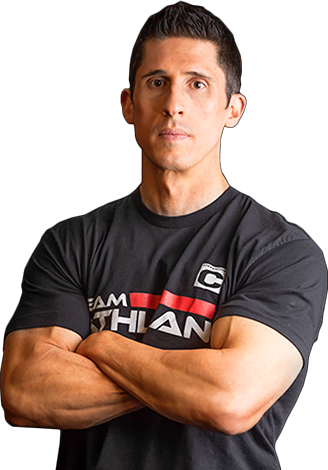
Jeff Cavaliere M.S.P.T, CSCS
Jeff Cavaliere is a Physical Therapist, Strength Coach and creator of the ATHLEAN-X Training Programs and ATHLEAN-Rx Supplements. He has a Masters in Physical Therapy (MSPT) and has worked as Head Physical Therapist for the New York Mets, as well as training many elite professional athletes in Major League Baseball, NFL, MMA and professional wrestling. His programs produce “next level” achievements in muscle size, strength and performance for professional athletes and anyone looking to build a muscular athletic physique.