



why choose pea protein?
The one for people who can’t do dairy. The backup plan. Definitely not what you’d reach for if whey protein were sitting right there next to it.
Guys, that reputation is about a decade out of date.
Admittedly, scoop for scoop, pea protein has less leucine, the amino acid that triggers muscle growth. And this is typically the reason people overlook pea protein in favor of whey.
Don’t let this stop you from considering pea protein.
Because when you bump up the total protein, you naturally increase the amount of leucine, and that’s when pea protein keeps pace with whey for strength and size.
This guide breaks down everything you need to know about pea protein including where it comes from, how it stacks up against other plant proteins, what it does for your body, how much you need, and how to read a label so you don’t walk out with a tub of flavored filler.
Here’s what we’ll cover:
1) WHAT IS PEA PROTEIN?
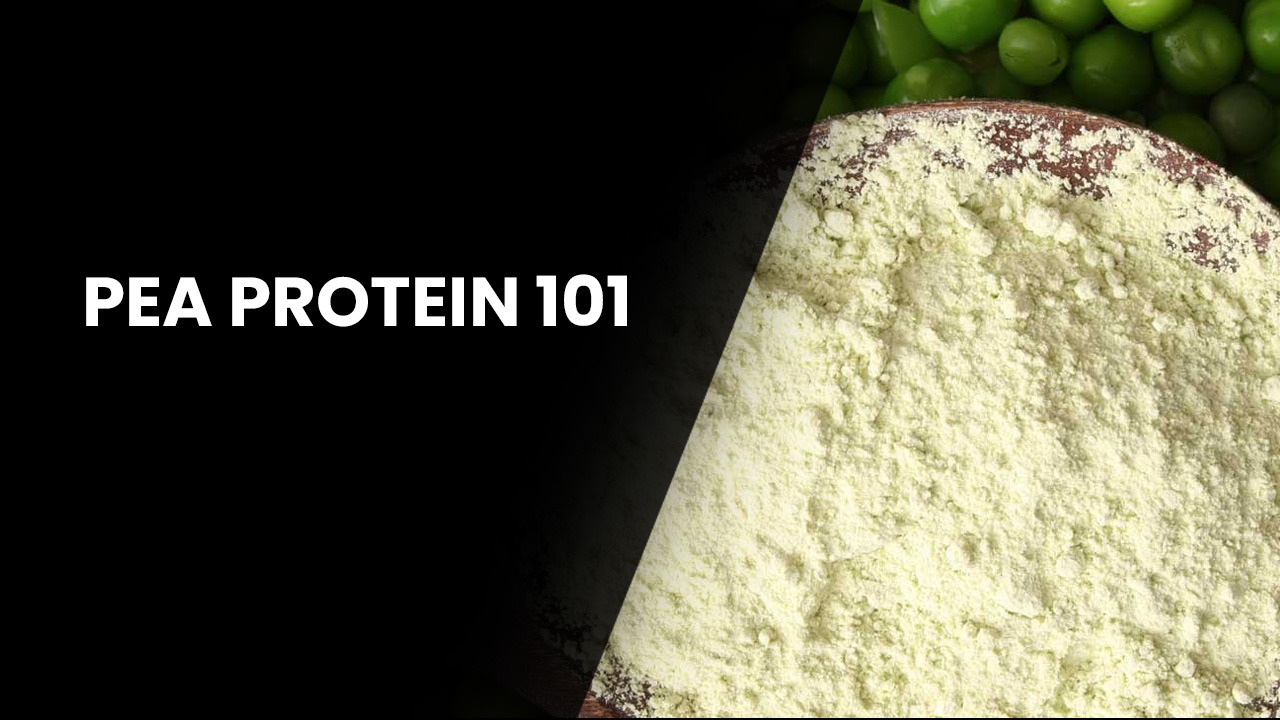
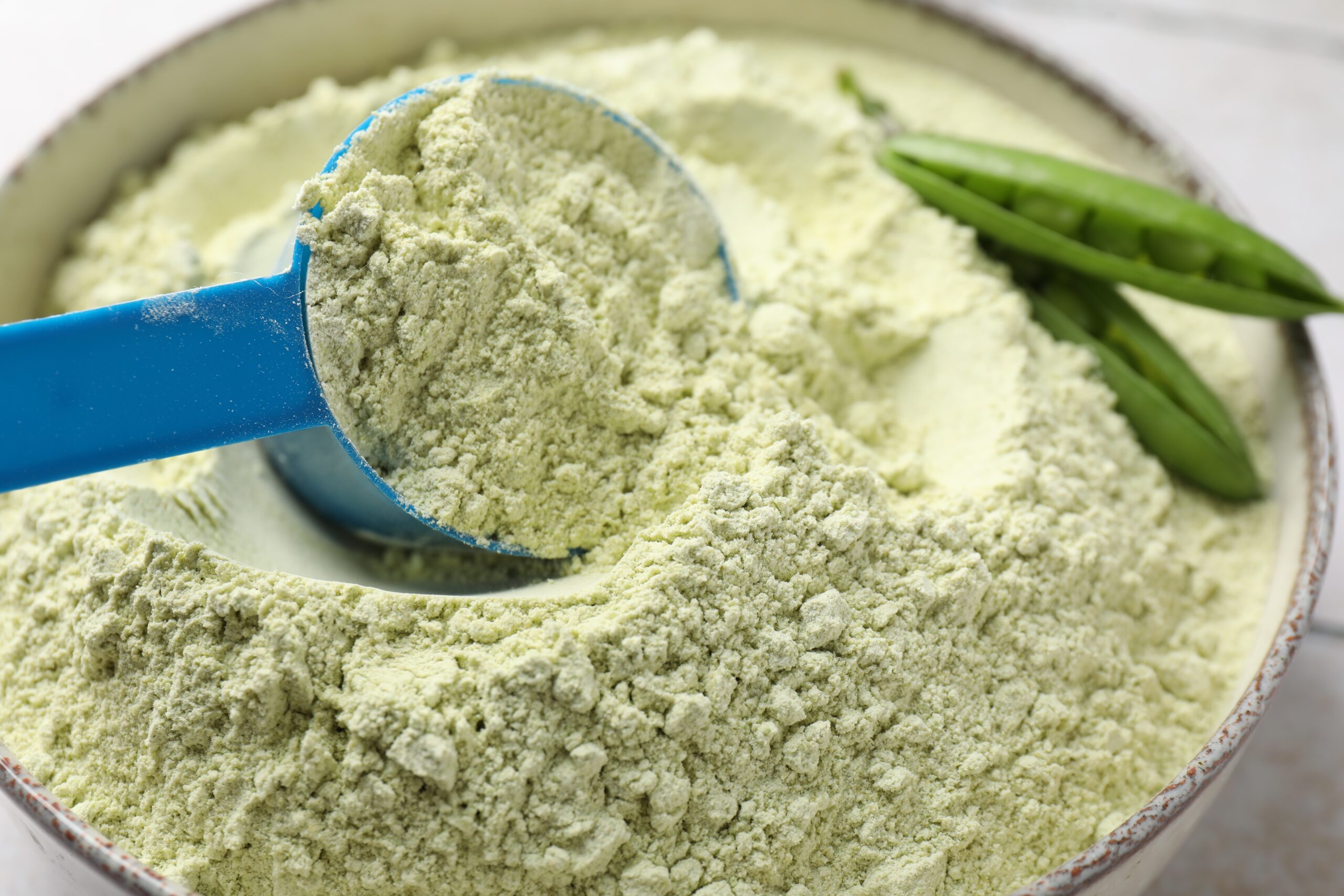
The peas in pea protein aren’t the bright green ones in your freezer. They’re yellow split peas, a dry, starchy member of the legume family, the same group as lentils and chickpeas.
That’s the raw material. Pea protein powder is what’s left after you separate the protein from everything else in the pea.
Knowing how that separation works tells you why one tub reads 80% protein and another reads 50% protein.
FROM SPLIT PEA TO SCOOP
It starts with dried yellow peas, milled into a fine flour that holds three things at once: the protein you’re after, plus the starch and fiber that make up the rest of the pea.
Separating the protein from those other two is the whole job. The industry calls it protein extraction, and there are two ways to get it done.
The dry fractionation method is the cheaper route.
The flour runs through air classification, which uses air currents to sort the lighter protein particles away from the heavier starch.
It’s simple, it’s purely physical, and it only takes you so far. What comes out is pea protein concentrate, sitting around 50% to 55% protein, with plenty of carbs and fiber still along for the ride.
Most pea protein on supplement shelves, though, is made through the wet fractionation method.
The flour goes into water so the protein dissolves, then the pH is adjusted until the protein clumps and drops out of the liquid. That step is called iso-electric precipitation.
From there it gets rinsed, neutralized, and spray dried. This route is a genuine chemical process, not just sorting by weight, and it pulls out far more of what you don’t want.
The end result is roughly 80% to 85% protein, sold as pea protein isolate.
ISOLATE VS CONCENTRATE
Almost every pea protein powder made for training is isolate.
When a label reads “pea protein” or “pea protein isolate,” that’s the 80% version, and it’s the one you want.
More protein per scoop, fewer carbs along with it.
Concentrate shows up less often on its own. You’ll mostly find it inside budget products or used in food manufacturing.
There’s nothing wrong with it, but a bigger share of every serving is carbs and fiber instead of protein, so you’d need a bigger scoop to reach the same number of grams of protein.
You’ll also see peas turn up in forms that have nothing to do with your shaker:
- Textured pea protein goes into plant-based meat.
- Hydrolyzed pea protein, broken down for faster digestion, shows up in some specialty products.
- Pea milk sits on the shelf as a dairy alternative.
Different products, different jobs. For building muscle, you want the powder, and you want the higher-protein version.
2) PEA PROTEIN VS OTHER PLANT PROTEINS
Here’s something most guys don’t realize about plant proteins: every one of them is missing something.
There are nine amino acids your body has to get from food. It can’t make them on its own.
These are the essential amino acids. Your muscles need all nine to grow. If you’re short on any one of them, muscle building slows down, no matter how much total protein you eat.
Every plant protein, with the exception of soy, is low on at least one of those nine. Pea, rice, and hemp each have a weak spot.
That might sound like a deal-breaker, but it’s not.
Once you know which one each protein is short on, fixing it comes down to combining the right proteins.
Let’s start with pea protein.
PEA PROTEIN
Pea protein, made from split peas, is high in lysine and arginine.
It also brings a good amount of branched-chain amino acids, or BCAAs. There are three of them: leucine, isoleucine, and valine.
These three are what your muscles use directly to repair and grow. Leucine is the main driver of muscle growth.
Pea protein’s weak spot is methionine. Close that gap, and pea becomes a complete protein.
But which plant protein contains a lot of methionine?
Enter rice protein.
RICE PROTEIN
Rice protein is the opposite of pea.
Rice is high in methionine, the exact one pea is short on. And rice is low in lysine, the one pea has plenty of.
Pea and rice are made for each other because two incomplete proteins add up to one complete amino acid profile.
You’ll see them paired in protein supplements constantly, and it’s not marketing. Put both in one protein shake and each covers what the other doesn’t have.
One thing to know about rice protein on its own: brown rice pulls heavy metals out of the soil it grows in, especially inorganic arsenic.
Reputable brands test for it so there’s no need to worry, but it’s a reason rice protein quality varies more than pea protein.
HEMP AND SOY
Two more alternative proteins round out the shelf, and they sit at opposite ends.
Hemp protein powder is only 30% to 50% protein, well below pea or rice. The rest is mostly fiber.
That’s great for digestion, but it makes hemp a poor protein replacement when muscle is your goal. You’d need a huge serving just to hit a normal protein number.
Soy is the opposite. Soy protein isolate runs about 90% protein and is complete on its own, no blending needed.
On paper, it’s the strongest plant protein for building muscle, and it’s one of the few with research linking it to heart health.
The catch is that plenty of guys steer clear of soy over hormone concerns, and it’s also a common food allergen. Between the hormone worries and the allergen issue, most people pass on it.
WHY BLENDS WIN
If you’re on a plant-based diet and training hard, stop thinking about single protein sources. Think of blends.
Pea and rice together is the go-to pairing, but pea and rice isn’t the only combination that works.
The principle is the same: pair pea with a plant protein that fills its methionine gap. Here are some options:
- Pea + Brown Rice: The most common. Pea is high in lysine and low in methionine. Brown rice is the opposite. Cleanest combination for a complete amino acid profile.
- Pea + Pumpkin Seed: Pumpkin seed protein is high in methionine, which fills pea protein’s gap. Less common in dietary supplements, but a strong option when you see it.
- Pea + Sunflower Seed: Sunflower seed is also high in methionine. Pairs well with pea for the same reason.
- Pea + Hemp: Hemp has some methionine plus omega-3s and fiber. Not as clean a match as rice, but a reasonable alternative.
Some products use tri-blends like pea + rice + hemp, combining the amino acid match with extra nutrients.
That isn’t settling for less than animal protein. That’s two or three plant sources doing together what one can’t do alone.
A good plant-based protein is a blend, not a single ingredient.
ATHLEAN-RX Vegan PRO-30G uses pea and brown rice as the base, with chia and flax added in. The pea and rice cover the essential amino acids. The chia and flax bring fiber and omega-3 fats, for boosted nutrition on top of the 30 grams of protein.
PLANT PROTEIN CHEAT SHEET
Not all plant proteins solve the same problem. Some bring the protein density. Others help cover the amino acid gaps.
The key is knowing what each one does: some stand alone, some need a partner, some work better as support ingredients than as the main source.
Use this cheat sheet to see what each plant protein does best.
| PROTEIN SOURCE | PROTEIN % | STRENGTH | WEAK SPOT | BEST USE |
| Pea Protein | 80-85% | High in lysine and BCAAs | Low in methionine | Base of any plant protein blend |
| Brown Rice Protein | Around 80% | High in methionine | Low in lysine | Top pairing partner for pea |
| Pumpkin Seed Protein | 60-70% | High in methionine | Low in lysine, less common | Pairing partner for pea |
| Sunflower Seed Protein | 50-65% | High in methionine | Low in lysine, less common | Pairing partner for pea |
| Hemp Protein | 30-50% | Some methionine, plus fiber and omega-3s | Low protein content | Pairing partner with bonus nutrients |
| Soy Protein | Around 90% | Complete on its own | Common allergen, hormone concerns | Standalone plant protein if you tolerate it |
3) BENEFITS OF PEA PROTEIN
Pea protein is the remaining option when dairy is off the table. Lactose trouble, a vegan diet, a skin breakout. That’s the story most guys know.
But pea protein isn’t only a backup plan.
It brings benefits of its own, some that any good protein delivers and some that dairy can’t.
Here are five reasons to consider pea protein in your supplement line-up.
BUILDS MUSCLE AS WELL AS WHEY
This is the one that surprises people. Alternative proteins like pea have a reputation as the lesser choice for building muscle. The research doesn’t back that up.
In a 12-week study, 161 men ran the same resistance training program.
One group took pea protein, one took whey, one took a placebo. At the end, the two protein groups had gained the same muscle thickness.
Same training, same timeline, same result. If building muscle is the goal, pea protein gets you there.
EASIER ON YOUR STOMACH
If a whey shake leaves you bloated, gassy, or cramping, the culprit is lactose, the natural sugar in milk.
A lot of guys can’t break it down well, and their gut pays the price.
Pea protein has none of it. It’s made from a plant, not milk, so there’s nothing there for a lactose-sensitive gut to react to. It’s also free of two other common triggers: gluten and soy.
Plenty of people assume protein powder and a calm stomach can’t go together. Pea protein is the fix.
KEEPS YOU FULL LONGER
Protein is the most filling of the three macronutrients, and pea protein is no exception.
When you drink it, it triggers the gut hormones that tell your brain you’ve had enough to eat. At the same time, it tamps down ghrelin, the hormone that drives hunger.
The result is simple. You feel full longer, and you’re less likely to raid the kitchen an hour later.
That helps a lot when you’re losing fat.
Fat loss comes down to eating fewer calories than you burn, and the hardest part is the hunger that comes with it.
A pea protein shake between meals takes the edge off and makes the calorie deficit easier to stick to.
STEADIER BLOOD SUGAR
Eat a meal that’s mostly carbs, and your blood sugar shoots up fast, then drops just as hard. That drop is the afternoon crash, the sluggish, foggy, need-a-nap feeling that hits a couple hours after lunch.
Pea protein helps flatten that curve.
In one controlled study, healthy adults who had pea protein alongside a carb-heavy drink saw a smaller rise in post-meal blood sugar levels than those who took the carbs alone.
More pea protein meant a smaller spike.
Steadier blood sugar means steadier energy. Fiber helps here too, since it slows digestion and keeps the rise more gradual, and many pea protein blends provide a few grams per serving.
GET AN IRON BOOST
Pea protein naturally contains iron. Whey has next to none.
Iron is the mineral your blood uses to move oxygen around your body. A serving of pea protein can deliver around 5 milligrams, roughly a quarter of what you need in a day.
It’s the plant-based type, so your body doesn’t absorb it quite as efficiently as the kind in red meat, but it still adds to your daily total.
For a guy training hard, that isn’t a small thing. Running low on iron drains your energy and your endurance.
Getting some with every shake, instead of zero, is an edge in pea protein’s favor.
4) CAN PEA PROTEIN BUILD MUSCLE?
Which is better: plant protein or animal protein? Guys, your muscles don’t know whether a protein came from a cow or a pea.
They respond to two things: how much leucine a single serving delivers, and how much total protein you eat across the day.
Nail those two, and pea protein can help you build more lean muscle.
THE LEUCINE QUESTION
You’ve heard that protein builds muscle. Get more specific, and it’s truer to say leucine builds muscle.
Every time you train, you break muscle tissue down, and your body repairs and rebuilds it. That rebuild has a name: muscle protein synthesis.
Leucine is what starts it by turning on a pathway called mTOR, the body’s muscle-building on-switch.
Without enough leucine, that switch stays off.
Whey protein is about 11% leucine. Pea protein is about 8%. Per gram, whey holds more of the exact amino acid that triggers growth.
A 30-gram scoop of whey delivers a little over 3 grams of leucine. The same amount of pea protein comes to about 2.4.
The gap isn’t huge, but it’s there, and a small pea scoop can leave you under what your muscles want in one hit.
HOW TO CLOSE THE GAP
Closing it comes down to one number you control: how many grams of pea protein you put in the shaker.
To switch mTOR fully on, you want about 3 grams of leucine in one sitting.
Pea protein, at 8 percent leucine, gets there at about 38 grams of protein. For most powders, that is a scoop and a half, sometimes two. Scoop sizes vary, so go by the grams of protein on the label, not the scoop.
One move that does not close it: swapping to a pea-rice blend instead of pouring more.
Rice protein has about the same 8 percent leucine as pea, so blending the two adds no leucine at all. It fixes the methionine gap from earlier, not this one. For leucine, the only lever is grams.
Now the second number, and it is the bigger lever of the two: your total protein for the day.
To build muscle, aim for roughly 1 gram of protein per pound of bodyweight. For example, a 180-pound lifter wants about 180 grams a day, food and shakes combined.
WHAT THE STUDIES SHOW
The lab work backs the math.
In one study, researchers had young men and women take a pea-based plant protein, the same plant protein with extra leucine added, or whey.
On its own, the plant protein raised muscle protein synthesis, but less than whey protein did.
Then came the finding that settles it. Once extra leucine brought the plant protein level with whey, it triggered the same muscle-building response.
Same protein. Add leucine. Same result. That’s the whole argument in one experiment. The source was never the issue. The leucine was.
Longer training studies point the same way.
The 12-week trial from earlier had the pea and whey groups gaining the same muscle thickness, and they did it on a standard 25-gram serving taken twice a day.
The leucine per dose was never maxed out, but the daily intake and the training were locked in.
Other research comparing plant and animal protein across weeks of lifting keeps finding the same thing: when total protein is high enough, the source stops being the deciding factor.
Pea protein builds muscle. Treat leucine and total dose as the levers, and it builds it as well as anything else on the shelf.
5) PEA PROTEIN SIDE EFFECTS AND DOWNSIDES
For most guys, pea protein goes down without a fight. No lactose, no dairy, none of the common allergens. That’s more than a lot of protein powders can say.
But no protein is perfect.
Pea has three rough edges worth knowing before you buy, but all three are easy to manage once you know they’re coming.
THE EARTHY TASTE
Depending on the brand, this is the thing you might notice. Pea protein has an earthy, slightly beany flavor whey doesn’t have.
Some guys barely register it. Others call it a dirt taste and mean it.
It comes from the pea itself. Peas are legumes, and legumes bring an earthy, vegetal flavor that survives the trip from field to powder. Texture can run a little gritty too.
Again, this is heavily brand dependent.
But let’s say you got a brand that has a stronger “earthy” taste. This isn’t going to be hard to cover up.
Chocolate hides it better than vanilla, since cocoa is strong enough to bury the earthy note.
Non-dairy milks like almond or oat help more than plain water. So does a smoothie with banana or peanut butter.
A well-flavored product covers most of it on its own. Today’s pea proteins taste far better than the chalky versions from ten years ago.
SODIUM CONTENT
This next one doesn’t show up on taste or texture. It shows up on the label.
Pea protein isolate tends to run higher in sodium than whey. It’s a side effect of how the powder is made.
The protein gets pulled out of the pea with a salt solution, and some of that sodium stays in the final product.
The numbers aren’t alarming, but they aren’t nothing.
A serving of whey has 60 to 70 milligrams of sodium. A serving of pea protein often runs 200 or more, three to four times that.
Even so, it’s still a small share of a 2,300-milligram daily limit, so for most guys it changes nothing.
The only reason I’m bringing it up is because I believe it’s worth a look if you watch your sodium for blood pressure, or if a doctor has you on a restricted intake.
Check the label, compare a few brands, and pick one on the lower end. Sodium varies a lot from one pea protein to the next.
BLOATING ON BIG SERVINGS
Pea protein is gentle on most stomachs. That’s because there’s no lactose in it like you will find with whey concentrate.
But there’s a catch, and it ties straight to the last section.
To hit your leucine target, we told you to pour bigger servings of pea protein, around 38 grams.
Down that much protein in one go, on an empty stomach, and your gut might protest. Pea is no exception. The result is some bloating or gas, less harsh than the lactose kind, but there.
Avoiding this is simple:
Don’t slam a huge dose the second you wake up. Take it with food, or with plenty of water.
New to pea protein? Start with a smaller scoop and build up over a week or two so your gut adjusts.
And if a 38-gram dose sits heavy, split it into two smaller ones across the day. You still reach your protein total, minus the discomfort.
6) HOW MUCH PEA PROTEIN DO YOU NEED?
Pea protein does not change how much protein your body needs in a day. It just changes where some of that protein comes from.
Before you scoop anything, you need one number: your daily protein target.
Pea protein powder accounts for part of that target, and whole food covers the rest.
Pea protein is not a mass gainer. You are not using it to flood your day with calories or stand in for whole food. You are using it to top off the protein your plate misses.
Set your daily total, break it across the day, then let pea protein fill the gap.
YOUR DAILY TARGET
Your daily protein target comes down to two things, your body weight and your goal. Most guys fall between 0.7 and 1.0 grams of protein per pound of body weight.
If you are training to hold the muscle you already have, 0.7 grams per pound is enough.
If you’re working out to add muscle, or to lose fat without dropping the muscle under it, then go to 1.0 gram per pound.
Hard goals cost more protein, and a deficit puts your muscle at risk unless you keep protein high enough to protect it.
Pick your number, multiply by your bodyweight, and you have your daily total. The math is identical for pea protein, eggs, or steak. A gram of protein is a gram of protein.
BREAK IT INTO MEALS
That total is not one giant sitting. Spread it out. Aim for 30 to 50 grams of protein per meal, three to five times a day.
Your body handles steady doses of protein better than one massive load, and four moderate meals are far easier to hit than one enormous one.
Nobody is eating 180 grams of protein at breakfast.
This holds for any protein, pea included. A pea protein shake follows the same rule. Keep each one inside that 30-to-50-gram window.
WHERE PEA PROTEIN COMES IN
Order of operations: whole food first, pea protein second.
Whole food brings the protein and a lot more with it. You also get iron, healthy fats, and the micronutrients a powder cannot match.
Most of your protein should come off a plate, not out of a tub.
If you eat meat and dairy, your best options are going to be the following:
- Chicken breast, around 40 grams in a medium breast
- Lean beef or steak, about 30 grams in a 4-ounce portion
- Fish like salmon or tuna, roughly 30 grams in a 5-ounce fillet
- Eggs, about 18 grams in three large ones
- Greek yogurt, around 20 grams per cup
But what if you don’t eat meat and that’s the whole reason why you’re using pea protein? The rule holds for you too! The protein just comes from a different list:
- Seitan, about 20 grams in a 3-ounce serving
- Tempeh, around 17 grams in 3 ounces
- Extra-firm tofu, about 15 grams in a 3- to 4-ounce block
- Edamame, around 18 grams per cup
- Lentils, beans, and chickpeas, 15 to 18 grams per cup
Smaller sources stack up across a day, too. Dairy alternative pea milk brings about 8 grams a glass, and plant-based egg alternatives add a little more on top.
No single one of these anchors your day, but together they nudge your running tally up.
Pea protein closes the gap. Some days your plate leaves you 40 or 60 grams short of your number for the day.
One shake gets you 30-plus grams of protein in the time it takes to rinse the shaker. Treat it as the patch over what whole food missed, not the centerpiece of your diet.
PEA PROTEIN AND TIMING
Pea protein is digested about as completely as whey. The difference is speed.
Whey floods your blood with amino acids fast. Pea releases them more gradually, sitting between fast whey and slow-digesting casein.
That steadier pace changes how tightly you need to time it.
The old reflex is to slam a shake the second you rack the weights. With pea, there is less reason to rush.
Its amino acids take longer to show up, so if you want them to work around your training, drink it a bit earlier, before or during the session instead of after.
And the post-workout window is wider than what you may read online. Protein within an hour or two on either side of your workout is plenty.
That slower release works in your favor the rest of the day.
Pea trickles its amino acids in instead of dumping them all at once, so it keeps feeding you longer between meals, or overnight as the last protein before bed.
None of this outranks your daily total. Timing is fine-tuning, not the foundation. Lock that number in first, and you can stop worrying about the clock.
7) HOW TO CHOOSE A PEA PROTEIN (AND WHAT TO AVOID)
Most pea protein powders look identical on the shelf, and that grams of protein number on the front tells you less than you think.
What separates a good one from a bad one comes down to three things, all of which are easy to verify:
START WITH THIRD-PARTY TESTING
When you think of plant protein, heavy metals probably aren’t the first thing to come to mind.
Plants draw lead, cadmium, and arsenic up from the soil they grow in, so plant proteins hold more of them than whey does, including around three times the lead.
This is a food safety concern worth taking into account because a 2025 analysis of 160 protein powders found most of the plant-based ones were over California’s Proposition 65 limits for these metals.
Luckily, pea protein tends to be a lower-risk choice compared with some other plant-based proteins. By reaching for pea protein, you have already picked the cleaner side of the aisle.
The next step is choosing a clean pea protein supplement, because heavy metal levels can still vary a lot by brand, largely depending on where the peas were grown.
Look for proof someone outside the company checked it.
The brands worth your money run their pea protein through independent heavy metal testing and show it, either with published results or a seal from an outside lab.
NSF Certified and Informed Sport are the names to look out for on a supplement label. This tells you that a lab with no connection to the brand has verified what the supplement label claims.
NSF also runs a “Certified for Sport” tier that screens for banned substances, worth seeking out if you compete and get drug tested.
Testing pays off twice.
The same lab testing that screens for those metals also confirms the protein number on the label is accurate.
Some powders pad that figure with cheap added aminos to look stronger than they are, and a tested one has nowhere to hide.
What to avoid is a product that says nothing about testing at all or one that claims they test “in-house.”
That’s like a student being asked to grade his own homework.
And do not let the word “organic” stand in for any of this. Organic certification ensures limited pesticides and no GMOs, which is no small thing, but it says nothing about heavy metals.
READ THE INGREDIENT LIST
Flip the tub over. A good pea protein keeps a short ingredient list: pea protein, or pea and rice, a flavor, maybe one thickener for the texture.
If you can read the whole thing in one breath, that is a good sign. But a really long list is the warning sign.
The one to dodge is a “proprietary blend,” which lumps ingredients together so you cannot see how much of each you are getting.
After that, watch for added sugar sitting high in the ingredients, and a stack of gums and fillers there to bulk it up.
The more crowded the label, the less of it is protein.
Now, let’s talk about two of the misunderstood and misread things on a supplement label:
The first is “non-GMO.” You will see it stamped on plenty of pea proteins, but there is no commercial GMO pea, so a pea protein is non-GMO with or without the stamp.
Treat it as reassurance, not a reason to pay more.
The other is an extra protein like rice. That is not filler. Rice fills in the amino acids that pea protein is light on, so a pea-and-rice blend is an upgrade, not a red flag.
The sweetener is on this list too.
Sucralose and acesulfame potassium are the common ones, and regulators consider them safe at the dose in a daily shake, so they are not the villain the internet makes them out to be.
If you would still rather skip artificial sweeteners, look for stevia or monk fruit. And do not trust a “no artificial sweeteners” badge on the front while plain sugar sits in the ingredients.
CHECK WHAT YOU’RE GETTING PER SCOOP
A protein number on the front means little on its own.
Twenty-five grams of protein might come in a lean thirty-gram serving or a bulky fifty-gram one, and those are not the same product.
Find the scoop size and the calories on the back and read them against the protein.
Twenty-five grams in a thirty-gram scoop is nearly all protein. Twenty-five in a fifty-gram scoop is protein plus a lot of something else.
Whether that something else is fine sends you back to the ingredient list. Rice protein, fiber, or ground seeds are worth having, and a bigger serving to hold them is no problem.
Cheap filler is the opposite. It’s dead weight that empties the container faster while you think you are buying protein.
You will also see “isolate” and “concentrate” on labels. Isolate runs more protein per scoop, concentrate less. Either can be a good buy.
The point is not to chase one word on a label; it is to know what is in each scoop before you pay for it. Do not let a big claim close the deal on its own. Turn the tub around first.
Three checks, and not one takes longer than a minute in the aisle: a testing seal, a short ingredient list, and a scoop that is mostly protein. If you do this, choosing a pea protein stops being a gamble.
WHAT I RECOMMEND
I am not going to walk you through what to look for and then leave you standing in the aisle scratching your head.
The pea protein I point people to is the one we make: ATHLEAN-RX Vegan PRO-30G.
It clears all three of the requirements that we discussed above:
It is third-party tested and NSF Certified, so the contamination question gets answered outside our own walls.
Its ingredient list is short and clean: pea and brown rice protein, chia, flax, stevia.
And the scoop tells the same story, 30 grams of protein for 180 calories, with the rest going to fiber and seeds rather than filler.
That is the standard I would hold any pea protein to, and our Vegan PRO-30G is the one I trust enough to put my name on.
Your muscles respond to amino acids, total dose, and consistency, not the source printed on the front of the tub.
Pea protein works because it can deliver what muscle needs when you choose a clean product and use enough of it.
Set your daily protein target, choose a clean third party-tested powder, and hit that number consistently enough for your training to show up in your body.
Check out our complete line of ATHLEAN-RX Supplements and find the best training program for you based on your fitness level and goals.

- Pea protein is not the consolation prize. In a head-to-head training study, it built the same muscle as whey, because your body answers to amino acids and dose, not the source.
- Pea protein is made from yellow split peas. For training you want the isolate, near 80 to 85 percent protein, not the concentrate, which is closer to half carbs and fiber.
- On its own, pea is short one amino acid: methionine. Rice has it to spare, so a pea-and-rice blend covers all nine essentials.
- Leucine is the amino acid that turns muscle growth on, and pea has less of it than whey, gram for gram. Close that gap with a bigger serving, around 38 grams of pea protein.
- Your daily protein total does more for your physique than any one scoop. Hit 0.7 to 1.0 grams per pound of bodyweight, toward the top end when you are chasing muscle or losing fat.
- Spread that total out. Thirty to fifty grams of protein per meal, several times a day, beats one giant load your body cannot use at once.
- Always go with food before supplements. Pea protein is there to patch what your plate misses, not to act as a mass gainer.
PEA PROTEIN FAQ
Pea protein has three “downsides,” but each is easily manageable once you know it is coming.
The first is taste. Pea protein has an earthy, slightly beany note, though it varies by brand and modern formulas hide it well. If you are sensitive to it, pick a chocolate version and blend it with a non-dairy milk instead of water.
The second is sodium, which runs higher in pea isolate than in whey because of the salt used to extract the protein. For most people that changes nothing, but if you track sodium for blood pressure, compare a few labels and choose a lower one, since the amount swings widely by brand.
The third is bloating, which can hit if you down a big serving too fast on an empty stomach. Take it with food, ease in with a smaller scoop for the first week or two and split any large dose across the day.
Neither one is better across the board. The right pick comes down to your goal and what your system tolerates, not the protein itself.
For building muscle, the two end up even. Pea protein has less leucine per gram, so a pea serving has to be a little larger to spark the same muscle response, but what you build comes out the same. Measure by the protein grams on the label, since pea scoops are often smaller than the dose you are aiming for.
Whey wins if you are after the most leucine in the least powder, or a fast hit of amino acids right after training.
Pea protein releases its amino acids more slowly, which suits the stretch between meals or the hours before bed.
Pea also pulls ahead if dairy bothers you or you follow a plant-based diet.
Pea protein is a powder made from yellow split peas, the dried, starchy legume, not the soft green peas you eat as a side.
To make it, producers mill the peas into a flour, then separate the protein from the starch and fiber around it.
The common method, wet fractionation, dissolves the protein out in water and dries it into pea protein isolate, around 80 to 85 percent protein.
A cheaper air-sorting method yields a concentrate closer to 50 percent, with more carbs left in.
For training, you want the isolate, since it packs more protein and fewer carbs per scoop, while concentrate mostly turns up in budget products and packaged food.
As a dry powder, pea protein has a long shelf life, often a year or two unopened. Store the tub sealed somewhere cool and dry, and it stays good well past the day you open it.
Pea protein's health benefits go beyond helping you build muscle.
With no lactose, gluten, or soy, it is gentle on digestion, so a stomach that reacts badly to dairy-based protein will usually handle pea without trouble.
It is also filling: protein satisfies hunger better than carbs or fat, so a shake between meals keeps you from overeating later, which helps when you are in a deficit to lose fat.
Paired with a carb-heavy meal, it steadies the blood sugar rise that follows, softening the energy dip a heavy lunch can bring.
And it supplies iron, a mineral plenty of people run low on. The iron in pea is the plant form, absorbed a little less readily than the iron in red meat, but it still adds to your daily intake.
REFERENCES
- Bibeault N, Païzis C, Deley G, Guérin-Deremaux L, Saniez MH, Lefranc-Millot C, Allaert FA. Pea proteins oral supplementation promotes muscle thickness gains during resistance training: a double-blind, randomized, Placebo-controlled clinical trial vs. Whey protein. J Int Soc Sports Nutr. 2015 Jan 21;12(1):3. doi: 10.1186/s12970-014-0064-5. PMID: 25628520; PMCID: PMC4307635.
- Thondre PS, Young E, Pledger S, Kefyalew S, Hatami I, Perreau C, Guérin Deremaux L, Lefranc-Millot C, Tammam J. A randomized controlled trial in healthy participants to compare the insulinogenic effects of whey protein and pea protein co-ingested with glucose. PLoS One. 2026 Jan 30;21(1):e0340386. doi: 10.1371/journal.pone.0340386. PMID: 41615946; PMCID: PMC12857942.
- Lim C, Janssen TAH, Currier BS, Paramanantharajah N, McKendry J, Abou Sawan S, Phillips SM. Muscle Protein Synthesis in Response to Plant-Based Protein Isolates With and Without Added Leucine Versus Whey Protein in Young Men and Women. Curr Dev Nutr. 2024 May 10;8(6):103769. doi: 10.1016/j.cdnut.2024.103769. PMID: 38846451; PMCID: PMC11153912.
Jeff Cavaliere M.S.P.T, CSCS
Jeff Cavaliere is a Physical Therapist, Strength Coach and creator of the ATHLEAN-X Training Programs and ATHLEAN-Rx Supplements. He has a Masters in Physical Therapy (MSPT) and has worked as Head Physical Therapist for the New York Mets, as well as training many elite professional athletes in Major League Baseball, NFL, MMA and professional wrestling. His programs produce “next level” achievements in muscle size, strength and performance for professional athletes and anyone looking to build a muscular athletic physique.