







WHAT DOES IT TAKE TO GET A FLAT STOMACH?
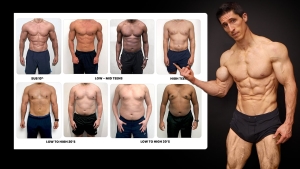
You need to lose the fat around your midsection, and you need to train your core in a way that helps your stomach look tighter when that fat comes off.
Most people only focus on one side of that equation.
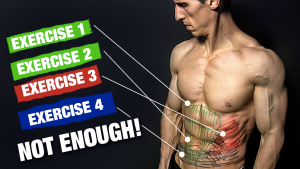
They do more crunches, planks, and ab workouts, expecting that to flatten their stomach. But if your body fat percentage is still too high, no amount of core work is going to give you the look you want.
On the other hand, if you only focus on weight loss and ignore training, you can end up with a smaller stomach that still does not look as tight or defined as you expected.
Here’s how to fix both sides of the problem.
I’ll start with how nutrition helps you lose belly fat by controlling calorie intake, food choices, and consistency.
Then I’ll break down the training you need to do to strengthen your core and improve body composition, so your stomach looks flatter, not just smaller.

NUTRITION TIPS FOR A FLAT STOMACH
The nutrition side of a flat stomach is where a lot of people come up short, which is why I want to talk about it first.
I don’t think people are lazy when it comes to diet.
They train hard in the weight room. They watch their PRs improve. Overall, they feel productive, but then they look in the mirror, and they just don’t see much change where they want it.
People have good intentions, but I think the plateau in progress comes down to overlooking the consistent things that drive belly fat loss.
They stay on track for one or two meals, but not for the whole day. They choose foods that seem healthy but still end up eating more calories than they realize. Then the extras start piling on (snacks, drinks, sauces, dressings, and bigger portions) and the deficit disappears.
Before training can help shape the result, nutrition has to handle the part that training cannot.
Let’s cover all of the nutrition habits that decide whether your stomach muscles get flatter or stay the same.
START WITH A CALORIE DEFICIT
Belly fat comes off when your calorie intake stays below what you burn.
That does not mean slashing calories as hard as possible. A steep calorie deficit can look great on paper, but it tends to fall apart fast. Hunger goes up, training starts to feel worse, recovery drops, and by the end of the day or the end of the week, people end up eating back the calorie deficit anyway.
A better starting point is a deficit of about 200 to 500 calories per day. That is enough for most people to make progress without dragging down energy, workouts, or consistency.
A good target is to lose about 0.5 to 1 percent of your body weight per week. For example, if you weigh 180 pounds, that puts you around 0.9 to 1.8 pounds per week.
Some weeks will be faster. Some will be slower. That does not always mean the plan is not working. A few things can change the rate of fat loss:
- People with more body fat to lose often drop weight faster at the start.
- People who are already leaner tend to lose weight more slowly.
- Water retention can hide fat loss on the scale from one week to the next.
- Sodium intake can push scale weight up even when fat loss is still moving in the right direction.
- Stress and poor sleep can affect both scale weight and how well you stick to the plan.
Look at the trend over a few weeks instead of reacting to one weigh-in.
It also helps to understand what a 200 to 500 calorie deficit looks like in real life. It is not as big as people think, and it is a lot easier to create with nutrition than with exercise.
As an example, let’s look at walking.
Walking burns far fewer calories than most people expect, at about 4 calories per minute, so even an hour only gets you into the mid-200s. But just one higher-calorie snack or one restaurant add-on can wipe that out fast.
Create most of the deficit through food intake.
Skip the sugary coffee drink. Swap a breaded chicken meal for grilled chicken. Measure the olive oil instead of free pouring it. Pass on the extra dressing, chips, or dessert.
Those changes can get you into a workable deficit a lot faster than trying to burn it off afterward.
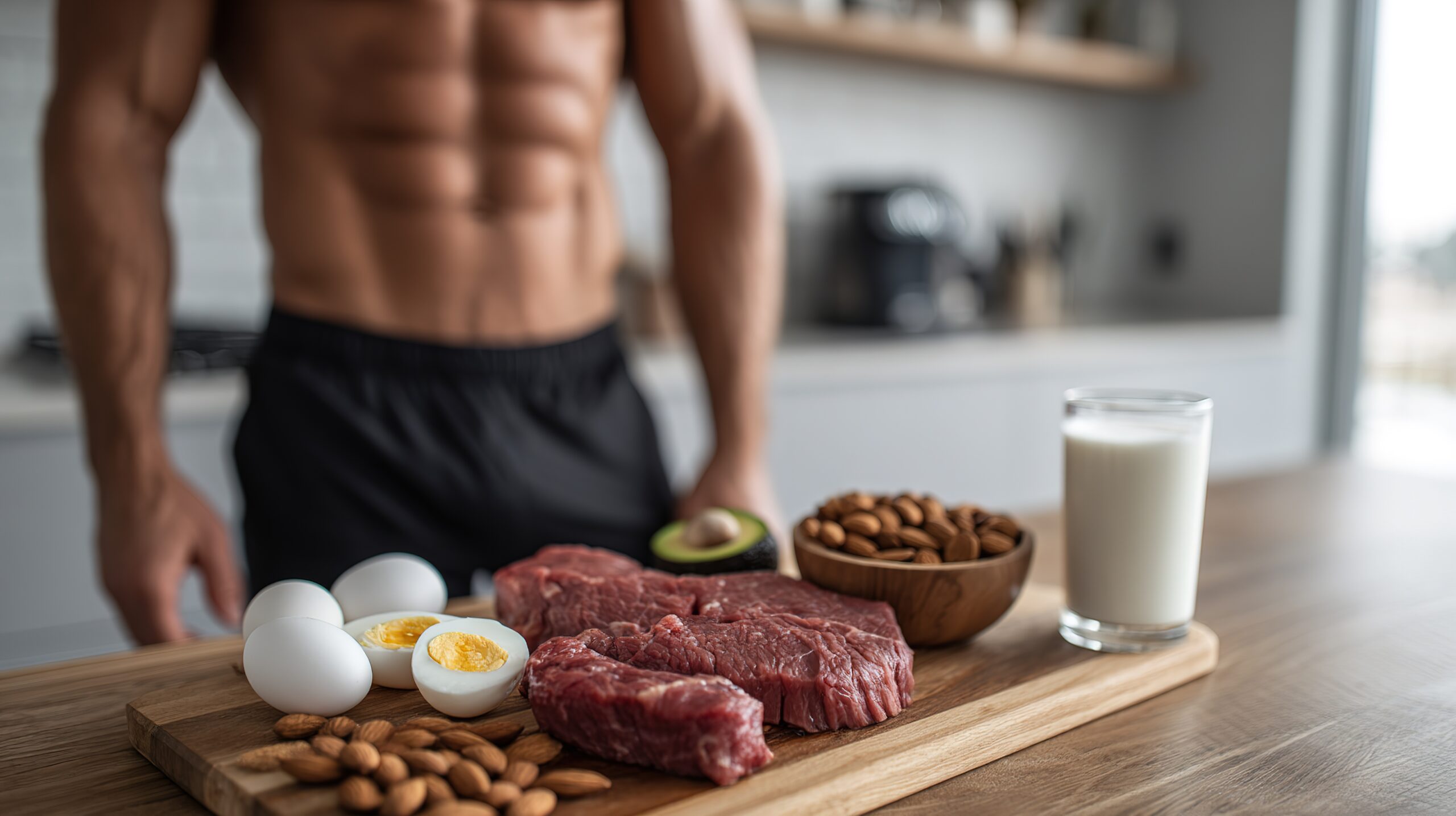
BUILD MEALS AROUND PROTEIN
Lean protein should be the anchor of your meals when fat loss is the goal.
One reason is hunger control. Meals built around protein tend to keep you full longer than meals built mostly around refined carbs or fat-heavy extras. That makes it easier to stay in a calorie deficit without feeling like you are starving halfway through the day.
Protein also helps you hold on to muscle while you lose fat by giving your body the raw material it needs to maintain muscle tissue during a calorie deficit.
That is important because you don’t just want the scale to go down. You want to improve body composition as well, so more of the weight you lose comes from fat instead of muscle. If you are training hard and trying to build or keep a tighter look through your midsection, lean protein intake needs to support that.
A practical target for most people is about 25 to 40 grams of protein per meal. Across the full day, a good range is about 0.7 to 1.0 grams of protein per pound of goal body weight. You can use our protein calculator to estimate your desired daily intake.
Let’s say your fitness goal weight is 170 pounds, that puts you around 120 to 170 grams of protein per day.
You do not need to hit the top end perfectly every day, but you do need to get close often enough for it to help.
Here is what 25 to 40 grams of protein can look like in real food:
- 5 to 6 ounces of chicken breast: about 35 to 45 grams
- 1 cup of low-fat cottage cheese: about 25 to 28 grams
- 1 cup of Greek yogurt: about 15 to 20 grams, depending on the brand
- 2 whole eggs plus 1 cup of egg whites: about 32 to 38 grams
- 1 scoop of protein powder: often about 20 to 25 grams
- 1 can of tuna: about 30 to 35 grams
- 5 to 6 ounces of salmon: about 30 to 40 grams
- 5 ounces of lean ground turkey: about 30 to 35 grams
A simple way to make this work is to build each meal around a real protein source instead of hoping protein just ends up in the meal somewhere.
Start by deciding what the protein is, then build the rest of the meal around it. Spread that protein across 3 to 5 meals or feedings per day instead of trying to cram most of it in at night, since that makes it harder to hit your target and usually leaves earlier meals too light.
Protein powder can help when you need something quick or convenient, but it should fill gaps, not replace meals that could have been built from real food.
And do not assume a meal is high in protein just because it includes a little chicken, a scoop of yogurt, or some peanut butter. The numbers still have to support it. A meal only helps you hit your protein target when it gives you enough to count.
TRACK LIQUID CALORIES
Liquid calories are one of the easiest ways to wipe out a calorie deficit without noticing it.
The problem is not just that drinks can be high in calories. It is that they do not do much for hunger compared to solid food, so they are easy to stack on top of meals instead of replacing them.
Here are some of the most common liquid calories and the range they usually fall into:
- Soda: about 140 to 170 calories per 12-ounce can
- Juice: about 100 to 160 calories per 8-ounce serving
- Sweet coffee drinks: about 150 to 400+ calories depending on the size and what gets added
- Smoothies: about 250 to 600+ calories depending on the ingredients and portion size
- Beer: about 100 to 200 calories per drink
- Craft beer: often 170 to 300+ calories per pint
- Wine: about 120 to 130 calories per 5-ounce glass
- Cocktails: about 150 to 300+ calories depending on the mixer and pour
Now, put that next to the deficit you are trying to create.
If your target is a 200 to 500 calorie deficit per day, one sweet coffee drink can eat up 150 to 400 calories of it right away.
A smoothie with fruit juice, nut butter, and protein powder can push you past the full 200 to 500 calorie range on its own.
A couple beers or cocktails at dinner can do the same before you even count the meal.
That’s why liquid calories are such a problem for fat loss. They can push calorie intake up fast without making you feel like you ate much more.
This does not mean every smoothie or glass of wine is off-limits. It means you stop treating drinks like they do not count.
Water, sparkling water, unsweetened tea, and black coffee make it much easier to keep your intake under control. Then, when you do want something higher in calories, you fit it into the day on purpose instead of letting it unknowingly eat into your deficit.
WATCH OUT FOR EXTRAS
This is where a lot of people lose control of the calories deficit without noticing it.
The main meals may be fine. Breakfast is decent. Lunch looks clean. Dinner is not terrible. But then the extras start showing up around those meals, and that is where calorie intake climbs fast.
Sauces are a good example. Barbecue sauce, teriyaki sauce, honey mustard, mayo-based sauces, and creamy dips can add 50 to 150 calories in a serving that barely looks like anything.
Dressings do the same thing. A vinaigrette or creamy dressing can land anywhere from 80 to 160 calories per 2 tablespoons, and a heavy pour can turn that into 200 calories or more without much effort.
Oils are even easier to underestimate. Two tablespoons of olive oil are about 240 calories. Think about how much oil you use when you’re cooking, when you top the meal, and when you throw it on a salad as a dressing.
A meal that looked like part of a healthy diet can easily end up carrying a few hundred extra calories before you even get to the main protein or starch.
Snacks are another place where people get caught.
A “small” handful of nuts can be 170 to 200 calories. A protein bar can run 200 to 300 calories. Chips, crackers, trail mix, granola, and nut butter-based snacks can all push intake up fast, especially when they get eaten casually instead of built into the day on purpose.
Dessert is the most obvious one.
There is a big difference between finishing dinner with fruit and finishing it with a cookie, brownie, slice of cake, or ice cream.
A single cookie might cost you 100 to 150 calories. A brownie or piece of cake can land around 250 to 500 calories. A bowl of ice cream can do the same, depending on the portion. That is enough to wipe out a large part of the deficit from the day, especially when the meal itself was already big enough.
This is why healthy food choices alone are not enough. Someone can make healthy recipes at home, eat meals that look clean, and still fail to lose fat mass because the extras keep pushing intake higher than expected.
A healthy lifestyle is not just about the main foods on the plate. It is also about how often these small add-ons show up and how much they change the final calorie total.
SUPPLEMENTS FOR A FLAT STOMACH
Let me start by saying that supplements, on their own, are not going to flatten your stomach.
They cannot replace a calorie deficit, getting enough protein, or training that improves body composition. What they can do is help you hit those targets more consistently.
That is where the right supplements can be helpful.
Some make it easier to reach your daily protein target. Some help you train harder or recover better. Some support muscle retention while body fat comes down.
The other thing I’d like to address, and to set expectations, is that this section is not about trendy fat burners or quick-fix products like peptides.
It is about the few supplements that have a real case for supporting better nutrition, better training, and a flatter stomach when the basics are already being handled properly.
PROTEIN POWDER
Protein powder is one of the easiest ways to get more protein into the day without adding another full meal.
That is why it helps here.
Getting a flat stomach is not just about losing weight. You also want to hold on to muscle while body fat comes down. Protein supports that, and it also makes meals more filling, which can make the diet easier to stick to.
Most protein powders give you about 20 to 30 grams of protein per serving. That makes them useful when a meal is low in protein, when you are busy, or when whole food is not practical.
Whey is the most common choice because it is convenient, high-quality, and rich in essential amino acids. Casein also works, especially when someone wants a slower-digesting option.
ATHLEAN-RX PRO 30G makes sense here because it gives you 30 grams of protein per serving, which puts it right in a range that can meaningfully help with your daily target.
It also uses a blend of whey protein isolate, whey protein concentrate, and egg white protein, giving you a complete protein source in one serving.
And for people who do not want another heavy meal around training, it is an easy option to digest and get down quickly.
The best use for protein powder is to fill a gap, not replace solid meals by default.
It is there for convenience and consistency. When food is not enough to meet your protein goals, it gives you a clean way to keep protein intake where it needs to be.
CREATINE MONOHYDRATE
Creatine helps on the training side of a flat stomach.
It does not burn belly fat. What it does do is help you get more out of your workouts, which matters when the goal is to keep strength up, hold on to muscle, and improve body composition while body fat comes down.
Creatine helps your muscles regenerate energy faster during short, hard efforts. That can help you squeeze out more quality reps, maintain better performance across sets, and keep training output higher over time.
That matters even more when calories are lower.
Dieting often pulls training performance down with it. Creatine can help limit some of that drop, which gives you a better chance of keeping muscle while you lean out.
A flatter stomach is not just about seeing the scale move. It is also about what your body looks like when the fat comes off. The more muscle you keep, the better that usually goes.
The best form to use is creatine monohydrate.
It is the one with the most research behind it, and for most people, it is all they need. A simple dose is 3 to 5 grams per day.
You do not need to cycle it. You also do not need to load it unless you want to saturate faster. For most people, taking the daily dose and staying consistent is enough.
One thing to know: creatine can push scale weight up a little at first because it pulls water into muscle tissue. That is not body fat, and it is not fat around your middle.
Use it for what it does well: better training quality, better strength retention, and better support for muscle while you are trying to get leaner.
CAFFEINE
Caffeine can support a flat-stomach goal in two ways.
First, it can modestly increase thermogenesis and fat oxidation. Second, and more importantly for most people, it can improve training energy, focus, and output. The performance side is the bigger reason it belongs here, especially when calories are lower and workouts start to feel flat.
A practical starting dose for most people is about 100 to 200 mg before training.
Research often uses a wider range of about 3 to 6 mg per kilogram of body weight, but you do not need to jump straight to the high end to notice a difference. More is not better if it leaves you jittery, anxious, or unable to sleep.
Now, you can drink a cup of coffee, but that tends to come with a lot of extra calories in the form of creamers and sweeteners.
I also think that if you’re going to drink caffeine to support fat burning and workout performance, you should throw in some extras.
That’s why I’d recommend using X-CITE Pre-Workout. It gives you 200 mg of caffeine anhydrous per serving, which is enough for many people to feel a real boost in training energy and focus without going straight to an over-the-top stimulant dose.
It also adds 6 grams of L-citrulline malate, 3.2 grams of beta-alanine, 1.5 grams of L-tyrosine, and 2 grams of Creatine HCL, making it a more complete pre-workout formula instead of just caffeine in a tub.
It’s a solid option for workouts where energy and focus are dragging. You are not using caffeine to “melt” fat off your stomach. You are using it to train harder, keep output up, and get a small thermogenic bump on top of that.
Use it with some restraint, especially if you are sensitive to stimulants, train late in the day, or have blood pressure, anxiety, or other medical concerns. For the latter, I’d check with a healthcare professional first before using any type of pre-workout supplement.
TRAINING TIPS FOR A FLAT STOMACH
A lot of people put real effort into training and still do not get much back from it around their stomach.
The issue is not effort. It is how that effort gets used.
Too much of it goes into random abs workouts, high-rep burnout sets, and belly fat exercises that do not do much to change how the midsection looks.
The training side of a flat stomach needs a different approach.
You need lifting that improves body composition, a core routine that trains the right muscles, and ab exercises that are done with control instead of just volume.
Guys, I want to make sure that you are doing everything you can to train your core the right way to see results.
Coming up, I’m going to talk about the role of full-body strength training, the deeper core muscles most people ignore, the stomach vacuum, and the ab exercises that are worth your time.
START WITH FULL-BODY TRAINING
Full-body training means each workout covers major movement patterns instead of isolating one body part at a time.
This type of strength training helps you keep more muscle while leaning out. That changes how your waist looks once the fat starts coming off.
Lose weight without enough resistance training and you can end up smaller without looking much tighter. Keep more muscle and the result looks sharper.
In a typical total-body session, I would recommend focusing on the following movement patterns and exercises (not necessarily in this order for each workout):
SQUAT
- Goblet Squat
- Front Squat
- Back Squat
LUNGE
- Reverse Lunge
- Walking Lunge
- Split Squat
HINGE
- Romanian Deadlift
- Traditional Deadlift
- Hip Thrust
PUSH
- Push-Up
- Dumbbell Bench Press
- Overhead Press
PULL
- Dumbbell Row
- Chest-Supported Row
- Pull-Up (Lat Pulldown)
CARRY
- Farmer’s Carry
- Suitcase Carry
- Front Rack Carry
CORRECTIVE
- Band Pull-Aparts
- Face Pulls
- Glute Bridge
- Dead Bug
- Bird Dog
This full body structure gives you more return than building the week around isolation movements and flat stomach workouts.
ACUTE VARIABLES TO USE
Exercise selection matters, but so do the training variables.
A lot of people do decent movements, then water down the result with sloppy programming. The weight is too light, the reps get too high, the sets are too easy, or the rest periods are too short to keep performance up.
Sets and Reps: For your main full-body lifts, a good target is 3 to 4 sets of 6 to 12 reps. That gives you enough load to keep strength moving and enough volume to support muscle retention while body fat comes down.
Intensity: For your main full-body lifts, use weights that land around 70 to 85 percent of your one-rep max for most working sets. That is heavy enough to preserve or build muscle, but not so heavy that every set turns into a grind. A good target is to finish most sets with 1 to 3 reps left in the tank. In other words, the set should feel hard, but you should not be hitting failure every time.
Tempo: Use a controlled 2 seconds up / 0 second pause / 2 seconds down on most reps. That keeps the movement controlled, increases time under tension, and makes it harder to rely on momentum.
Rest Breaks: Rest periods matter too. For compound lifts like Squats, Romanian Deadlifts, and Presses, rest about 90 seconds to 3 minutes between sets.
HOW MANY SESSIONS PER WEEK
For most people, 3 to 4 full-body strength sessions per week work best.
That gives you enough weekly volume to maintain or build muscle, enough frequency to improve the lifts that matter, and enough recovery to keep performance moving in the right direction.
I’d recommend 3 sessions per week work well for beginners, busy schedules, and people already doing some aerobic exercise during the week.
For people with more training experience who recover well and want more total work, I’d say go with 4 sessions per week.
But remember that more is not better if recovery starts slipping.
If soreness is dragging into the next session, loads are dropping, or sleep quality is getting worse, the plan needs to be pulled back.
SAMPLE 3-DAY FULL-BODY WORKOUT
Here is a simple 3-day full-body setup built around the movement patterns that do the most work.
Each workout trains the whole body, keeps the exercise list tight, and gives you enough volume to make progress without turning recovery into a problem.
Aim to get stronger on the lifts that keep muscle on your frame while body fat comes down.
DAY 1
- Squat: Goblet Squat: 3 to 4 sets of 8 to 10
- Push: Dumbbell Bench Press: 3 to 4 sets of 8 to 10
- Pull: Dumbbell Row: 3 to 4 sets of 8 to 12
- Hinge: Romanian Deadlift: 3 sets of 8 to 10
- Carry: Farmer’s Carry: 2 to 3 rounds of 20 to 40 yards
- Corrective: Face Pulls: 2 to 3 sets of 12 to 15
DAY 2
- Lunge: Reverse Lunge: 3 sets of 8 to 10 per leg
- Push: Overhead Press: 3 to 4 sets of 6 to 10
- Pull: Pull-Up or Lat Pulldown: 3 to 4 sets of 8 to 10
- Hinge: Hip Thrust: 3 sets of 8 to 12
- Carry: Suitcase Carry: 2 to 3 rounds of 20 to 30 yards per side
- Corrective: Dead Bug: 2 to 3 sets of 6 to 10 per side
DAY 3
- Squat: Front Squat or Back Squat: 3 to 4 sets of 6 to 8
- Lunge: Split Squat: 3 sets of 8 to 10 per leg
- Push: Push-Up: 3 sets of 10 to 15
- Pull: Chest-Supported Row: 3 to 4 sets of 8 to 12
- Carry: Front Rack Carry: 2 to 3 rounds of 20 to 30 yards
- Corrective: Bird Dog or Band Pull-Aparts: 2 to 3 sets

THE BEST ABS & CORE EXERCISES FOR A FLAT STOMACH
Your full-body workouts are the base and from there, you fill in the gaps with core work.
You can add these exercises to the end of your full-body sessions or set aside 1 to 2 days per week for core work and cardio.
Don’t treat all core exercises like they do the same job. Some train spinal flexion. Some resist movement. Some control rotation. Some challenge the trunk to stay stable while the body moves.
Below, I’m going to go over each function of the core and the best exercise to target that specific function.
By the end, you’ll have a complete core workout built for a flatter stomach and better overall core development.
SPINAL FLEXION: LEVITATION CRUNCH (UPPER ABS)

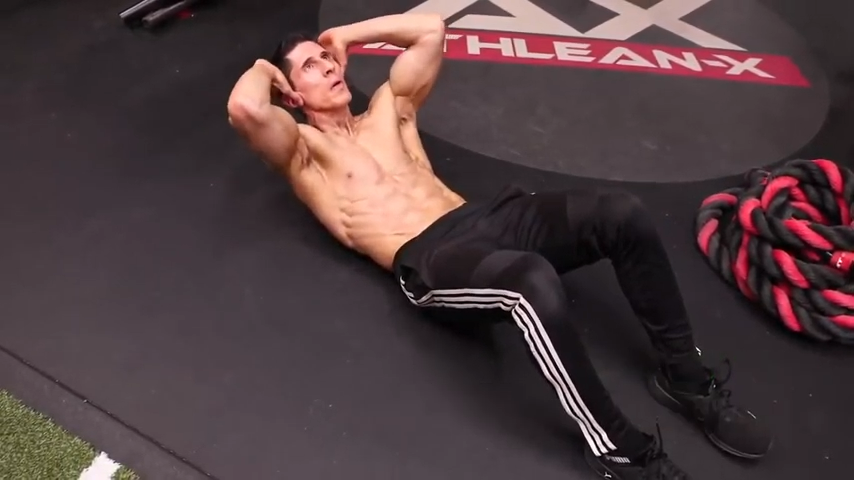
HOW TO DO THE LEVITATION CRUNCH:
- Start by lying flat on your back with your feet flat on the floor and your knees bent.
- Place your hands lightly behind your head or keep your arms in a comfortable position that does not pull on your neck.
- Lift your shoulder blades slightly off the floor and begin a small curling motion upward.
- Focus on bringing your rib cage toward your pelvis instead of trying to sit all the way up.
- Keep the movement short and controlled. Make the upper portion of the rectus abdominis do the work, not to create momentum.
- Lower back down under control and repeat without letting the movement turn into neck strain or a full sit-up.
WHAT MAKES IT EFFECTIVE: The Levitation Crunch keeps the work on the upper abs by using a short, controlled curl instead of a big, sloppy crunch. That takes stress off the neck and keeps tension where you want it.
SPINAL FLEXION: SWIPER (LOWER ABS)
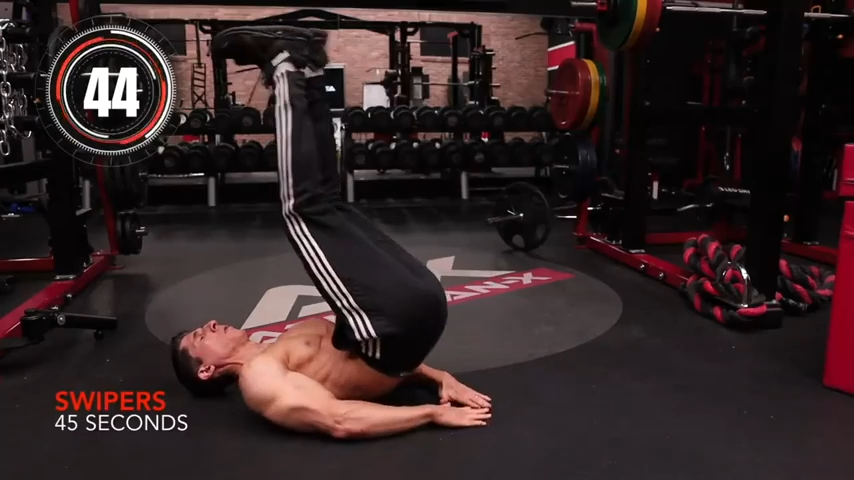
HOW TO DO THE SWIPER:
- Start with your upper body flat on the floor and your arms at your sides.
- Bring your knees toward your chest in a controlled curling motion.
- As your knees come in, focus on lifting your hips and tailbone off the floor.
- Once your hips come up, swipe your hands underneath your tailbone in a half-circle motion.
- Use that hand swipe as feedback. If your hips do not come up enough, your hands will not clear underneath.
- Lower back down under control and repeat without swinging your legs or letting your hip flexors take over.
WHAT MAKES IT EFFECTIVE: The Swiper gives you immediate feedback. If your hips are not lifting, the rep is not there. That keeps the focus on the lower abs instead of turning the movement into sloppy leg swinging.
EXTENSION STABILITY: HOLLOW ROCKS
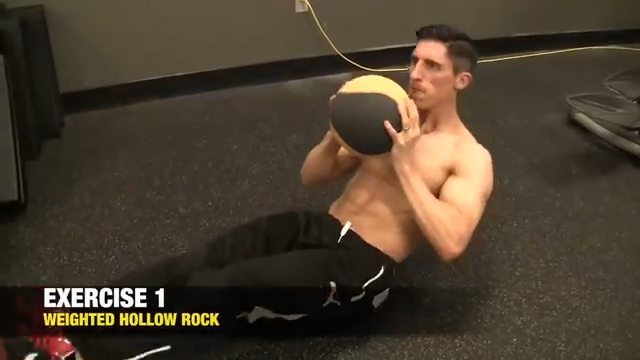
HOW TO DO HOLLOW ROCKS:
- Lie on your back with your lower back pressed into the floor.
- Extend your legs and arms, then lift your shoulder blades and feet slightly off the ground.
- Pull your ribs down and keep your midsection tight so your body holds one solid shape.
- Start rocking forward and backward in a small range without letting your lower back come off the floor.
- Let the movement come from your trunk staying locked in, not from swinging your arms or kicking your legs.
- Keep each rep smooth and controlled from start to finish.
WHAT MAKES IT EFFECTIVE: Hollow Rocks force your core to stay braced while your body moves. That is what makes them better than loose, rushed reps that fall apart the second motion starts.
ANTI-LATERAL: SIDE PLANK (THREAD THE NEEDLE)
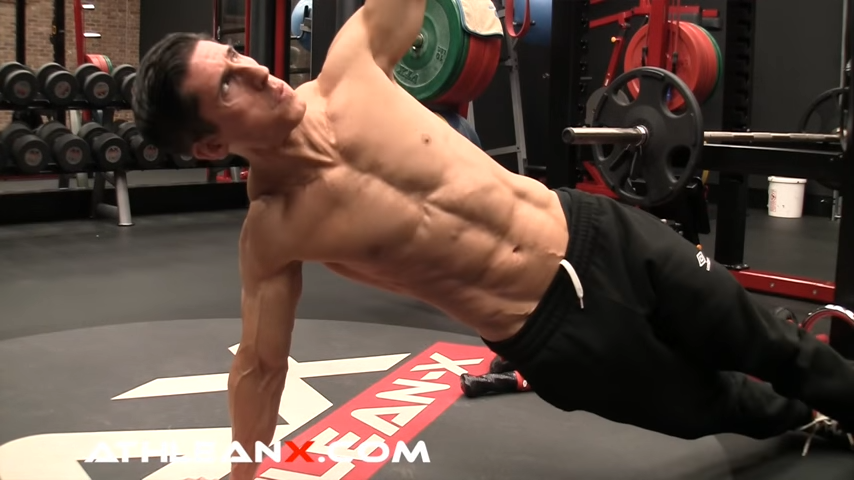
HOW TO DO SIDE PLANK/THREAD THE NEEDLE:
- Get into a side plank position with your elbow directly under your shoulder and your hips lifted.
- Stack or stagger your feet and keep your body in a straight line from head to heel.
- Brace your midsection and keep your hips steady.
- Rotate your upper body and reach the top arm underneath your torso.
- Reverse the motion and reach back up without letting your hips drop.
- Keep every rep slow and controlled.
WHAT MAKES IT EFFECTIVE: This adds movement to the side planks without losing stability. Your obliques have to control the rotation while keeping the hips from sagging.
ANTI-ROTATION: PALLOF PRESS

HOW TO DO PALLOF PRESS:
- Set a resistance band or cable at chest height and stand sideways to it.
- Hold the handle at the center of your chest with both hands.
- Set your stance and brace your core so your torso stays still.
- Press your hands straight out in front of you.
- Hold that position for a brief second without letting your body rotate.
- Bring your hands back to your chest under control and repeat before switching sides.
WHAT MAKES IT EFFECTIVE: The Pallof Press trains your core to resist rotation instead of creating it. That makes it one of the best drills for building trunk control.
ROTATIONAL STABILITY: RUSSIAN TWISTS
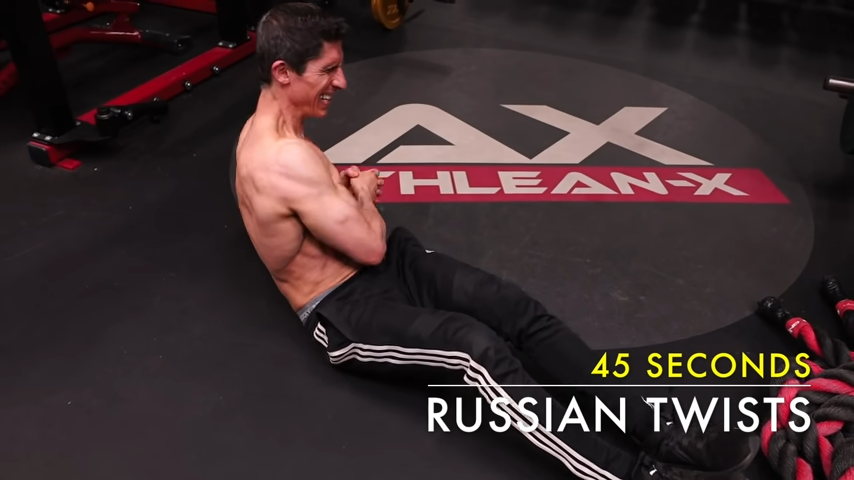
HOW TO DO RUSSIAN TWISTS:
- Sit on the floor with your knees bent and your feet planted.
- Lean your torso back slightly and keep your spine tall.
- Brace your core and extend your arms in front of you.
- Rotate your torso to one side under control.
- Return to center, then rotate to the other side.
- Keep the movement smooth and driven by the trunk, not by swinging the arms.
WHAT MAKES IT EFFECTIVE: Russian Twists work when the rotation stays controlled. That shifts the work to the obliques and deeper core muscles instead of turning the rep into a fast arm swing.
ROTATIONAL POWER: LANDMINE ROTATION
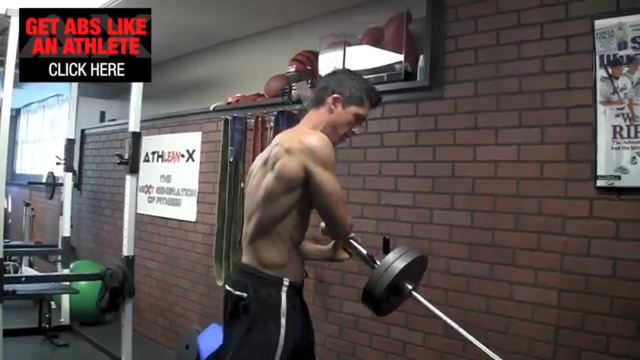
HOW TO DO THE LANDMINE ROTATION:
- Hold the end of a barbell anchored in a landmine or corner setup.
- Stand with your feet slightly wider than hip-width and keep your knees soft.
- Brace your core and keep your hips under control.
- Rotate the bar down toward one side with your torso following the motion.
- Drive the bar back through center and rotate to the other side.
- Keep the movement forceful but controlled from rep to rep.
WHAT MAKES IT EFFECTIVE: This trains your core to create rotation with speed while staying under control. That makes it a strong option for building power through the trunk instead of just endurance.
DEEP CORE ACTIVATION: LEANING STOMACH VACUUMS

HOW TO DO LEANING STOMACH VACUUMS:
- Place your hands or forearms on a stable surface like a bench, bed, or countertop.
- Keep your spine long and your neck relaxed.
- Take a deep breath in through your nose and expand your rib cage.
- Exhale fully through your mouth until you feel empty.
- Once the air is out, pull your abdominal muscles wall inward and slightly upward.
- Hold the position briefly, then relax and reset before the next rep.
WHAT MAKES IT EFFECTIVE: The supported position makes it easier to feel the deep core working. It’s a strong place to start if you are still learning the movement.
DEEP CORE ACTIVATION: STANDING STOMACH VACUUMS
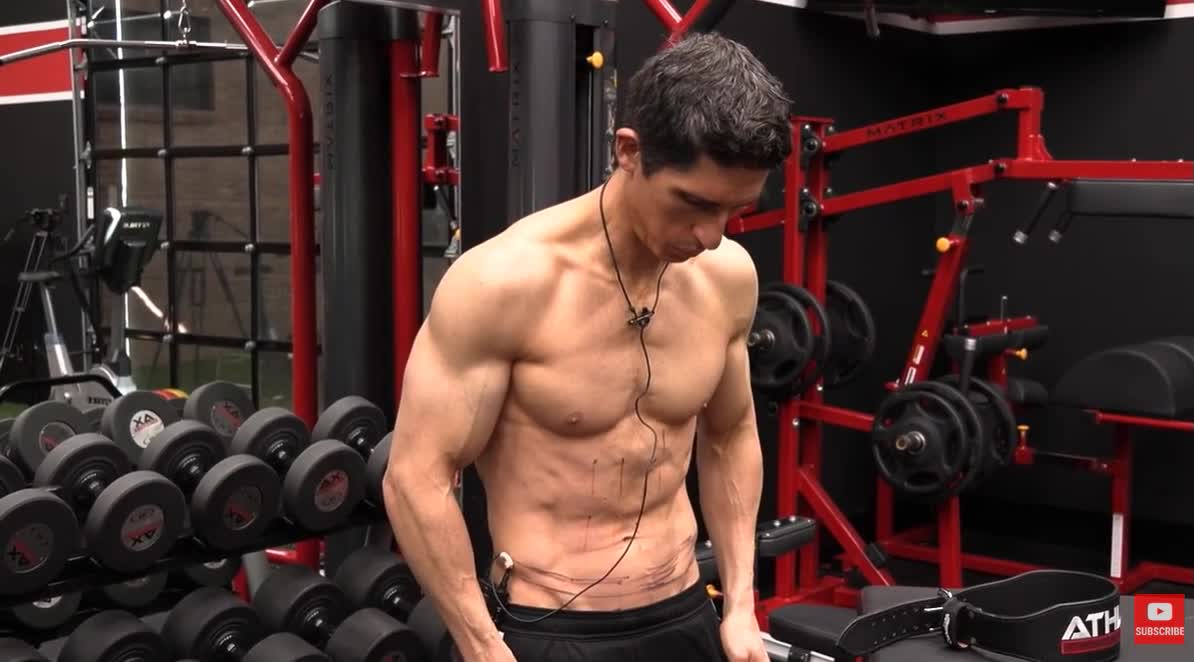
HOW TO DO STANDING STOMACH VACUUMS:
- Stand tall with your feet about hip-width apart.
- Keep your ribs stacked over your pelvis and your shoulders relaxed.
- Take a deep breath in through your nose.
- Exhale fully through your mouth until no air is left.
- Once empty, draw your abdominal wall inward and slightly upward toward your spine.
- Hold for 5 to 10 seconds to start, then relax before the next rep.
WHAT MAKES IT EFFECTIVE: The standing version makes the deep core work harder because you have to control position against gravity. That gives it better carryover to lifting and everyday movement.
CARDIO FOR A FLAT STOMACH
Cardio should support the plan, not run it.
Your full-body and core strength workouts are still the foundation. Nutrition still decides whether body fat comes down.
Cardio comes in after that to help with extra calorie burn, conditioning, heart health, and week-to-week consistency.
It can raise calorie output. It can improve work capacity. It can make the week easier to follow by giving you a little more structure. But it does not replace full-body strength training, and it does not fix poor nutrition.
Walking, biking, rowing, cardio machines, moderate intensity aerobic exercise, and vigorous high intensity exercises can all work here.
What matters is picking the type and amount you can recover from, fit into your week, and repeat without dragging down your lifting or core work.
USE HEART RATE ZONE WORKOUTS
If your cardio has no target, it turns into guesswork.
Heart rate zones fix that. They give you a clear way to control effort instead of hoping the workout is hard enough or easy enough based on feel alone.
A simple way to estimate your maximum heart rate is this formula:
- 220 minus your age
So, if you are 40 years old, your estimated max heart rate is:
- 220 – 40 = 180 beats per minute
Once you estimate your maximum heart rate, you can use it to set the intensity of your cardio.
In other words, instead of guessing how hard to go, you use a percentage of your max heart rate to decide whether the workout should feel easy, moderate, or very hard.
For this plan, the three most useful targets are:
- Zone 2: Aim for 60 to 70% of your maximum heart rate
- Zone 3.5: Set it for 75% of your maximum heart rate
- Zone 5: Try to hit 90 to 95% of your maximum heart rate
So, let’s use the same example of a 40-year-old person with an estimated max heart rate of 180 beats per minute.
That would put the zones here:
- Zone 2: About 108 beats per minute
- Zone 3.5: About 135 beats per minute
- Zone 5: About 162 beats per minute
That gives you a much clearer target during cardio.
Instead of saying, “I think I’m working hard enough,” you can look at your heart rate and know whether you are in the easy, moderate, or high intensity range you were aiming for.
Now, what do these zone workouts look like?
For this plan, cardio falls into three buckets: Zone 2, Zone 3.5, and Zone 5.
Each one does a different job.
Zone 2 is your base. Zone 3.5 is your middle gear. Zone 5 is your short, high-effort work.
When people treat all cardio the same, they either go too easy to get much from it or it is too hard to recover well from it.
ZONE 2: YOUR BASE CARDIO
Zone 2 should make up most of your cardio work.
This is your lower-intensity cardio, around 60 to 70% of max heart rate. It should feel steady and repeatable. You should still be able to talk, even if you are a little short of breath.
Good Zone 2 options:
- Brisk walking
- Incline treadmill walking
- Cycling
- Rowing
- Swimming
- Other low impact variations
A good starting target is 15 to 20 minutes per session, then build toward 25 to 30 minutes as your conditioning improves.
ZONE 3.5: YOUR MIDDLE GEAR
Zone 3.5 sits between easy cardio and all-out intervals.
This is around 75% of max heart rate. It should feel harder than a steady walk or bike ride, but not like you are redlining. You are working, but you are still in control.
A good way to use it is with a short conditioning circuit:
- 5 exercises
- 45 seconds of work
- 15 seconds of rest
- repeat the circuit for 10 minutes total
This gives you a tougher conditioning workout without turning the session into random boot camp chaos.
ZONE 5: SHORT, HARD INTERVALS
Zone 5 is your highest-effort cardio.
This is around 90 to 95% of max heart rate. It should feel very hard, which is why it needs to stay short. This is not the kind of work you tack on mindlessly after every workout.
Good Zone 5 options:
- Sprinting
- Hard intervals on a bike
- Rowing intervals
- Stairmaster pushes
- Other hard interval work you can perform safely
Two simple ways to structure it:
Option 1
- 20 seconds hard
- 40 seconds easy
- repeat for 5 minutes total
Option 2
- 5 minutes hard
- 5 minutes easier
- total time: 5 minutes
WEEKLY CARDIO SCHEDULE
A simple way to organize the week is to rotate the three cardio types like this:
- Monday: Zone 2
- Tuesday: Zone 5
- Wednesday: Zone 2
- Thursday: Zone 2
- Friday: Zone 2
- Saturday: Zone 3.5
- Sunday: Zone 5
This works because most of the week stays built around Zone 2, which is easier to recover from and easier to repeat. Then you layer in two harder Zone 5 days and one middle-effort Zone 3.5 session to push conditioning without turning every day into an all-out effort.
Do not get hung up on the exact days. The bigger priority is keeping the sequence intact and making sure the harder sessions do not start dragging down your lifting, core work, or recovery.
On full-body lifting days, these cardio sessions can stay short or be swapped for a brisk walk. On separate core-and-cardio days, you can give the conditioning a little more attention.
A flat stomach comes from doing the basic things well enough, long enough, for your body to change.
Bring body fat down with nutrition, keep muscle on your frame with hard training, and use core work and cardio to support the results.
Do that consistently, and your waist starts to look different because the work underneath it finally does too.
If you’re looking for a training and nutrition program to help you meet your goals, check out our programs at ATHLEAN-X and use our Program Selector to see which one is the best fit for you.

- A flat stomach takes two things: lower body fat and better core training.
- Nutrition drives the result first. No amount of ab work will uncover your midsection if calorie intake is still too high.
- Start with a calorie deficit you can hold. Around 200 to 500 calories per day is a practical range for most people.
- Build meals around protein. Aim for 25 to 40 grams per meal and enough total protein across the day to help keep muscle while leaning out.
- Liquid calories and extras can wipe out progress fast. Drinks, sauces, oils, snacks, and desserts add up faster than most people think.
- Full-body strength training should be the base. Use 3 to 4 workouts per week built around the following movement patterns: squat, lunge, hinge, push, pull, carry, and corrective work.
- Train the core by function, not just by fatigue. Your core needs flexion, stability, anti-rotation, rotation, and deep-core control.
- The stomach vacuum deserves a prime spot in the plan. It trains the deep core and helps you learn how to pull the abdominal wall in instead of just bracing outward.
- Cardio should support the plan, not replace it. Use Zone 2 for your base, Zone 3.5 for tougher conditioning, and Zone 5 for short intervals.
FLAT STOMACH FAQS
The fast answer is not more bicycle crunches or some holy grail waist workout.
To get a flat stomach, you need to bring body fat down while keeping muscle on your frame. That starts with a safe and realistic calorie deficit (usually between 200 and 500 calories per day), meals built around protein, and full-body training that keeps fat-free mass in place while you lean out.
That is where people get off track. They chase a six pack with fitness videos of Side Plank Dips, Lying Leg Raises, Mountain Climbers, and Pilates exercises that leave their abs burning. But none of that fixes the bigger problem if body fat is still too high.
That also means keeping expectations in check. You can make your stomach look tighter in a couple months by dropping some body fat and getting more control of the transverse abdominis, pelvic floor muscles, and the rest of the deep core.
But if you want a real visual change, it still comes down to consistency, not hacks.
Gut health, sleep, stress, and hormone levels can all affect how your stomach looks day to day, especially if bloating is part of the picture. But those are support pieces. The main driver is still body fat loss paired with smart training.
A flat stomach comes from three things working together: lower body fat, enough muscle, and better control of the core muscles around your midsection.
That first part is the one most people try to skip. If body fat percentage stays too high, no abs workout is going to uncover your midsection. You can do all the workouts from resistance band workouts to CrossFit workouts, but your stomach is not going to look flat just because your abs are tired.
The second part is muscle. If you lose weight without enough full-body training, you can end up smaller without looking much tighter. Squats, lunges, hinges, pushes, pulls, carries, and the rest of your big lifts do more for how your waist looks than random machine-based moves or another 10-minute ab circuit with a weighted plate.
The third part is core control. Your rectus abdominis is only part of the picture. A better-looking midsection also depends on the deeper system around it, including the transverse abdominis, internal obliques, external obliques, erector spinae, and pelvic floor muscles. That is why stomach vacuums, anti-rotation work, side planks, and other well-chosen core drills help. They train the muscles that hold the trunk in position instead of just chasing a burn.
So, what gives you a flat stomach? Not one exercise. Not one supplement. Not one personal trainer trick. It is body fat loss, full-body strength work, and core training that has a reason behind it.
REFERENCES
Jeff Cavaliere M.S.P.T, CSCS
Jeff Cavaliere is a Physical Therapist, Strength Coach and creator of the ATHLEAN-X Training Programs and ATHLEAN-Rx Supplements. He has a Masters in Physical Therapy (MSPT) and has worked as Head Physical Therapist for the New York Mets, as well as training many elite professional athletes in Major League Baseball, NFL, MMA and professional wrestling. His programs produce “next level” achievements in muscle size, strength and performance for professional athletes and anyone looking to build a muscular athletic physique.