






is TOFU a good protein source?
For decades, it was the default answer for anyone who stopped eating meat and wondered where the protein was coming from.
The shelf has since filled up with plenty of plant-based proteins, but you’ll still find tofu there.
Tofu is like the creatine of the plant protein world. It’s cheap and unglamorous but it’s a classic for a reason. It works.
In this guide to tofu protein, I’ll cover the numbers by type, why two blocks labeled firm can have very different amounts, how tofu measures against chicken, and where it fits in a training week.
HOW MUCH PROTEIN IS IN TOFU?
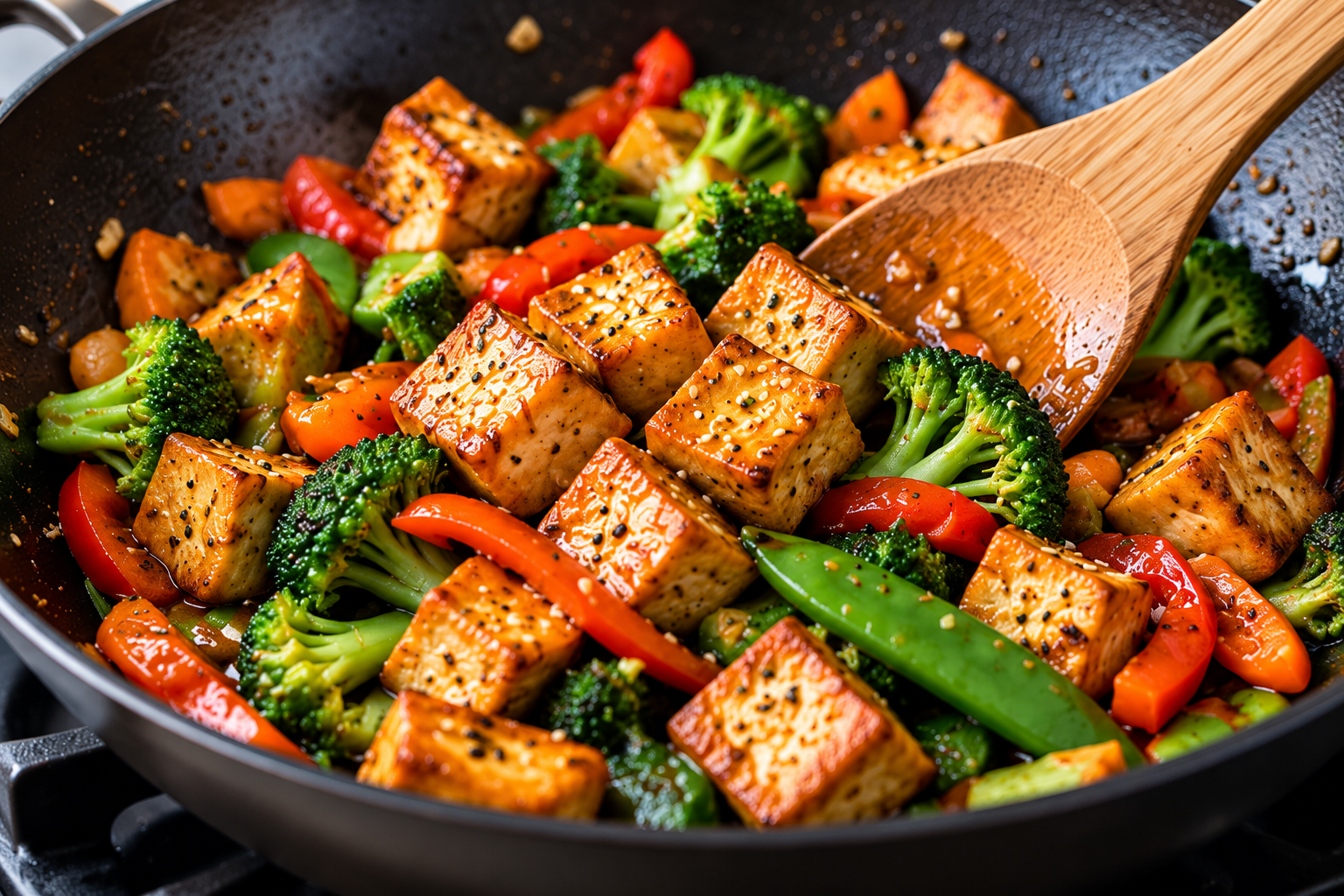
Ask how much protein is in tofu and the real answer is another question: which one?
Silken, soft, firm, extra firm. What separates them is water content. Silken tofu is about 90% water, and the firmest is closer to 70%, which leaves a lot more room for protein.
The gap between the softest and the firmest is wider than those four words make it sound.
HOW THE TYPES COMPARE
Every row below is three ounces, grouped by type. USDA records tofu as protein per 100g, so these figures are converted from that.
Divide the protein by the calories and you get the fourth column. It shows what 100 calories of each type buys you, which turns out to be a different ranking than protein content alone.
Silken is the one row that gets a range instead of a number.
USDA lists eight silken tofus, and the protein runs from about 4 grams to 7 across them, so a single figure would misrepresent most of them.
| TYPE | PROTEIN | CALORIES | PROTEIN PER 100 CAL |
| Silken | 4.1 to 7.0 g | 31 to 53 | varies |
| Soft | 6.1 g | 52 | 11.8 g |
| Regular | 6.9 g | 65 | 10.6 g |
| Firm | 7.7 g | 66 | 11.6 g |
| Extra firm | 8.5 g | 71 | 12.0 g |
| Hard | 10.8 g | 123 | 8.7 g |
| Firm, calcium-set | 14.7 g | 122 | 12.0 g |
| Fried | 16.0 g | 230 | 7.0 g |
| Dried | 44.6 g | 406 | 11.0 g |
Silken at the top and dried at the bottom differ by more than sixfold in protein at three ounces. The nutritional profile changes with every row, and the ones below take the biggest jumps in turn.
Calcium-set tofu is the outlier. It’s drier than the other firm block, and it reaches nearly 15 grams of protein in three ounces, more than three times what silken gives you.
Both firm rows say firm on the front of the box. One measures about 8 grams of protein, the other nearly double.
Hard tofu is the exception. It beats extra firm on protein, but there is far more fat in it, which drags it near the bottom of the last column.
Fried tofu looks strong at 16 grams until you see that it costs 230 calories.
Dried tofu has almost no water left in it. Three ounces leaves you with about 45 grams of protein, more than the same weight of chicken breast.
HOW TO MEASURE TOFU
If you’re tracking your protein, don’t measure tofu in blocks.
Blocks aren’t a standard size. In USDA’s records, a block of tofu can weigh anywhere from about 11 ounces to 17 ounces. That means half a block might weigh five ounces or eight, and the bigger one has about 60% more protein in it.
Use cups instead or put the tofu on a kitchen scale. Half a cup of firm calcium-sulfate tofu comes to about 22 grams of protein for 180 calories. A full cup runs to more than 43 grams of protein for 360 calories.
One more thing. Weigh the tofu before you press it, not after.
A tofu press squeezes water out of the block, so it comes out lighter than it went in. The protein doesn’t go anywhere, though, which means a pressed block weighed on a scale will read lower than what you actually ate.
READ THE PANEL, NOT THE FRONT
The front of the box tells you the texture. The back tells you the protein.
Nutrition labels on packaged tofu print the grams of protein per serving. That number is specific to the block in your hand, which beats any table, including the one above. It’s also why the panel is the one place a block fraction is safe to trust.
Check the serving size next to it, because it’s rarely the whole block.
The panel also lists total fat, saturated fat, trans fat, total carb and dietary fiber for that same serving. Those numbers are the block’s own, not an average.
If you cook the whole block, multiply the panel’s number by the servings per container.
BENEFITS OF TOFU PROTEIN
The protein is why most people buy tofu, but it isn’t the only reason to.
Tofu has been eaten for centuries and studied hard for the last thirty. Some of what turned up is more useful than those grams of plant protein.
SUPPORTS MUSCLE REPAIR
Muscle is rebuilt from twenty amino acids, and nine of them are essential amino acids your body can’t make.
Those nine complete amino acids are leucine, lysine, valine, isoleucine, phenylalanine, threonine, histidine, tryptophan, and methionine.
Tofu has every one of them, and that amino profile puts it in the small group of plant foods that count as a complete protein. That amino acid profile is what most plant foods are short of.
GREAT FOR BONE HEALTH
Three ounces of firm calcium-set tofu has about 580 milligrams of calcium. That’s 45% of what you need in a day, and FDA counts anything over 20% as high.
FDA also has an approved claim connecting the two: getting enough calcium throughout life, as part of a healthy diet, reduces the risk of osteoporosis and the bone loss behind it. Claims like that have to clear the agency’s highest evidence bar before anyone can print them.
Calcium isn’t the only thing that affects your bones, and nobody can tell you how much a given amount lowers your risk. FDA requires both of those caveats, and they’re fair ones.
Not every tofu reaches 580 milligrams of calcium. Check the calcium line on the Nutrition Facts panel, which prints the percentage for the block you’re holding. For example, you’ll notice silken tofu only comes in around 2%.
PROTEIN WITHOUT THE CARBS
Carbohydrate is where tofu is nearly empty. Three ounces of the calcium-set block has about 2 grams, and most of that is fiber, which passes through undigested. What’s left is under a gram of carbs.
Now, compare that to other popular plant proteins at three ounces and you’ll immediately see the difference.
Tempeh has about 7 grams of carbohydrate. Edamame has about 8 grams. Lentils have about 17 grams and quinoa has about 18 grams, which is roughly seven times what tofu carries.
If you’re counting carbohydrates or eating in a calorie deficit, nothing else on that list is close.
WON’T HURT YOUR TESTOSTERONE
If you’ve heard one bad thing about tofu, it’s that soy will mess with your hormones.
Soybeans contain compounds called phytoestrogens, and the name alone does most of the damage. They’re plant compounds that can attach to estrogen receptors, the same spots in your body that the hormone itself uses.
That part is true. What doesn’t follow is that they then behave like estrogen.
In 2021, a team pooled 41 clinical trials in men and measured five hormones, testosterone among them. Nothing moved. They checked the men eating the most soy separately, and the longer studies separately. Same answer both times.
The cancer research is similar. The American Cancer Society finds no increased risk from eating soy protein or soy foods. A 2018 review went further, linking higher soy intake to lower rates of prostate cancer. That one is observational, so treat it as a signal rather than a verdict.
PAIR IT WITH THESE
Tofu usually lands on a plate where meat would have been. The protein makes the trip. Three other things don’t.
Tofu has no vitamin B12. Not low, zero. Iron and zinc each sit at around an eighth of daily recommended intake in three ounces.
Meat is where most people get all three, so if tofu is replacing it a few times a week, those three have to come from somewhere else.
If you still eat meat sometimes, three ounces of steak covers all of them at once: B12 at 159% of the Daily Value, zinc at 30%, and iron at 15%.
If you don’t, a cup of lentils covers iron at 37% and zinc at 23%. B12 is the one plants can’t solve, so it comes from fortified foods or a supplement.
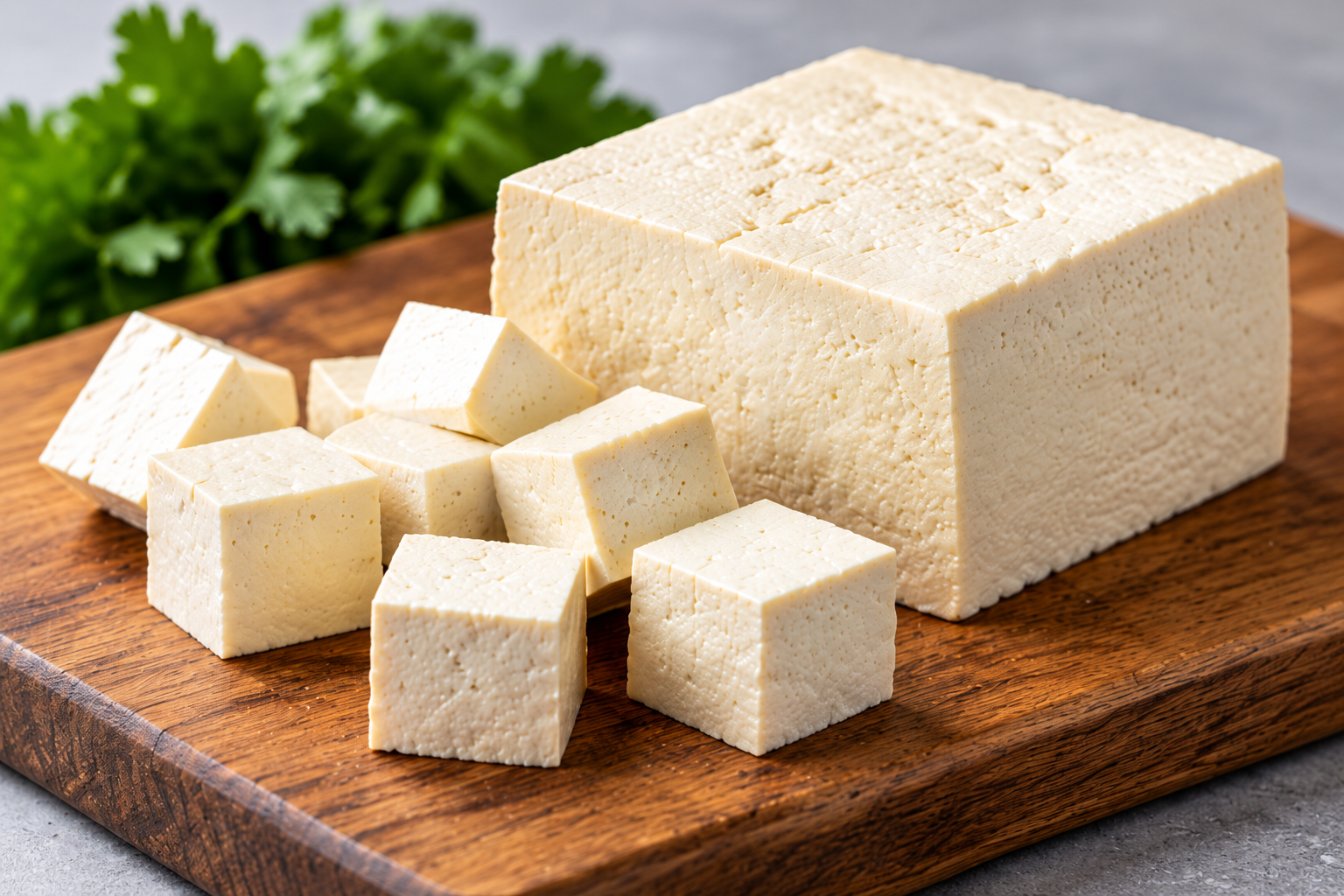
TOFU VS OTHER PROTEIN SOURCES
Going head-to-head, tofu just doesn’t stand a chance against the classic heavy hitters like chicken breast.
But that’s okay. Nobody buys tofu expecting otherwise.
Tofu’s competition is the other plant protein foods, the options you would consider buying to hit your protein goals.
You’ll notice that tofu appears twice on the table below. Both blocks are labeled firm, and the drier of the two has far more protein.
Every figure is three ounces. Everything except the tofu is cooked.
| FOOD | PROTEIN | CALORIES | PROTEIN PER 100 CAL |
| Chicken breast | 26.4 g | 140 | 18.8 g |
| Tofu, firm calcium-set | 14.7 g | 122 | 12.0 g |
| Tofu, firm | 7.7 g | 66 | 11.6 g |
| Tempeh | 16.9 g | 166 | 10.2 g |
| Edamame | 10.1 g | 103 | 9.8 g |
| Egg | 10.7 g | 132 | 8.1 g |
| Lentils | 7.7 g | 99 | 7.8 g |
| Black beans | 7.5 g | 112 | 6.7 g |
| Green peas | 4.4 g | 66 | 6.6 g |
| Chickpeas | 7.5 g | 139 | 5.4 g |
| Quinoa | 3.7 g | 102 | 3.7 g |
The table gives you the numbers. What to do with them is below: what 30 grams of protein costs from each of these, which is protein density in practice, and where tofu falls behind.
TOFU BEATS BEANS PER CALORIE
For most guys, give or take 30 grams of protein is a solid target for a meal. And you can easily hit that target with firm calcium-set tofu for about 250 calories. Other plant proteins aren’t as low calorie.
For example, 30 grams of protein from lentils is 385 calories. From black beans it is 450 calories. From chickpeas it is 555 calories.
Only tempeh puts more protein in three ounces than tofu does. It holds nearly 17 grams of protein in that portion. Calcium-set tofu stops under 15 grams. But keep in mind that the extra protein costs more calories. Tempeh is the better pick only when plate space is the limit, not your daily calories.
MORE FAT THAN CHICKEN
Remember that the goal is to get about 30 grams of protein per meal.
When it comes to a chicken breast, you get those 30 grams of protein in just three and a half ounces at 160 calories. From calcium-set tofu it takes about six ounces and 250 calories. Plain firm tofu needs nearly twelve ounces and 260 calories.
Chicken breast is the lean protein here, and fat is the reason why.
Calcium-set tofu has 7 grams of fat at three ounces. Chicken breast at that portion has 3 grams. Fat holds more than twice the calories of protein by weight.
Most of that is polyunsaturated fat rather than saturated fat, and tofu contains no cholesterol. Three ounces of chicken breast contains 72 milligrams of it.
LOW IN FIBER
Tofu’s carbohydrate is almost all fiber. That makes it a low-carb food, not a high-fiber one.
Three ounces of calcium-set tofu carries 2 grams of fiber, and plain firm tofu under a gram. Black beans, lentils and chickpeas each contain 6 grams of fiber or more at three ounces.
Chicken breast and the egg contribute none at all, so tofu is not bottom of the table here. Fiber is also the easiest gap to fill, since the vegetables already going on the plate supply it.
SOY PROTEIN ISOLATE IS DENSER
Soy protein isolate is 88 grams of protein per 100 grams at 335 calories. Per 100 calories that is 26 grams of protein, against 19 grams for chicken breast and 12 grams for tofu.
Soy protein concentrate is 64 grams of protein per 100 grams, and defatted soy flour is 51 grams of protein. The meat extender in USDA’s records, textured soy protein by another name, is 42 grams and is where a lot of plant-based meats and protein-packed entrees start.
On everything except protein, soy protein isolate loses. It has no fiber at all. Sodium is 1,005 milligrams per 100 grams against 14 milligrams in the same weight of tofu. Calcium goes the other way, 178 milligrams against 683 milligrams.
That is the trade you already make with whey isolate. More protein for the calories, less of everything around it. Isolate belongs in a shake. Tofu goes on a plate.
HOW TOFU FITS YOUR TRAINING GOALS
The thing I love about tofu is that it fits whether you are gaining muscle, losing fat, or maintaining.
How many other plant proteins can say that?
But what you need from tofu changes with your fitness goals. Building muscle asks whether the protein is good enough. Burning fat asks what it costs in calories.
Luckily, one block of tofu covers both.
BUILDING MUSCLE
Most plant foods cover the amino acids in pairs. Rice is low in lysine. Beans are low in methionine. Eat them together and each one answers for what the other is missing, which is where that old advice started.
Tofu skips that step. One block is a complete protein on its own, so a training meal can rest on a single food instead of a pairing.
Resistance work creates the demand, and training sessions are what the protein repairs. For anyone on vegan diets, or moving toward a vegan lifestyle, that is one less thing to plan around.
BURNING FAT
The number one rule of being in a caloric deficit is that you cannot skimp on protein. If you do, you run the risk of your body using that hard-earned lean muscle mass as fuel.
How many calories that protein costs you from tofu depends on which block you buy.
Thirty grams of protein from firm calcium-set tofu is 250 calories. From extra firm it is 249 calories. Those two are level.
Fried tofu needs 430 calories to reach the same 30 grams, because it holds more than twice the fat. Hard tofu needs 343 calories, which is more than silken at 270 calories.
When calories are tight, reach for calcium-set or extra firm. The 180 calories fried tofu brings come with no more protein.
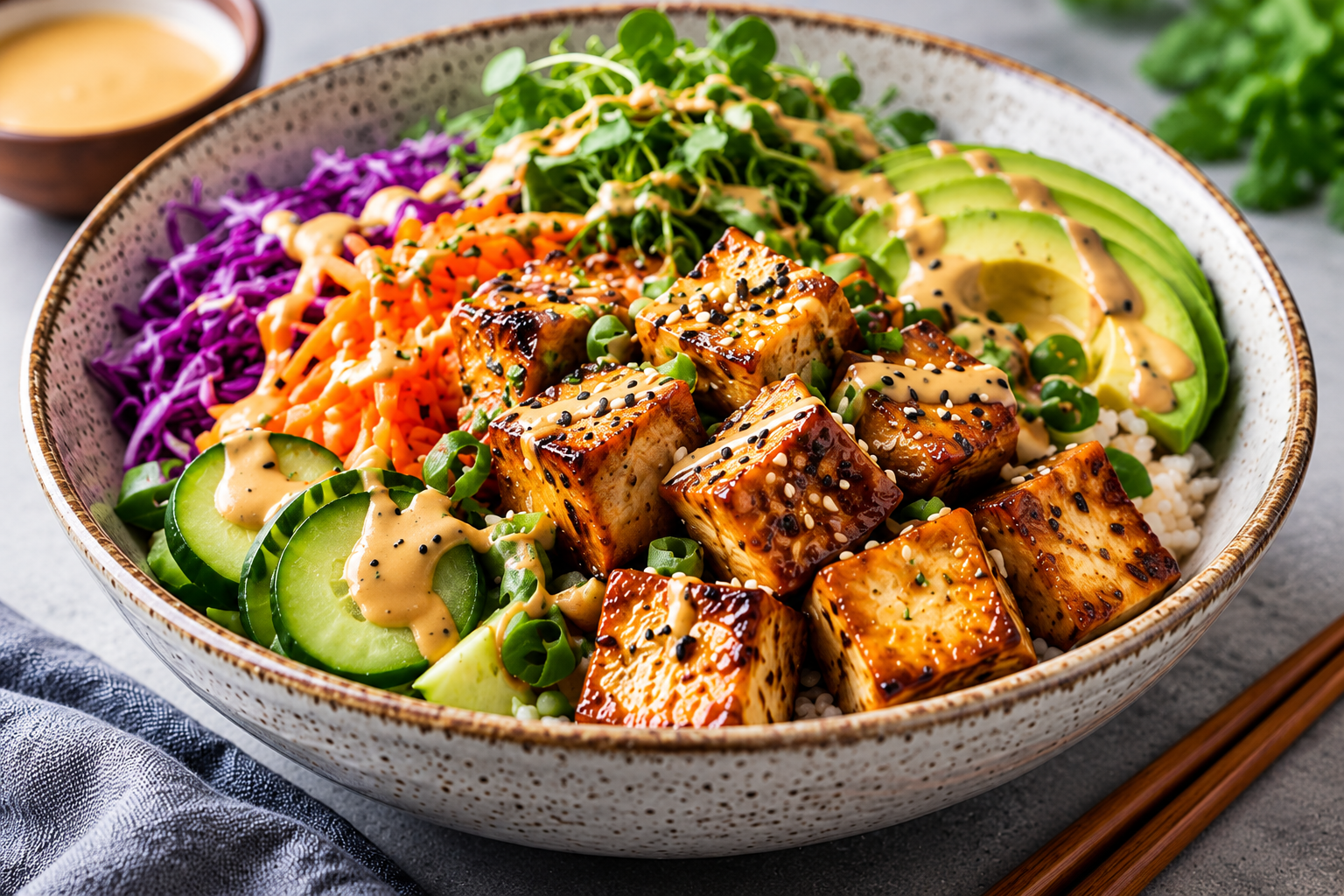
HITTING YOUR PROTEIN GOALS WITH TOFU
Protein adds up over a day, and no single meal comes close to covering it.
The total depends on what you weigh, and the meals are how it gets divided.
The question is how much of that total one tofu meal takes.
HOW MANY GRAMS A DAY
For every pound you weigh, aim somewhere between 0.8 and 1.2 grams of total daily protein.
Training volume determines how much protein you should aim for each day. If you work out harder and more often, you belong at the upper end of that range.
| BODY WEIGHT | DAILY PROTEIN TARGET |
| 150 lbs | 120 to 180 g |
| 170 lbs | 136 to 204 g |
| 190 lbs | 152 to 228 g |
| 210 lbs | 168 to 252 g |
Spread over three to five meals, that puts 30 to 40 grams on each plate.
A FULL DAY AT 150 POUNDS
At 150 pounds, your daily protein target is 120 to 180 grams. Here is a day that fits it, with four meals rather than five, because a smaller target does not need as many.
The portions are ordinary and the foods are the ones already in most kitchens. The whole day comes to about 1,755 calories before anything is added for training, so there is room around it.
| MEAL | FOOD | PROTEIN |
| Breakfast | 4 large eggs, 2 slices whole-wheat toast | ~32 g |
| Mid-morning | 1 cup nonfat Greek yogurt, 1 oz almonds | ~31 g |
| Lunch | 6 oz firm calcium-set tofu, 1 cup brown rice, 1 cup broccoli | ~38 g |
| Dinner | 3.5 oz chicken breast, 1 cup brown rice, 1 cup broccoli | ~40 g |
| TOTAL | ~141 g |
Added up, the day is 141 grams of protein. That is 0.94 grams per pound, clear of both ends of the target.
Every meal falls between 31 and 40 grams.
Lunch and dinner are the same plate with a different protein on it. One is six ounces of firm calcium-set tofu. The other is three and a half ounces of chicken breast. Both sit on brown rice and broccoli.
That tofu lunch is 38 grams of protein, a little over a quarter of the day. The chicken dinner is 40 grams.
If you weigh more than 150 pounds, you do not need different food. Bigger portions or an extra meal cover the difference.
HOW TO BUY TOFU
Four different foods go by the name tofu, and they are not interchangeable.
Fresh covers silken/soft tofu at one end and firm/extra-firm tofu at the other. Dried, fried and fermented come from different processing methods, and swapping one for another changes the protein, the calories and the salt in the meal.
Here is what each one is, and which to buy.
FRESH IS THE ONE RECIPES MEAN
Most fresh tofu comes in a tub of water and needs refrigerating. Silken is the exception, packed in a sealed carton that keeps at room temperature.
Three ounces of fresh tofu has 12 milligrams of sodium. When a recipe says tofu without saying more, this is what it means. Tofu starts as soy curds pressed into a block. What forms on top of the soy milk during that process is sold separately as tofu skin.
Two setting agents appear on the ingredient list. One is calcium sulfate. The other is magnesium chloride, one of the magnesium salts sold under its Japanese name, nigari.
Calcium-sulfate blocks run 300 to 580 milligrams of calcium in three ounces. The nigari ones sit between 240 and 290 milligrams. Silken comes in near 26 milligrams.
What the setting agent will not tell you is the protein. Calcium-sulfate blocks range anywhere from 7 to 15 grams of protein in three ounces, so the same ingredient covers both ends.
DRIED HOLDS THE MOST PROTEIN
Dried tofu is sold as koyadofu, bean curd that is frozen first and then left to dry until almost no water remains. USDA counts a serving as one piece at 17 grams, which has 9 grams of protein and contains 81 calories.
It keeps in a cupboard rather than a fridge, which is the reason to have some.
FRIED IS ALREADY COOKED
The oil it was fried in stays inside the block, so fried tofu is finished rather than raw.
It goes into soup or a rice bowl as it is.
FERMENTED IS A CONDIMENT
Fermented tofu is soybean curd sold in jars as fuyu, where the fermentation process and heavy salting let it keep without refrigeration.
The protein is not the problem. Three ounces of fuyu has about 8 grams, roughly what plain firm tofu gives at the same weight.
The sodium is the problem. Three ounces carries 2,443 milligrams of it, against 12 milligrams in fresh tofu at that portion.
Fuyu goes on food in teaspoons, the way anchovy paste does.
For everything else in this guide, buy fresh. The other three have their uses, but none of them replaces it.
TOFU AND SOY ALLERGY
Tofu is made from soybeans.
If you have a soy allergy, that rules tofu out. The allergy covers a longer list of foods that look nothing like tofu.
Some of them do not have the word soy anywhere in the name, and one form of soy is left off the warning label by law.
SOY FOODS THAT DO NOT SAY SOY
Five soybean foods sold in the US carry names that leave the word out.
- Miso is fermented soybean paste.
- Natto is fermented whole soybeans.
- Tempeh is a fermented soybean cake.
- Okara is the pulp left behind when soy milk is squeezed out.
- Edamame is the green soybean itself.
A packaged version has to declare the soy in its ingredients, whatever the name on the front says.
REFINED SOYBEAN OIL IS EXEMPT
That rule has one hole in it. The federal allergen law does not count highly refined oils as allergens, even when they are made from soybeans, so soybean oil sets off no warning.
The oil still appears in the ingredient list, spelled out as soybean oil. What is missing is the ‘Contains soy’ line that would otherwise follow.
FDA allowed that exemption because scientific experiments found that highly refined soybean oil does not provoke a reaction in people allergic to soy. Cold-pressed and expeller-pressed soy oils hold more protein and were not covered by that finding.
A label says soybean oil either way and does not say which. For anyone with a soy allergy, that is a question for a health care professional.
HOW TO COOK TOFU
Pressing is a step tofu needs and chicken does not, and not every block calls for it.
A block that has not been pressed loses its shape in the pan and turns watery. One that has been pressed holds a cube.
Here is which blocks need pressing, and the food preparation that follows.
PRESS THE FIRM, NOT THE SILKEN
Use silken in sauces, dips and smoothies, where it does not need to hold a shape. It is too delicate to press and will break apart if you try.
Firm is the one to press. Extra firm may not need it, so wipe it with a clean towel when you open the package and press it only if the towel comes away very wet. Super firm and store-bought baked tofu go straight to the knife.
To press, set the tofu block between clean towels on a plate. Put a second flat plate on top to spread the weight, then a large can or a cast iron skillet on top of that. Leave it there at least 30 minutes and swap the towel if it soaks through partway.
Cloth takes up more water than paper does. Once the block is drained, cut it into cubes, slices or sticks.
TWO WAYS TO SKIP THE PRESS
Microwave the block on high for four minutes, let it cool, then cut it up and cook it the same way you would a pressed block.
Freezing removes water as well, and it changes the texture while it does. Slide the block out of its package and freeze it solid, then thaw it overnight in a fridge or faster in cold water swapped every 30 minutes. Tofu that has been frozen comes out closer to meat.
BAKING AT 350°F
Marinate the pieces for at least 30 minutes. A firmer block soaks up flavor more slowly than a softer one.
Drain the marinade off, spread the pieces on a baking sheet, and bake for about 30 minutes, turning them once. They are done when the pieces feel solid and look lightly browned.
CRISPING IN A PAN
Coat the pieces in cornstarch and sauté them in a little vegetable oil.
Flip them so every face meets the pan and take them out once all of those faces are crisp.
HOW LONG TOFU KEEPS
Cooked tofu follows the leftovers rule. In the fridge, that is three to four days. And in the freezer, you get three to four months. Get it cold within two hours of cooking.
Raw tofu has a shorter life. An unopened package keeps a week, and the two agencies split on what happens after that. USDA’s FoodKeeper gives an opened block two to three days, while Oregon State Extension says three to four. Take the shorter figure if you want the safer one.
Store whatever is left in a clean container, covered with fresh water, at 40 degrees or below.
A raw block freezes for about five months.
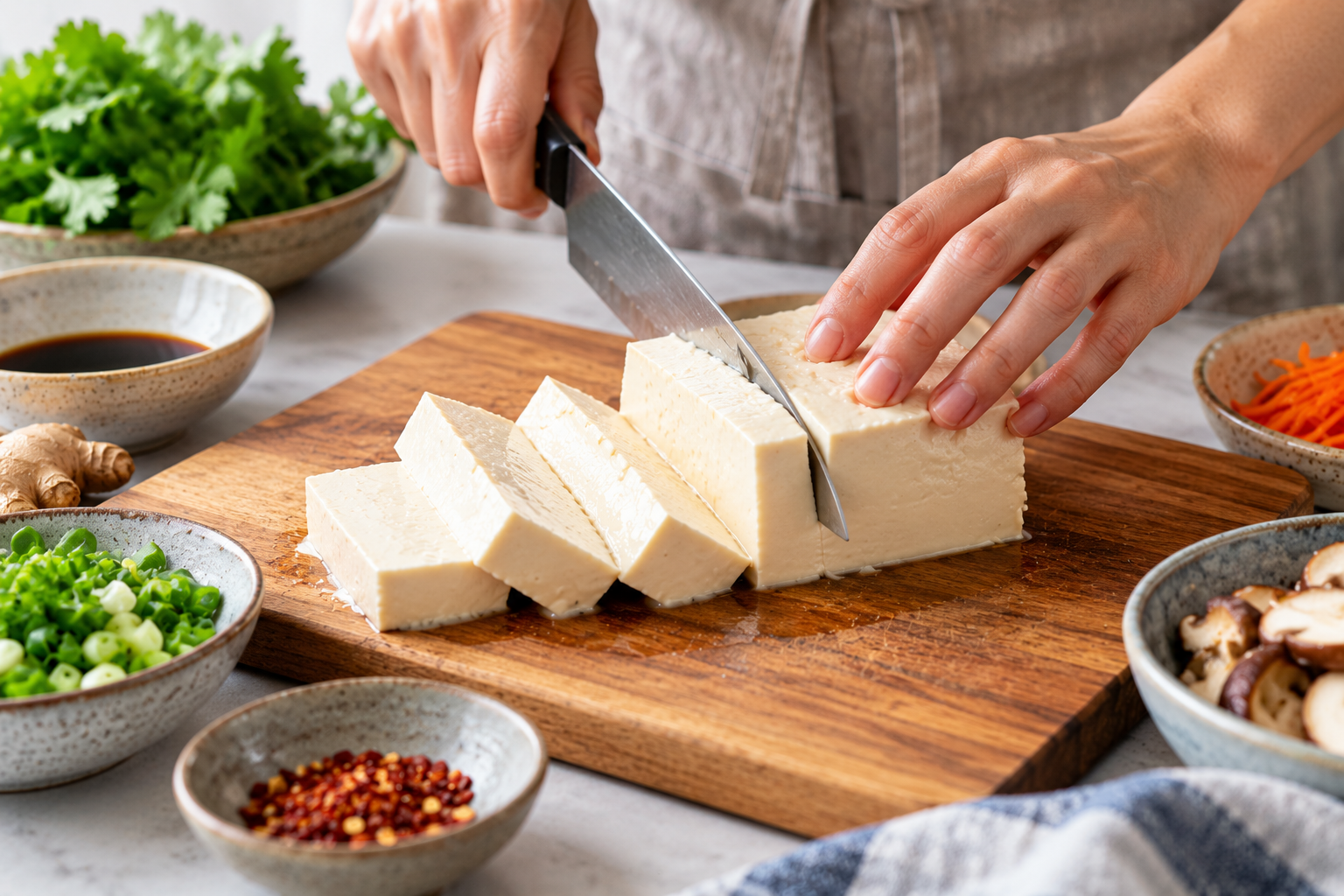
TOFU MEAL PREP: SIX RECIPES
Each of the six recipes below uses one of the four methods that I mentioned above and nothing else.
No two use the same tofu either. Silken, firm, extra firm, super firm, frozen and dried, one form each.
Protein per serving runs between 24 and 40 grams. Only the baked cubes and the soup clear 30 grams on their own, so treat the other four as most of a meal rather than all of it.
SILKEN TOFU SMOOTHIE
This is what silken is for. Nothing here gets pressed or heated, and a serving runs to 28 grams of protein.
INGREDIENTS (PER SERVING)
- 6 oz silken tofu
- 1 cup soymilk
- 1 medium banana
- 2 tbsp peanut butter
INSTRUCTIONS
- Break the silken tofu into a blender.
- Add the soymilk, banana and peanut butter.
- Blend until no lumps are left.
- Keep anything you do not drink cold and shake it before you do.
BAKED TOFU CUBES
Oven bake these as a batch. They have the highest protein of the six recipes at 40 grams to the serving.
INGREDIENTS (PER SERVING)
- 6 oz firm calcium-set tofu
- 1 tbsp low-sodium soy sauce
- 1 cup cooked brown rice
- 1 cup broccoli
INSTRUCTIONS
- Press the tofu at least 30 minutes, then cut it into cubes.
- Toss the cubes in the soy sauce and leave them another 30 minutes.
- Drain the marinade off and spread the cubes on a baking sheet.
- Bake at 350 degrees for about 30 minutes.
- Serve over the rice with the broccoli.
CORNSTARCH-CRISPED TOFU
Extra firm often needs no pressing, so run the towel test before you decide. A serving carries 24 grams of protein.
INGREDIENTS (PER SERVING)
- 6 oz extra firm tofu
- 1 tbsp cornstarch
- 1 cup sliced red pepper
- 1 cup cooked brown rice
INSTRUCTIONS
- Cut the tofu into cubes and toss them in the cornstarch.
- Sauté in a little vegetable oil, turning them so every side browns.
- Take them out when they are crisp all over.
- Cook the pepper in the same pan, then put both over the rice.
FROZEN TOFU CRUMBLE
Tofu that has been frozen and thawed breaks into crumbles instead of holding a cube, which is what this recipe requires. Each serving is 29 grams of protein.
INGREDIENTS (PER SERVING)
- 8 oz firm tofu, weighed before freezing
- ½ cup cooked black beans
- ½ cup chopped tomatoes
- ¼ cup chopped onion
INSTRUCTIONS
- Squeeze the thawed block out over the sink, then crumble it with your hands.
- Cook the onion until it softens, then add the crumbled tofu.
- Stir in the beans and tomatoes and heat it through.
KOYADOFU MISO SOUP
Dried tofu keeps in a cupboard, so this recipe needs nothing from the fridge. One serving contains 31 grams of protein.
INGREDIENTS (PER SERVING)
- 3 pieces dried tofu
- 1 tbsp miso
- ¼ cup wakame
- ½ cup sliced mushrooms
INSTRUCTIONS
- Soak the koyadofu in warm water until it softens, then squeeze it out and slice it.
- Simmer the mushrooms and wakame in water.
- Add the sliced koyadofu.
- Stir in the miso last.
COLD SUPER FIRM BOWL
Super firm tofu needs no press and no pan, so this one is assembly only. A serving has 24 grams of protein.
INGREDIENTS (PER SERVING)
- 6 oz super firm tofu
- 1 cup shredded red cabbage
- ½ cup grated carrot
- 1 cup spinach
INSTRUCTIONS
- Cut the tofu straight from the package into cubes.
- Toss the cabbage, carrot and spinach together.
- Put the cubes on top and add a dressing of your choice.
If you’re a plant protein person, I hope this helped you get more protein into your diet without having to pair foods to do it.
If you’re all about that carnivore lifestyle, my goal is to get you to try it. Tofu doesn’t have to replace anything, and once a week is enough to find out if you like it.
Either way, buy the firm calcium-set block, weigh what you cook, and flavor it with whatever you love since tofu is great at absorbing flavors.
Check out our complete line of ATHLEAN-RX Supplements and find the best training program for you based on your fitness level and goals.

- Fresh tofu runs from about 4 to nearly 15 grams of protein in three ounces, with firm calcium-set at the top of that range.
- Two blocks that both say firm on the front can differ by nearly double, so one holds twice the protein of the other.
- Blocks are not a standard size, running 11 to 17 ounces in USDA’s records, so put the tofu on a scale rather than counting halves.
- Weigh it before you press it, because pressing takes out water and leaves the protein behind.
- Tofu carries every one of the nine amino acids you have to eat, so a meal does not need a second protein beside it.
- Three ounces of firm calcium-set tofu covers 45% of the Daily Value for calcium.
- A pooled analysis of 41 clinical trials in men measured five hormones, testosterone included, and none of them moved.
- Chicken breast still wins, since 30 grams of protein takes three and a half ounces of it against six ounces of tofu.
- Thirty grams of protein contains 250 calories from calcium-set tofu and more than twice that from chickpeas.
- Press firm tofu for at least half an hour, leave silken alone, and give it half an hour in a 350-degree oven.
- Fermented tofu is a condiment rather than a protein, with more sodium in three ounces than a full Daily Value.
TOFU PROTEIN FAQS
Yes, but the type on the label changes the answer more than most people expect.
Firm calcium-set is the best of them. Three ounces holds nearly 15 grams of protein at 122 calories, and no other fresh tofu returns more protein per calorie.
Firm and extra firm are the everyday picks, at about 8 grams in three ounces. Both come close to calcium-set on protein per calorie, on a smaller portion.
Silken and soft are poor choices for protein, at 4 to 6 grams in three ounces. Use them for texture in sauces and smoothies rather than for hitting a number.
Hard tofu is the one that catches people. It holds about 11 grams in three ounces, more than extra firm, but the fat pushes that portion to 123 calories, which drops it below every other fresh tofu on protein per calorie.
Fried is worse again, with 16 grams of protein containing 230 calories. Dried holds the most protein of any type, about 45 grams in three ounces, though it contains 406 calories.
No, and I am not going to pretend otherwise. Three ounces of chicken breast carries 26 grams of protein at 140 calories. Tofu at its best comes to under 15 grams for 122 calories.
But you are not choosing between them. Look at the sample day above and you will find tofu at lunch and chicken at dinner, and the day hits its target because both are on it.
If tofu had to beat chicken, it would lose. It does not. It competes with the lentils, beans and chickpeas you would otherwise put on the plate, and it beats every one of them on both counts.
REFERENCES
- U.S. Department of Agriculture, Agricultural Research Service. (2018). FoodData Central, SR Legacy. — records 168411, 168917, 170017, 171477, 172421, 172448, 172449, 172450, 172451, 172461, 172467, 172475, 172476, 173424, 173735, 173757, 174280, 174290, 174291, 174297
- U.S. Food and Drug Administration. (2024). Daily Value on the Nutrition and Supplement Facts Labels.
- U.S. Food and Drug Administration. (2024). The Lows and Highs of Percent Daily Value on the Nutrition Facts Label.
- U.S. Food and Drug Administration. Health claims: Calcium, vitamin D, and osteoporosis. 21 CFR 101.72.
- Reed, K. E., Camargo, J., Hamilton-Reeves, J., Kurzer, M., & Messina, M. (2021). Neither soy nor isoflavone intake affects male reproductive hormones: An expanded and updated meta-analysis of clinical studies. Reproductive Toxicology, 100, 60–67.
- American Cancer Society. Soy and cancer risk: Our expert’s advice.
- Applegate, C. C., Rowles, J. L., Ranard, K. M., Jeon, S., & Erdman, J. W. (2018). Soy consumption and the risk of prostate cancer: An updated systematic review and meta-analysis. Nutrients, 10(1), 40.
Jeff Cavaliere M.S.P.T, CSCS
Jeff Cavaliere is a Physical Therapist, Strength Coach and creator of the ATHLEAN-X Training Programs and ATHLEAN-Rx Supplements. He has a Masters in Physical Therapy (MSPT) and has worked as Head Physical Therapist for the New York Mets, as well as training many elite professional athletes in Major League Baseball, NFL, MMA and professional wrestling. His programs produce “next level” achievements in muscle size, strength and performance for professional athletes and anyone looking to build a muscular athletic physique.