






is vascularity hard to achieve?
I hear a lot of guys saying, “My veins just don’t pop. I guess I wasn’t born with it.”
If that were true, every guy with great genetics would walk around year-round looking like a roadmap, not only when he’s warm, pumped, and two sets into resistance training.
That’s why so many lifters stress over it.
They diet, they train, and yet their superficial veins stay hidden while someone else’s bicep vein shows up the second the blood flow kicks in. It makes you wonder if you’re doing something wrong with your body fat, hydration, or training intensity.
Hey, I get it, but the first thing you need to know about getting vascular is that vascularity changes with temperature, subcutaneous fat, blood pressure, and the type of stimulus you hit your muscles with.
And most people unknowingly interfere with one or more of those factors.
Today, I’ll break down what vascularity really is, why it fluctuates so much, and the specific things you can train to make it show more often along with the one factor that makes every other strategy pointless if you ignore it.

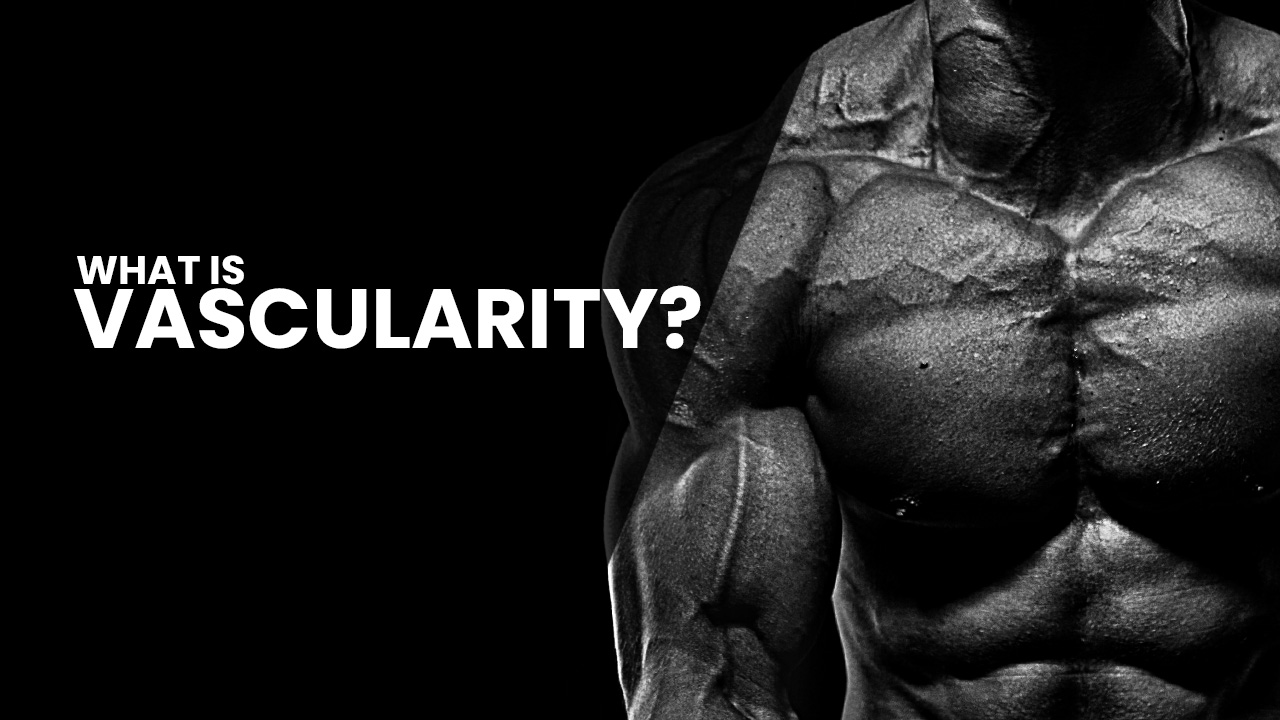
WHAT IS VASCULARITY?
Vascularity is simply the visibility of your veins but the reason they show is a specific physiological combo: low subcutaneous fat, increased blood circulation, and veins that respond when you train.
When you lift, whether it’s Barbell Curls, Dumbbell Push-Ups, or a round of high-intensity weightlifting, blood rushes to the working muscles.
As your body shuttles more plasma fluid and oxygen into the area, the veins expand. That expansion is called venous distension.
And if the fat layer between your skin and veins is thin enough, you see them clearly.
Maybe you’ve worked out with a buddy and after a few warm-up sets, you suddenly see a clean bicep vein. During a big set, you’re watching veins snaked across his arms.
This isn’t magic. It’s mechanics: blood flow + low insulation + a vascular system that knows how to dilate.
WHY IT MAKES YOU LOOK MORE MUSCULAR
Here’s something people don’t want to admit: you can have great muscle mass, but without vascularity, you won’t look as defined.
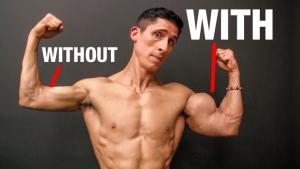
Veins add contour. They outline the muscle. They make your arms look denser, harder, and more athletic even if your muscle gains haven’t changed at all.
That slight “pop” with the superficial veins, and the subtle venous distension instantly adds aesthetic symmetry. It gives the illusion of deeper cuts, more separation, and tighter muscle definition.
This is why bodybuilders tan, pump up, and chase every trick in the book. It’s like the garden hose veins communicate to everyone that this person trains hard.
WHAT VASCULARITY IS NOT
Vascularity gets misunderstood because people chase shortcuts that don’t impact how veins behave long-term.
It’s not about performance-enhancing substances or topical vasodilators (creams you put on the skin).
Those might create a brief surface-level flush, but they don’t change your underlying physiology like blood flow, vessel responsiveness, or the layer of fat covering your veins.
It’s also not about buying every new piece of resistance training equipment that promises a better pump like blood-flow restriction cuffs or trendy “pump maximizing” gadgets.
Sure, they can produce temporary swelling, but none of that translates into lasting vascularity when you’re not wearing them.
The same goes for medical grade equipment like blood flow measuring devices and compression socks.
This all boils down to attempting to physically “force” veins toward the surface. That’s not how your circulatory system works.
Veins respond to changes in blood flow, body fat, temperature, and training stimulus, not pressure tricks or clothing choices.
Real vascularity comes from improving the conditions that matter, not from shortcuts that look dramatic for five seconds in the mirror.
VASCULARITY MYTHS
Vascularity is one of the most misunderstood parts of looking lean and muscular. The moment someone sees visible veins, they assume it’s something you either have or you don’t.
And that’s where most people stop trying. They chalk it up to DNA instead of understanding what’s happening under the skin.
When you rely on genetics as the explanation, you ignore all the real, controllable factors that influence how your veins look.
Before you decide you’re not built for vascularity, let’s break down the biggest misconceptions holding you back.
GENETICS DETERMINE EVERYTHING
I keep repeating this because it’s the number one myth and the reason most guys don’t chase veiny arms. They’ll point at someone with naturally high microvascular density and assume they were born that way.
Sure, some people start with a leaner layer of fat or more reactive vascular anatomy, but that doesn’t fully lock you into a predesigned physique.
Here’s the most important thing to remember: Genetics influence where you begin, not where you finish.
If DNA truly dictated everything, no amount of weight lifting, conditioning, or diet changes would reveal new veins and yet, we see it happen all the time.
Lifters who improve their programming, dial in their nutrition, and commit to real fat loss routinely uncover vascularity they never had before.
Genetics might write the blueprint, but your training and diet decide how much of that blueprint becomes visible.
VASCULARITY DOESN’T CHANGE DAY-TO-DAY
A lot of people think vascularity is fixed. If you’re not vascular when you wake up, you’re just not a vascular person.
But vascularity is incredibly dynamic.
Temperature alone can transform how you look. Warm weather naturally dilates vessels, while cold weather tightens them. That’s physiology, not genetics.
Even within a single workout, vascularity can shift dramatically.
Once you start moving, whether it’s cardiovascular exercises, pump-focused sets, or high intensity interval work, your blood circulation increases, your tissue temperature rises, and your veins expand.
It’s why someone who looks average before training can look significantly more defined twenty minutes later. If vascularity were static, none of these changes would happen.
TRAINING CAN’T IMPROVE VASCULARITY
If training didn’t matter, endurance athletes, fighters, and high-volume lifters wouldn’t be some of the most vascular people on Earth.
Over time, consistent training increases your microvessel density, improves your vascular supply, and strengthens the vessels’ ability to dilate.
The more efficient your circulatory system becomes, the more easily those veins show and stay visible during and after training.
Even people who start doing regular cardio workouts or conditioning notice that their veins become more reactive. Training literally reshapes your physiology.
YOU NEED SPECIAL TOOLS TO MEASURE OR IMPROVE IT
It’s easy to get caught up in the idea that you need special equipment only found at high-grade labs.
Guys, you don’t need to track your veins with clinical-grade assessment tools, ultrasounds of metaphyseal circulation, or a deep dive into intracapsular vascular supply.
It’s overkill and totally unnecessary.
And it’s that level of overthinking that just further pushes you from pursuing your goal of getting more vascular.
As I’ll break down below, all you need are the time-tested basics.
YOU CAN’T OUTWORK YOUR BIOLOGY
Continuing with the point above, the truth is, you can influence every meaningful factor behind vascularity.
You can lower your body fat with smart eating of lean foods in a calorie deficit, promoting consistent fat loss.
You can improve blood flow with the right training stimulus, whether that’s weight lifting, strategic pump work, or high-volume conditioning.
You can manage hydration to avoid water-electrolyte imbalances, and you can create the temperature and pump conditions that make veins easier to see during training.
Sure, genetics might influence how easily veins show up, but they don’t determine whether vascularity is possible.
Most people don’t lack the genes. They lack the conditions that bring those veins to the surface.

FAT LOSS: WHERE IT ALL STARTS
Look, if you’re not willing to get your nutrition in check, nothing else I tell you in this article is going to matter.
You can chase every trick, tactic, and hack you see online, but vascularity will never show through if your body fat is too high. This is the part most guys want to skip because it isn’t flashy but it’s the only part everything else depends on.
And I’m not talking about getting bodybuilder-stage shredded. You don’t need striated glutes or paper-thin skin.
You just need to get lean enough that your veins aren’t buried under a thick layer of fat.
Once that barrier drops, every other vascularity factor like blood flow, pump work, even training-induced residual tension suddenly becomes far more effective.
WHY BODY FAT COVERS YOUR VEINS
Subcutaneous fat is insulation. That’s all it is. And just like insulation keeps heat from escaping a house, it also keeps your veins from being seen through your skin.
You can have a monster pump, perfect volume training, and the best workout of your life, but if there’s still too much insulation over your superficial veins, nothing is going to show.
Think of it this way: you can train your veins as much as you want, but if the layer sitting between them and the outside world is too thick, none of that work gets through.
In other words, it’s not a vascularity problem. It’s a visibility problem.
HOW LEAN YOU ACTUALLY NEED TO BE
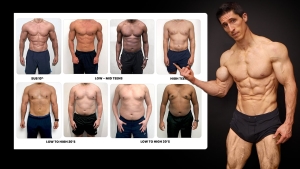
The goal isn’t to get stage shredded, but you do need to understand what different body fat percentages look like and how much definition you can expect.
At the extreme end, 1–4% is professional bodybuilder territory. This is the anatomy-chart look that shows deep striations and extreme vascularity. It’s absolutely not sustainable for everyday life.
A more realistic but still demanding level is 5–7%. This is the classic fitness-model range that features sharp definition, visible veins, and a clean, photo-ready look. It takes serious discipline to maintain.
For most lifters, the sweet spot is 8–10%. This is the lean, athletic “ATHLEAN” range. Abs are clearly visible, vascularity appears in arms and shoulders, and this look is far more sustainable.
Around 11–12%, you’ll still have some definition and occasional vascularity depending on lighting, hydration, and pump work, but it won’t be constant.
In the 13–15% range, you look fit but not sharply defined. Some forearm veins may show, but abs and deeper cuts remain covered.
By 16–19%, vascularity is essentially hidden. You might still look healthy and athletic, but definition is muted across the body.
Most average men fall around 20–24%, where muscle definition fades and no vascularity is visible at all.
Past 25%, you enter the obesity range. Muscle is there but completely masked by fat. And above 35%, no definition or vascularity is visible.
With that said, keep in mind that body fat looks different on different guys. Height, age, and genetics all influence how each percentage appears.
But if your goal is to see veins consistently, you’re almost always aiming for something in the low-teens or below, but not a specific number on the scale.
Targeting a body-fat range is the most accurate way to chase the look you want.
WHAT HAPPENS AS BODY FAT DROPS
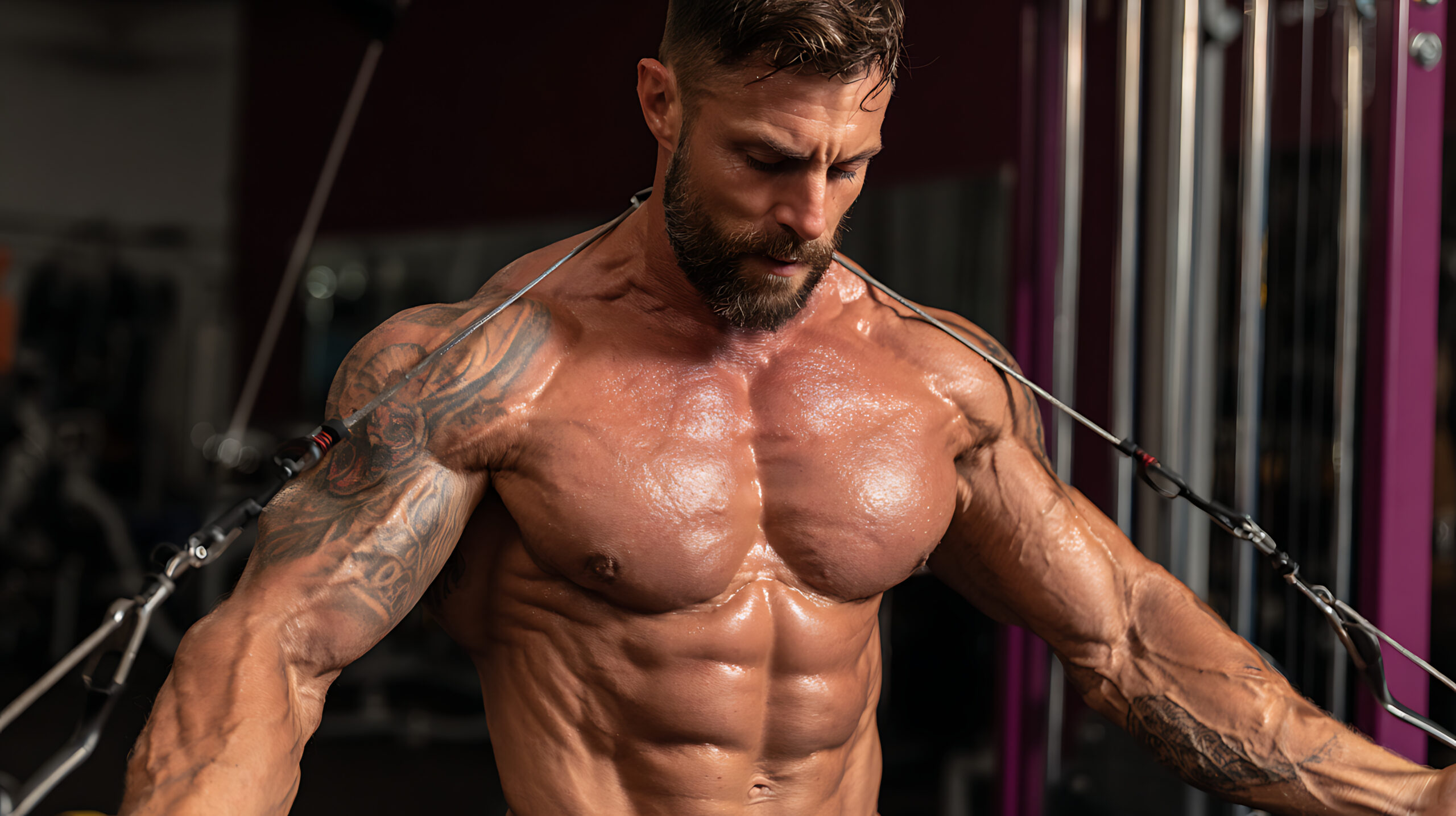
As your body fat starts to come down, everything about your vascularity changes. Veins react faster to pump work, showing up earlier in your workouts and sticking around longer afterward.
Temperature shifts like stepping outside on a warm day or getting deep into a set suddenly make a much bigger difference.
You’ll also notice that vascularity stops being a “workout-only” phenomenon.
Resting veins begin to appear more consistently, especially in the forearms and biceps. Your arms take on that denser, harder, more defined look even if you haven’t gained a single ounce of muscle.
It’s simply the result of having less insulation covering what was there the whole time.
The more you lean out, the more your physique moves from “pump-dependent” to “always on.”
Those garden-hose veins that used to show only after a brutal session start becoming part of your everyday look, not something you need the perfect lighting or workout to see.
HOW TO LOWER BODY FAT
Understanding body fat is one thing. Actually lowering it is something else entirely.
This is where most people start strong and fall apart fast because they overcomplicate what should be a straightforward process.
You don’t need extreme diets, marathon workouts, or a list of rules long enough to fill a textbook. You just need a few principles you can actually follow every day.
Here’s how to make fat loss predictable, manageable, and sustainable without tanking your performance or your sanity.
CREATE A MANAGEABLE CALORIE DEFICIT
If you want to lose body fat, you need a calorie deficit. There’s no way around it. But it doesn’t need to be dramatic.
Aim for 300 to 500 calories below maintenance each day. That’s enough to drive steady fat loss without tanking your training intensity.
Avoid the temptation to crash diet. When you cut too aggressively, you lose strength, motivation, recovery ability, and eventually muscle.
The goal is to stay consistent, not miserable.
And when it comes to tracking, keep it simple. You don’t need to weigh every grain of rice. Use the hand-portion method, a balanced plate approach, or track for 1 to 2 weeks to get a baseline.
PRIORITIZE LEAN PROTEIN AND HIGH-SATIETY FOODS
Protein is your best friend when you’re losing fat.
It protects your muscle definition as your body fat drops and keeps you fuller for longer, which makes sticking to a deficit dramatically easier.
Most guys should aim for 0.8 to 1.0 grams of protein per pound of bodyweight per day. If you prefer thinking in percentages, keep 30 to 40% of your daily calories coming from protein.
For example: If you weigh 180 pounds, shoot for 145 to 180 grams of protein daily. That could look like a day built around eggs in the morning, chicken or turkey at lunch, Greek yogurt as a snack, and salmon or lean beef for dinner.
Just as important is timing. Be sure to spread your protein intake across your meals so you’re not cramming 120 grams into one sitting.
Pair those proteins with high-satiety carbohydrates like potatoes, oats, beans, rice, fruits, and plenty of vegetables.
These foods digest slowly, provide more volume per calorie, and keep you feeling full without blowing your deficit.
Hunger is the number one reason diets fall apart so you want foods that fight it, not fuel it.
CONTROL PROCESSED CARBS, SUGARS, AND LIQUID CALORIES
If you want to stay in a calorie deficit, the fastest way to sabotage yourself is with foods that go down easy and do nothing to keep you full.
Processed carbs, pastries, candy, flavored coffees, and sugary drinks can wipe out an entire day’s deficit without you even noticing. They digest fast, spike your appetite, and leave you hungrier than before.
Liquid calories are especially sneaky. A single soda or fruit juice can add 150 to 300 calories with zero satiety.
Multiply that by a few drinks a day, and you’ve basically canceled your progress. Swapping them for water, flavored water, or zero-calorie options is one of the simplest wins you can make.
This doesn’t mean you need to swear off treats for life. Have them intentionally, not impulsively.
Enjoy them, move on, and don’t let them become a daily habit that consistently pulls you out of the deficit you’re trying to maintain.
USE TRAINING THAT SUPPORTS FAT LOSS WITHOUT BURNING YOU OUT
Training is a massive part of how vascularity develops, and I’ll break down the details in the next section. For now, here’s the big-picture approach to training while cutting fat.
Despite the myth that endless cardio is the best path to fat loss, the foundation of your routine should always be compound-focused resistance training.
Focus on movement patterns that recruit the most muscle, burn the most calories, and send the strongest message to your body: “Keep this muscle. We need it.”
The fundamental movement patterns include:
- Squat
- Lunge
- Hinge
- Push
- Pull
- Carry
- Corrective
Skip this step and you risk losing muscle along with fat, which leaves you smaller but softer. That’s the exact opposite of what we’re chasing.
Once your lifting is locked in, conditioning becomes the finishing touch, not the main event. Use it to boost calorie burn and improve capacity without replacing strength work.
I’d recommend 1 or 2 HIIT sessions per week if you like pushing intensity. But if you’re new to the fitness game, try 1 or 2 moderate cardio sessions for extra movement that won’t crush recovery.
Just don’t turn your week into a punishment.
If your training constantly leaves you exhausted, sore, or mentally drained, you won’t stay consistent. And consistency—not brutality—is what drives real fat loss. You should be able to hit your workouts, recover well, and come back strong.
Think of training as the structure that shapes your physique, while nutrition strips away the fat covering it. The next section will break down exactly how to train for better vascularity, blood flow, and pump response.
HYDRATION + SODIUM/POTASSIUM BALANCE
If there’s one thing a lot of guys neglect, it’s hydration. Getting in the ideal amount of hydration affects everything including your performance, your recovery, and yes, how your veins look.
Dehydration or poor sodium/potassium balance flattens blood volume, kills pumps, and makes your physique look softer.
Drink water throughout the day, salt your food reasonably, and include potassium-rich foods like potatoes, bananas, beans, and leafy greens.
Keeping your fluid and electrolyte balance steady helps your body function and look its best.
HOW TO TRAIN FOR FAT LOSS: START HERE
When you’re cutting body fat, the primary job of your training is simple: keep your muscle. Nutrition handles the fat loss. Training protects the structure underneath.
If you don’t lift during a cut, your body has no reason to hold onto muscle.
You’ll lose weight, sure, but you’ll also lose the definition and shape that give vascularity its meaning in the first place.
Muscle retention leads to sharper lines, deeper separation, and veins that have an actual “frame” to run across.
This is why the goal during a fat-loss phase isn’t to burn as many calories as humanly possible. That approach leaves you exhausted, smaller, and flat.
The real goal is to shape the physique while you reveal it. Here’s how to work out to keep the muscle full, strong, and trained so the vascularity you’re unlocking actually has something to sit on top of.
BUILD YOUR FOUNDATION
The base of your program should always be compound movements. These are the exercises that recruit the most muscle, burn the most energy per rep, and send the strongest “keep this tissue” signal to your body.
Compounds also build the physical structure that vascularity enhances. Visible veins look far more impressive on arms and legs that actually have size, density, and shape.
Every strength session should prioritize the seven fundamental movement patterns, each chosen for its ability to train the body in the way it naturally moves:
Squat: This pattern trains your entire lower body and core through vertical force production. Think Back Squats, Front Squats, Goblet Squats, and Leg Press variations.
Lunge: This challenges single-leg strength, stability, and balance while correcting left–right imbalances. Examples include Walking Lunges, Reverse Lunges, Split Squats, and Step-Ups.
Hinge: This pattern targets the posterior chain (glutes, hamstrings, and lower back) while building power and structural strength. Stick with the basics like Deadlifts, Romanian Deadlifts, Hip Thrusts, and Good Mornings.
Push: This includes all upper-body pushing movements that train the chest, shoulders, and triceps. Examples include Bench Press, Overhead Press, Push-Ups, and Dips.
Pull: This pattern trains the muscles of the upper back, lats, and biceps through horizontal and vertical pulling. You can include Pull-Ups, Barbell Rows, Lat Pulldowns, and Seated Cable Rows.
Carry: Carries build total-body stability, grip strength, and core control under load. I recommend Farmer’s Carries, Suitcase Carries, Rack Carries, and Overhead Carries.
Corrective Work: These movements fix weak links that limit strength and function, keeping your big lifts strong and pain-free. My favorites are Band Pull-Aparts, Face Pulls, hip mobility drills, and rotator cuff work.
WORKOUT NUMBERS
The classics are still around for a reason: they work. If you build a classic-focused workout and you follow it consistently, you’ll build the kind of physique vascularity actually enhances instead of hides.
Use these guidelines when creating your fat loss workouts:
3–4 Strength-Focused Days: Hit full-body sessions 3x per week or an upper/lower split 4x per week. This gives you enough frequency to stimulate muscle growth without beating up your recovery. If you can’t recover from session to session, you’re going too heavy, too often, or doing too much junk volume.
6–10 Reps for Working Sets: This range is the sweet spot for building strength and size at the same time. Heavy enough to trigger muscle retention during a cut, but controlled enough to avoid form breakdown. Stick to 3 to 5 working sets per big lift.
Controlled Tempo: Lower the weight for 2 to 3 seconds, pause briefly at the bottom, and drive up with power. If the weight is moving faster than you can feel the muscle working, you’re using momentum, not strength. That does nothing for the physique you’re trying to carve out.
Full Range of Motion: Want to properly recruit and grow the most muscle? Focus on things like deep squats, full lockouts on presses, and complete stretches on rows. Partial reps have their place, but not as the foundation. Full ROM also improves mobility, joint health, and long-term performance.
Moderate Rest: You should rest long enough to hit quality reps, not just grind through sloppy sets. Too little rest turns strength training into conditioning. Too much rest lets intensity fall off. Ninety seconds is a great middle ground for compounds, and 60 to 90 seconds works well for accessory lifts.
This strength layer is your foundation. It tells your body exactly what to keep as you lose fat, fuels your metabolism, and builds the structure your vascularity will highlight once the insulation comes off.
THE NEXT STEP: HYPERTROPHY
Once your compound strength work is in place, the next layer of your training is hypertrophy and your volume work.
This is where you create the shape, fullness, and density that make vascularity visually stand out. Strength training builds the frame. Hypertrophy fills it in.
This layer matters for more than size:
- Higher training volume produces a stronger, faster pump response, which is key for vascularity.
- Repeated swelling and stretching inside the muscle improve vascular dilation over time.
- Fuller muscles literally push veins closer to the skin, making them more visible the leaner you get.
Here’s how to structure this phase effectively and actually make it work:
10–20 Total Sets Per Muscle Group Per Week: Spread these across 2 to 3 sessions per week to keep frequency high and fatigue manageable. For example, instead of doing 15 sets of chest on Monday, you might do 6 sets Monday, 6 Wednesday, 4 Friday.
Use 8–12 Reps as Your Main Working Range: This is the sweet spot for mechanical tension and metabolic stress, which are two key drivers of hypertrophy. You should finish sets with 1 to 2 reps left in the tank, not grinding to absolute failure every time.
Switch It Up with Lifting Hacks: Techniques like chest supersetting into triceps, back into biceps, or shoulders into shoulders ramp up metabolic stress and blood flow fast. These aren’t just intensity techniques. They teach the muscle to accept more blood and maintain dilation longer.
Favor Dumbbells, Cables, and Machines for Volume Work: These tools give you a more stable environment so you can focus on effort, tension, and controlled reps rather than fighting for balance. This keeps the target muscle under consistent stress, which is exactly what you want.
Use a Mix of Angles and Grips: Small changes like incline vs. flat, pronated vs. supinated, and wide-grip vs. neutral help stimulate different fibers and create more complete development, which contributes to an overall fuller look.
This hypertrophy layer teaches your muscles to take in more blood, respond more aggressively to pump work, and improve their dilation capacity.
TRAINING FOR FAT LOSS: INTENSITY
This is the layer most lifters skip entirely and it’s the one that has the biggest impact on how responsive your veins become.
High-intensity pump circuits don’t just burn. They train your vascular system.
When you push a muscle into long, repeated bouts of swelling, you’re teaching the smooth muscle in your blood vessels to dilate faster, stay open longer, and move more blood with less resistance.
It’s the vascular version of conditioning work and it’s the secret to seeing veins show up more reliably as you get leaner.
These exercises flood the area with blood, drive up tissue temperature, and amplify the visibility of veins that were previously buried under fat. The leaner you get, the more dramatic the effect becomes.
Here are some examples of pump-focused finishers:
- Chest: 3–5 minutes of nonstop push-up variations (standard → wide → feet-elevated → slow-tempo).
- Back: High-rep banded rows or machine rows for 100 total reps with minimal rest.
- Shoulders: Continuous lateral raise → front raise → overhead raise sequence for 2–3 minutes.
- Legs: Bodyweight squat burnouts with 60–90 seconds of squats followed by 30 seconds of squat pulses.
- Glutes/Hamstrings: Hip-thrust iso holds paired with high-rep glute bridges (2–3 rounds).
- Quads: Leg-extension drop set: heavy set → moderate → light → 20–30 partials at the end.
- Back/Glutes: Romanian deadlift “stretch sets” with light weight and long time-under-tension.
- Core: 3-minute nonstop plank circuit (front plank → side plank → reverse plank → repeat).
How often should you do these? I’d recommend doing these once every 1 to 2 weeks as a dedicated “vascularity booster” session.
If you’re more experienced and you’ve been lifting for a while, you can add 3 to 6-minute finishers after your main sets are finished.
The goal isn’t to destroy the muscle. The goal is to condition the vascular system so that it reacts harder and faster during every other workout.
THE FINAL PIECE: CONDITIONING
Conditioning isn’t the star of the show but it’s the accelerator that makes everything else work better.
When you use it correctly, it lets you burn extra calories without dipping into muscle tissue, improves how efficiently your heart delivers blood, and raises tissue temperature.
And if you’ve been paying attention, you know temperature is one of the biggest triggers for increasing vein visibility.
Better conditioning also improves your lifting.
When your cardiovascular system is strong, you recover faster between sets, maintain better performance across an entire session, and get deeper, more consistent pumps. That directly translates to better vascularity, not just during your workout, but afterward as well.
Here’s how to structure conditioning so it enhances your results instead of interfering with strength work:
1–2 HIIT Sessions Per Week: Use these for controlled bursts of intensity. HIIT spikes heart rate, ramps up calorie burn, and increases blood flow fast without requiring long, draining workouts. Keep them short and sharp.
2–3 Steady or Moderate Cardio Sessions on Non-Lifting Days: Think of these as your easy burners. They add movement, help with recovery, and create additional caloric output without beating up your joints or nervous system. You should finish these feeling better, not worse.
20–30 Minutes per Session: That’s all you need. Go longer if you enjoy it, but don’t feel like you need 60 to 90 minutes. The goal is consistency, not exhaustion.
Some conditioning options work especially well for vascularity because they generate quick heart-rate elevation and rapid tissue warming:
- Sprint intervals (on flat ground or a hill)
- Battle ropes for full-body metabolic work
- Assault bike bursts for brutal but joint-friendly intensity
- Weighted incline walking to target legs and glutes without impact
- Rowing machine conditioning for total-body blood flow
Each of these raises heart rate, increases circulation, and builds the cardiovascular foundation you need for better vascularity without eating into your lifting performance.
TRAINING FREQUENCY & WEEKLY LAYOUT
The best training plan for vascularity isn’t the one that destroys you. It’s the one you can recover from and repeat.
You need enough frequency to stimulate strength, enough volume to build muscle, and enough conditioning to support fat loss. The layout matters just as much as the exercises themselves.
Here are two simple, effective templates that hit every layer we’ve talked about so far.
OPTION A: 3-DAY STRENGTH SYSTEM (BEGINNER OR BUSY SCHEDULE)
This layout is perfect if you’re short on time but still want to build muscle, get lean, and train vascular responsiveness.
Monday: Focus on full body strength. That means compounds and moderate volume to help you build the frame.
Wednesday: This is your upper body day with a pump finisher. It should include presses, pulls, shoulder work, then a high-rep arm or shoulder pump circuit.
Friday: This day is dedicated to lower body work and conditioning. Focus on things like squats, lunges, hinges, then 10 to 15 minutes of conditioning work.
Tuesday & Saturday: These are your cardio days where you’ll be doing light-to-moderate steady-state or incline walking.
This approach hits everything you need without crushing your recovery.
OPTION B: 4-DAY SPLIT
This split includes more frequency, more volume, and better conditioning balance. Ideal if you want strength, size, and vascularity all working together.
Monday: This is your upper body strength day that focuses on heavier compounds for chest, back, and shoulders. Use low-to-moderate reps.
Tuesday: Lower body strength is the target here. That means squats, hinges, carries, and glute work. Build the foundation.
Thursday: It’s time for upper body volume work with a pump finisher and that means more reps, more angles, and shorter rest, then a pump circuit to finish.
Friday: Today, you’ll do lower body volume work followed by a HIIT session. Leg-focused volume work followed by 10–20 minutes of HIIT conditioning.
Wednesday & Saturday: These days can be dedicated to cardio or recovery. Keep it easy with things like incline walking, light cycling, mobility work, or nothing at all if you’re too spent.
This structure hits every major mechanism of vascularity: strength, hypertrophy, pump work, and conditioning.
DON’T FORGET ABOUT RECOVERY
You can train perfectly and eat perfectly, but if you recover poorly, your vascularity will never look the way it should.
Poor recovery equals flat, soft, unresponsive pumps while optimized recovery provides fuller muscles, better dilation, and more visible veins.
Recovery is what determines whether your muscles look full and defined or deflated and lifeless. And it’s not complicated, but you do need to get the basics right.
Sleep: Aim for 7–9 hours. Your pumps, your performance, and your fat-loss efforts all fall apart without it.
Nutrition Timing Around Training: Get protein and carbs before and after your workout. You’ll train harder, recover faster, and maintain muscle while cutting.
Stress Management: High stress ruins recovery, disrupts sleep, and makes pumps disappear. Even 5 to 10 minutes of walking, stretching, or deep breathing daily helps.
Don’t Train in a Chronic Deficit: Cutting calories is necessary but cutting forever isn’t. Too low for too long results in worse recovery, worse pumps, and worse vascularity. Keep your deficit modest and controlled.
You don’t need perfection, but you do need consistency. When recovery is dialed in, vascularity finally has the environment it needs to show up.
Vascularity isn’t a mystery. It’s the natural byproduct of lowering body fat, training with purpose, and creating the conditions your veins need to show.
You don’t need tricks, hacks, or perfect genetics. You just need to control the variables that matter and stay consistent long enough for them to work.
Do that, and the vascular, sharp, athletic look you’ve been chasing stops being something other guys have and starts being something you’ve earned.
Check out our complete line of ATHLEAN-RX Supplements and find the best training program for you based on your fitness level and goals.

- Vascularity is simply visible veins created by low subcutaneous fat, strong blood flow, and a vascular system that knows how to dilate.
- The biggest myth is that vascularity is determined solely by your genes. Yes, genetics set your baseline, but body fat, training stimulus, temperature, and hydration determine what shows.
- Another myth is that vascularity doesn’t change day to day. Temperature, pump, hydration, and blood flow can transform your look in minutes.
- Fat loss is the foundation of vascularity. If your body fat is too high, your veins stay hidden no matter how hard you train. Fat is insulation, and insulation blocks visibility.
- Lowering body fat starts with a manageable calorie deficit, not starvation tactics. A consistent 300 to 500 calorie daily deficit beats crash diets every time.
- High-protein, high-satiety eating keeps you lean without losing muscle. If you don’t protect muscle, you get smaller, not more defined.
- Processed carbs, sugars, and liquid calories are the fastest way to erase a deficit. Controlling these is one of the simplest ways to accelerate fat loss.
- Strength training is the backbone of fat loss because it signals your body to keep muscle. Without lifting, you lose the structure vascularity sits on.
- Compound movements are your foundation because they recruit the most muscle and burn the most calories per rep. Squats, hinges, pushes, pulls, lunges, and carries build the body that veins highlight.
- Hypertrophy and volume work create the fullness, roundness, and density that make veins more noticeable.
- High-rep pump circuits teach your vessels to dilate faster, stay open longer, and push more blood. This is the smooth-muscle conditioning most lifters never do.
- Conditioning ties it all together by increasing calorie burn, improving cardiovascular efficiency, and raising tissue temperature. Better conditioning equals better pumps, better recovery, and better vascularity.
VASCULARITY FAQ
Vascularity is the visibility of your veins through the skin, created by a combination of low subcutaneous fat, increased blood flow, and blood vessels that can efficiently dilate during training.
When the insulation over your veins is thin enough and your circulatory system is responsive, blood fills the muscles, the vessels expand, and the veins become more defined.
It’s important because vascularity instantly enhances the appearance of your physique. Veins outline the muscles, add contour and depth, and make your arms, shoulders, and legs look harder, leaner, and more athletic even if you haven’t added a single pound of muscle.
It’s more than just cosmetic. It’s a visible sign that you’re lean, well-trained, and physiologically efficient.
Body fat determines whether your veins are visible or buried.
Fat sits between your skin and your vascular tissue, and the thicker this layer is, the harder it is to see any veins, no matter how hard you train or how much blood is pumping through the muscle. This is why two people with the same workout can look completely different: one has lower insulation, the other doesn’t.
As body fat drops, everything about vascularity improves. Veins respond faster to pump work, show up earlier in workouts, and stay visible longer afterward.
Warm temperatures suddenly make a bigger difference, and resting vascularity (especially in the forearms, biceps, and shoulders) becomes more common.
The leaner you get, the more your physique moves from pump-only veins to an always-visible look.
Exercise influences vascularity through several overlapping mechanisms. Strength training builds and preserves muscle, the structure veins run across, so you have an actual frame for vascularity to enhance.
Hypertrophy and volume work increase muscle fullness, improve pump response, and repeatedly stretch the vessels, training them to dilate more efficiently.
Pump circuits and high-rep finishers push this even further by conditioning the smooth muscle in your veins. This repeated dilation and constriction teaches the vessels to respond more aggressively during workouts, making veins pop faster and stay open longer.
Conditioning work (like sprints, incline walking, rowing, or assault bike intervals) boosts your cardiovascular efficiency, raises tissue temperature, and improves overall circulation, and these are three factors that directly increase vein visibility.
As you get leaner and your circulation becomes more efficient, the effects compound, making veins noticeable during training and eventually even at rest.
REFERENCES
Prior, B. M.; Yang, H. T.; Terjung, R. L. What makes vessels grow with exercise training?
Journal of Applied Physiology, 2004, 97(3), 1119–1128. doi:10.1152/japplphysiol.00035.2004.
Jeff Cavaliere M.S.P.T, CSCS
Jeff Cavaliere is a Physical Therapist, Strength Coach and creator of the ATHLEAN-X Training Programs and ATHLEAN-Rx Supplements. He has a Masters in Physical Therapy (MSPT) and has worked as Head Physical Therapist for the New York Mets, as well as training many elite professional athletes in Major League Baseball, NFL, MMA and professional wrestling. His programs produce “next level” achievements in muscle size, strength and performance for professional athletes and anyone looking to build a muscular athletic physique.